Honda has officially announced the discontinuation of the Super Cub 50 cc model due to the implementation of stricter emission regulations.
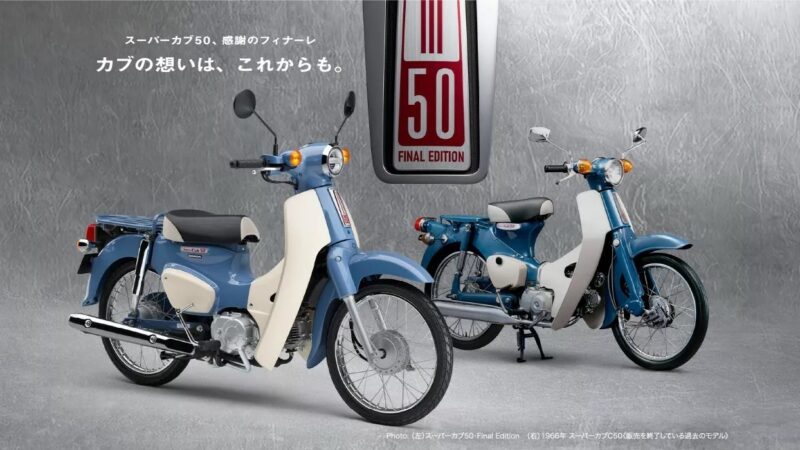
To celebrate this milestone, Honda has launched the Super Cub 50 Final Edition, featuring classic colors of white and Bonnie Blue inspired by the original Super Cub.
The Super Cub 50 Final Edition also boasts a two-tone solo seat, a special “Honda 50 Final Edition” emblem, a classic instrument cluster, a rear rack, and a uniquely designed key.
For the Japanese market, the Super Cub 50 comes equipped with a 49 cc engine producing 3.6 hp and 3.8 Nm of torque.
Production of this Final Edition will be limited to just 2,000 units, each priced at ¥270,000 (approximately RM7,743).
In Japan, 50 cc motorcycles have been a key pillar of the transportation system during the post-war economic boom. Due to their affordability and fuel efficiency, they have also remained a popular choice among workers and students.
In addition to stricter emission laws, the rising popularity of e-bikes and electric scooters has contributed to a decline in sales of these small-displacement motorcycles.
In addition to its lineup of custom trucks, Toyota has a special ‘menu’ to showcase at the SEMA 2024 exhibition.
This special offering is the GR86 Rally Legacy Concept, which boasts a design inspired by the 1990s Toyota Celica WRC rally cars.
In addition to its Castrol-inspired livery, this GR86 is equipped with striking red mud flaps, white rims, a Celica GT-Four-style rear wing, and a cluster of floodlights on the hood.
More remarkably, this GR86 is powered by a turbocharged 1.6-liter three-cylinder G16E-GTS engine that delivers 300 hp and 370 Nm of torque, paired with the GR-Four all-wheel drive system borrowed from the GR Corolla model.
Fitting the GR Corolla’s engine and drivetrain into the GR86 was no simple task.
Engineers had to design custom subframes and engine mounts before integrating the complete engine along with the hubs, spindles, and front axles from the Corolla.
Additionally, the GR86 is equipped with a rear differential to maintain the original gear ratios.
Inside the cabin, you’ll find racing seats and steering wheels from Sparco, a safety cage, and a sequential racing transmission shifter replacing the original manual gearbox.
With the debut of the GR86 Rally Legacy, does this mean Toyota is ready to offer a Celica model to its fans in the future?
The expansion project for the Kuala Lumpur–Karak Highway (KLK) is slated to commence in January 2025 and is expected to be completed by 2029, according to an announcement made by Deputy Minister of Works, Datuk Seri Ahmad Maslan.
He stated that the project will be carried out by AFA Prime Berhad (formerly known as ANIH Berhad), which holds the concession for the KLK highway.
According to him, the KLK highway expansion will cover a distance of 45.3 kilometers (km) with a total cost amounting to RM2.1 billion, which will be fully funded by the highway concessionaire.
“Currently, the concession company is in the process of finalizing the design before commencing physical construction at the site, which is expected to start in January 2025.
“This delay is due to the recent completion of a shareholder change. According to the concession agreement, the construction period for the KLK expansion will take four years and is expected to be completed by 2029,” he said in the Dewan Rakyat today.
He made these remarks while responding to a question from Wan Razali Wan Nor (PN-Kuantan) regarding the government’s plans to address traffic congestion on the KLK and whether alternative routes will be constructed for the network leading to the East Coast from Kuala Lumpur.
Further commenting, Ahmad explained that the scope of the KLK expansion work, which runs from the Gombak Toll Plaza to Bentong, includes adding one lane to increase the existing three-lane section to four lanes for Section 1 (from Gombak Toll Plaza to Genting Sempah).
Additionally, he mentioned the expansion from the existing two lanes to three lanes in Section 2 (from Genting Sempah to Bentong).
“This scope of work will also involve the construction of a new two-lane tunnel adjacent to the existing tunnel in the eastbound direction,” he clarified.
In conjunction with the launch of the Eliminator 500 cruiser motorcycle, MODENAS has also opened pre-orders for the 2025 Kawasaki ZX-6R super sports model.
With the starting price from RM59,900, this bike can be ordered at all Kawasaki All-Star showrooms from December 1 to January 31, 2025, with a deposit of RM500.
The first 50 owners will be invited to an exclusive handover event in Sepang in February 2025.
The specifications of the Kawasaki ZX-6R are as follows:
Engine: Inline 4-cylinder DOHC, 636 cc, Euro 5
Power: 122 hp @ 13,000 rpm
Torque: 69 Nm @ 10,800 rpm
Transmission: 6-speed, assist & slipper clutch
Front Suspension: 41 mm Showa SFF-BP fork
Rear Suspension: Single shock absorber, preload adjustable
Front Brake: Dual 310 mm rotors, 4-piston calipers
Rear Brake: Single 220 mm rotor, single-piston caliper
In conjunction with the Malaysian MotoGP event, MODENAS has officially launched its latest cruiser, the 2025 Modenas Eliminator 500 with the price starting from RM30,100 (without insurance and roadtax).
This model is a rebadged version from Kawasaki Eliminator 500, aligning with the approach taken for previous motorcycles under 750 cc.
The Modenas Eliminator is powered by a parallel twin 451 cc engine, capable of producing 44.7 hp at 9,000 rpm and a torque of 43 Nm at 6,000 rpm.
Power is transmitted to the wheel via a six-speed manual transmission equipped with an assist-slipper clutch.
The Eliminator features a 41 mm front telescopic fork, complemented by twin shock absorbers with preload adjustment, offering a wheel travel of 120 mm at the front and 90 mm at the rear.
For stopping power, the motorcycle employs dual 310 mm disc brakes with twin-piston calipers at the front, paired with a single disc and a single-piston caliper at the rear. It also includes a two-channel anti-lock braking system (ABS).
The Eliminator 500 comes with 18-inch rims fitted with 130/70 front tires, and 16-inch alloy rims with 150/80 rear tires.
Additional features include LED headlights and taillights, an LCD cluster display with Rideology app support, a fuel tank capacity of 12.8 liters, and a seat height of 735 mm.
The collaboration between Mercedes-Benz and Geely extends beyond just the smart EV brand.
According to a recent report from CarNewsChina, Mercedes will utilize an engine developed by Horse Powertrain Limited in its next-generation sedan the Mercedes-Benz CLA-Class, which previously relied on engines from Renault.
It is important to note that Horse Powertrain Limited is a joint venture owned 50:50 by Geely and Renault, responsible for producing engines that will be supplied to automotive companies such as Renault, Geely, Mitsubishi, Nissan, Volvo, and Proton.
The four-cylinder inline 2.0-liter turbo engine expected to be used in the 2026 CLA-Class is projected to deliver an output of 250 hp and a torque of 360 Nm.
This engine will be developed and manufactured in China, while the catalytic converter components will be assembled in Germany to ensure compliance with emissions standards.
Additionally, the CLA-Class will feature several other technologies, including a 48V mild hybrid system and a smart driver assistance system developed by the Chinese startup Momenta, in which Mercedes was one of the earliest investors.
The new CLA will also be available in a fully electric version, equipped with a rear-wheel drive electric motor delivering 235 hp, paired with an 89.6 kWh battery pack for a range of up to 750 km (WLTP data).
The MMA platform used by the CLA also supports an 800V electric architecture, allowing for 400 km of range to be added with just 15 minutes of charging.
Mercedes is expected to launch the new generation CLA model in 2025.
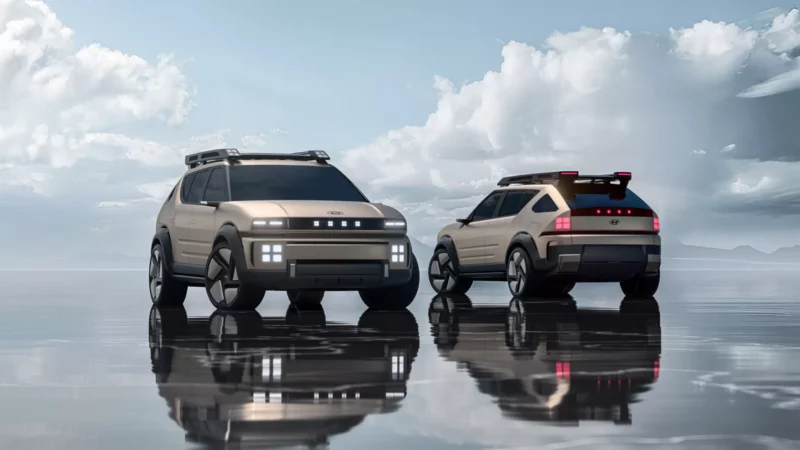
Hyundai has recently unveiled a hydrogen-powered concept model – the Hyundai Initium FCEV Concept – set to replace the Hyundai Nexo and expected to hit the market in the first half of 2025.
The appearance of the Initium bears a strong resemblance to a peculiar crossover from the 2000s.
Here are five facts you should know about the Hyundai Initium FCEV Concept:
Hydrogen SUV with a Range Exceeding 650 km
The Hyundai Initium is powered by a single electric motor generating 201 horsepower, driven by a fuel cell system. While the capacity of the hydrogen tank is not disclosed, the Initium is capable of traveling over 650 km on a full tank.
In comparison, the Hyundai Nexo generates a maximum power of 161 horsepower and has an EPA-rated range of 621 km.
Enhanced FCEV System
According to Hyundai, the stated range can be achieved through improvements to the fuel cell system. These enhancements include increasing the output from the fuel cell stack, as well as boosting the battery pack capacity.
With these upgrades, the Initium will also support vehicle-to-load (V2L) functionality.
New Design Language “Art of Steel”
Through the Initium, Hyundai aims to showcase its new design philosophy, “Art of Steel,” which will be applied to most future production models. At a glance, the Initium features design elements from existing models such as the IONIQ 5 and Santa Fe, incorporating a more striking look with LED graphics resembling the Windows logo at the front and rear.
All four corners are adorned with 21-inch aerodynamic wheels, along with a roof rack that includes built-in lights.
The rear design of the Initium evokes memories of the Pontiac Aztek, famed for its controversial aesthetics from 2000 to 2005.
Family-Friendly Cabin Space
Currently, Hyundai has not disclosed the cabin layout but promises a comfortable space for family use, featuring larger door openings and more generous recline angles for the rear seats.
Safety features include a more robust chassis and nine airbags.
Hyundai to Assist Owners in Finding Charging Stations
One of the main challenges for hydrogen vehicle owners is the difficulty in refueling due to a limited network of stations. To address this issue, Hyundai will create a dedicated route planner to help drivers locate hydrogen refueling stations along their routes.
This system will also check the operational status and availability of these stations in addition to tracking the number of vehicles waiting to refuel.
TC Subaru Sdn Bhd, the exclusive distributor of Subaru vehicles in Malaysia, is set to enliven the Tokyo Auto Salon Kuala Lumpur 2024 by showcasing two vehicle models adorned with special liveries inspired by local design elements.
The unique liveries applied to the Subaru BRZ and WRX were created by Motorsport Playground, drawing inspiration from a blend of Japanese engineering culture and Malaysian heritage elements, such as Songket patterns and Bunga Raya motifs that replace traditional Sakura flowers.
It is noteworthy that Subaru previously participated in a time attack challenge at the PETRONAS Sepang International Circuit using standard factory-spec Subaru BRZ and WRX vehicles.
Leveraging the expertise of TD Racing, both cars underwent necessary preparations, including basic alignments and oil checks, before attempting the time attack.
Driven by professional racer Freddie Ang, the manual transmission Subaru BRZ recorded a time of 02:42.211, while the Subaru WRX with CVT completed the lap in approximately 02:43.472.
TC Subaru is also collaborating with local clothing brand Pestle & Mortar Clothing (PMC) to offer an exclusive streetwear collection available for purchase at TASKL 2024, taking place from November 8 to 10 at the Malaysian International Trade and Exhibition
Centre (MITEC).
The Proton R3 racing division has announced the four drivers who will pilot two Proton S70 R3 vehicles for the Sepang 1000KM endurance race next month.
Car number 81 will be driven by the duo of Syafiq Ali and Fahrizal Hasan, while car number 82 will feature young drivers Alister Yoong and Ariff Azmi.
The pairings were selected based on their respective experiences in motorsport.
Syafiq Ali holds the record for the most individual wins in the history of the Sepang 1000KM race and has secured three podium finishes with Proton R3. Fahrizal Hasan has a long history of success in high-performance car racing, winning his class twice in the 12-Hour Sepang race.
Car number 82 features the youngest driving pair in Proton R3’s history, both of whom are products of the Axle Sports Academy, run by Alex Yoong, Malaysia’s only Formula 1 driver.
Twenty-one-year-old Alister Yoong has accumulated significant experience in single-seater racing, while 18-year-old Ariff Azmi is a karting champion who competed alongside Alister in last year’s 1000KM race.
Additionally, Proton R3 unveiled the actual race car, the Proton S70 R3, which will be used in the upcoming endurance race.
According to Roslan Abdullah, Deputy CEO of Proton, “Motorsport is a core component of Proton’s DNA, and our heritage in competitive racing began with the first Proton Saga.”
“Although we have not competed in the Sepang 1000KM for the past three years, the Proton R3 team has kept pace with the latest developments in the racing industry, resulting in rapid advancements in the race car just a year after the Proton S70’s launch.”
“The Proton R3 team has a long history of promoting young driver careers and enhancing their profiles through collaboration. We are excited to work with this talented driving team this year, which gives us the best chance to claim the title and bolster PROTON’s record as the most successful brand in the history of the Sepang 1000KM,” Roslan Abdullah added.
The Toyota Hilux BEV was introduced in Thailand a few years ago, featuring a single cab body configuration.
To better suit the demands of mining operations, Toyota has decided to unveil a prototype unit of the Hilux BEV, based on the single cab body style.
In collaboration with mining company BHP, Toyota aims for this Hilux BEV prototype to provide invaluable data for developing a production model.
Over the next 12 months, this Hilux BEV pickup will replace diesel trucks for various operations at Port Hedland, one of the largest iron ore mining sites in the world.
This double-cab prototype Hilux BEV closely resembles the diesel engine version, with the only distinguishing feature being the presence of a charging port on the front fender.
Additionally, Toyota has fitted a bull bar at the front, complete with extra LED lights.
To date, Toyota has kept the specifications of the Hilux BEV prototype under wraps.
However, this is not the first time we’ve heard news about the use of electric Hilux trucks to replace diesel-powered vehicles in mining areas.
A few years ago, Toyota Australia developed an electric version of the Land Cruiser 70 Series as part of efforts to reduce emissions.
Last year, SEA Electric and MEVCO announced a AU$1 billion collaboration to develop 8,500 EV units based on the Hilux and Land Cruiser for use in the mining industry.
Moreover, in the UK, Toyota is conducting an initiative to test up to ten prototype Toyota Hilux units powered by fuel cell electric vehicle (FCEV) technology adapted from the hydrogen sedan Toyota Mirai.
Who would have thought that a manufacturer known for smart devices now has a compelling recipe to keep Porsche engineers on their toes at the Green Hell track?
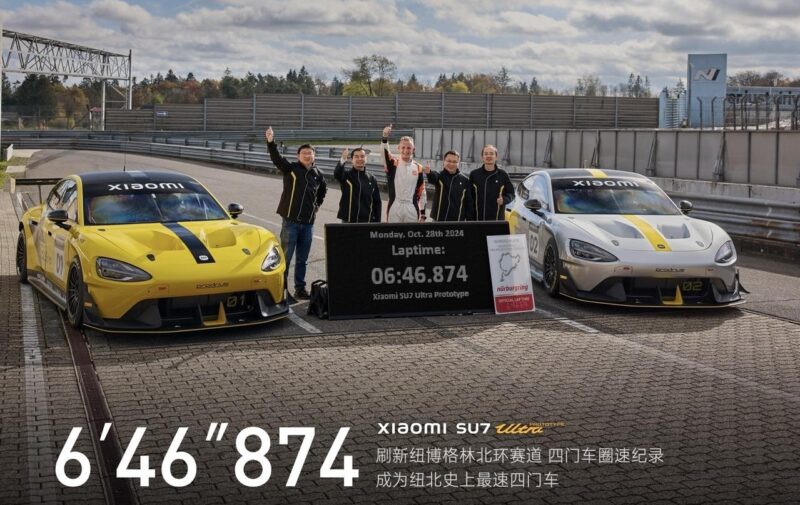
Xiaomi Auto recently achieved a record for the fastest electric sedan lap around the Nurburgring Nordschleife, clocking in at 6 minutes and 48.874 seconds with its prototype model, the SU7 Ultra.
Despite being a prototype, it is fast enough to surpass the previous record set by the Porsche Taycan Turbo GT, which was 7 minutes and 7.55 seconds.
According to a report from CarNewsChina, the manufacturer initially faced significant challenges, as their attempts to set the record were postponed multiple times due to weather conditions.
The Xiaomi SU7 Ultra was announced in mid-2023 as a high-performance variant equipped with the HyperEngine V8s electric drive unit.
With a three-motor configuration, the Xiaomi SU7 Ultra can deliver a staggering 1,548 horsepower, accelerating from 0 to 100 km/h in just 1.97 seconds, and achieving a top speed of 350 km/h.
This impressive performance figure comes from a manufacturer primarily known for consumer electronics.
Moreover, Xiaomi’s electric sedan has made a significant impact within the automotive industry.
According to reports from various media outlets, Ford CEO Jim Farley allegedly imported a unit from Shanghai and personally drove the Xiaomi SU7 sedan for six months.
“I don’t like to talk too much about competition, but I’ve driven the (sedan) Xiaomi. I’ve been driving it for six months and I don’t want to let it go,” he stated.
Xiaomi plans to revisit the Nurburgring in 2025 to attempt a new fastest lap record using a production model.
Proton through its motorsports division Proton R3, has just announced the lineup of drivers who will pilot the latest S70 R3 vehicle at the Sepang 1000KM (S1K) race next month.
At the same time, media representatives were introduced to the new race car that will be used by the Proton R3 team.
Here are five things you should know about the Proton S70 R3:
Still using the Campro engine
As previously reported, the Proton S70 R3 will not compete with the 1.5-liter three-cylinder turbo engine.
Instead, it will utilize the long-standing Campro S4PH 1.6-liter engine, which has been in use since Proton R3’s involvement in the S1K with vehicles like the Preve, Suprima S, Iriz, Saga, and Satria Neo.
While Proton has not disclosed the exact specifications of this vehicle, earlier reports suggest that the S4PH engine fitted in the Saga and Iriz can produce over 200 hp!
Why not use the original S70 engine or removing the turbo?
Proton is participating in the S1K race in the MTC category, which allows the use of different engines from the same manufacturer.
This means that Proton can save on development costs by referring to data obtained from previous races for this new vehicle.
If they were to use the original engine, Proton would require more time to gather the necessary data. The decision to remove the turbo from the original S70 engine was also deemed inefficient; thus, it is better for Proton to stick with the proven Campro engine, which has already won five S1K championships.
For S70 fans, there’s no need to worry, as Proton has revealed plans to join the race next year using a street-spec Proton S70.
What’s different about the S70 R3?
Proton has added a front splitter, a rear spoiler, and 15-inch rims wrapped in 195/55 R15 tires.
Essentially, the suspension configuration of the S70 remains the same as the street model, compliant with regulations, but it has been enhanced with a set of dampers more suitable for racing.
A cabin loaded with racing equipments
In the cabin area, all unnecessary equipment has been removed, and even the door panels have been replaced.
What remains are Recaro racing seats, an AP Racing pedal box, a Motec display screen, a manual gear knob, and the mandatory safety cage.
Will there be a street version of the S70 R3?
Proton has previously revealed plans to produce a road version of the S70 R3, equipped with high-performance upgrades for public sale.
While it may not be available in the near future, the image gallery below allows you to imagine what the R3 variant of the S70 might look like on the road.
Will it have specifications similar to the S70 race car? As a Proton fan, we hope it’s not just a cosmetic change.
For the next few years, Jaguar wants you to forget about internal combustion engine vehicles, as they aim to focus on producing a lineup of electric-powered models.
However, if you have sufficient financial resources, you can request the manufacturer to recreate a model that has long been discontinued.
In this case, it’s the Jaguar E-Type.
Jaguar Classic has generously accepted a request from a collector in Southeast Asia who wishes to add a pair of Jaguar E-Types to their collection.
Using the original blueprint data from the Series 1 1961 to Series III models, Jaguar Classic has revived the E-Type Commemorative based on the special E-Type Commemorative Edition, of which only 50 units were produced in 1974 to mark the end of the E-Type’s production.
One is finished in Signet Green, while the other is in Opal Black.
These two classic cars maintain the original 3.8-liter inline six-cylinder engine, which has now been upgraded with an electronic fuel injection system, replacing the original triple carburetors.
The original four-speed manual transmission has also been replaced with a more modern five-speed unit.
According to Jaguar, they required over 2,000 hours to match all the modern upgrades on these classic vehicles, which include a heated windshield and a Bluetooth radio.
The cabin of the E-Type is adorned with Bridge of Weir tan leather seats, an aluminum center console engraved with the Series 1 blueprint, and gold and silver accents crafted by Deakin & Francis, the oldest jewelry manufacturer in Britain.
Given the quality of craftsmanship, only those with deep pockets can afford to own these classic E-Type Commemorative vehicles.
Mazda has announced the sale price for the EZ-6 sedan model, designed as the spiritual successor to the Mazda6 for the Chinese market.
The EZ-6 sedan is essentially a badge-engineered version of the Deepal SL03 model produced by Changan Automobile.
There, buyers can acquire an electric sedan powered by a single rear-wheel-drive electric motor delivering 255 hp and 320 Nm of torque, paired with two battery capacity options.
The base version comes with a 56.1 kWh lithium iron phosphate battery pack, offering a range of 480 km, while the 68.8 kWh battery pack allows for a range of over 600 km on a full charge.
There is also a range-extender version, where the Mazda EZ-6 range extender comes equipped with a 215 hp and 320 Nm electric motor supported by a 1.5-liter engine producing 94 hp to charge the battery pack.
Two battery capacity options are available for the range-extender version: 18.9 kWh or 28.4 kWh, with the smaller version enabling a zero-emission range of 105 km, while the larger unit increases the range to 160 km.
Most notably, thanks to the additional engine, the overall range of the EZ-6 range extender sedan can reach up to 1,300 km!
In terms of dimensions, the Mazda EZ-6 measures 4,921 mm in length with a wheelbase of approximately 2,895 mm, making it longer than its competitor, the Toyota Camry.
Other features include a 10.1-inch digital cluster screen, a 14.6-inch central screen, leather or Nappa leather upholstery, dual-zone automatic climate control, wireless device charging, a 64-color ambient lighting system, and a premium Sony audio system with 14 speakers.
The sale price starts at 139,800 yuan (RM85,531) for the range-extender variant, while the pure EV version starts at 159,800 yuan (RM97,768)
Cycle & Carriage (C&C) Cheras has now become the first C&C showroom to showcase the Peugeot brand alongside a lineup of Mercedes-Benz vehicles.
The inauguration ceremony was officiated by Thomas Tok, CEO of Cycle & Carriage; Linda Jackson, CEO of Peugeot; Daniel Gonzalez as the COO of Stellantis ASEAN, and Jamie Morais, the Managing Director of Stellantis Malaysia.
The exhibition center located on the first floor spans 4,655 square feet where customers can view Peugeot models such as the 408, 2008, 3008, 5008, and the Landtrek pickup truck, as well as a comfortable café space.
It is open daily from 8:30 AM to 7:00 PM, or from 11:00 AM to 5:00 PM every Sunday.
Cycle & Carriage also offers exclusive promotions in conjunction with the opening of this Peugeot showroom, where customers can enjoy savings of up to RM30,000 for the Landtrek model, up to RM40,000 for the 3008 model, and up to RM42,000 for the 5008 model.
In addition to Cheras, Cycle & Carriage will introduce the Peugeot brand at C&C Batu Caves and C&C George Town exhibition centers, as well as more branches nationwide in the near future.
Are you a fan of the Jaecoo brand but looking for a smaller-sized SUV compared to the current J7 offering?
Fret not, as Jaecoo Malaysia has confirmed the emergence of another new model set to hit the local market in the fourth quarter of the upcoming year (Q4 2025), namely the Jaecoo J5.
The Jaecoo J5 was officially unveiled at the Omoda | Jaecoo International User Summit 2024 in Wuhu, China recently.
Described as a pet-friendly SUV, the Jaecoo J5 comes equipped with several beneficial features.
For instance, extended seats for pet comfort, an air conditioning system with powerful filtration capabilities, smart climate control, and antibacterial health devices that can inhibit any bacteria growth inside the cabin.
The Jaecoo J5 is also suitable for outdoor activities as it has the ability to accommodate a load of up to 1,250 kg, a roof rack capable of holding up to 75 kg, charging ports, hooks in the cargo space, as well as versatile camping lights.
Other features include a free-hanging system, a 13.2-inch infotainment screen, and a 1.45 square meter panoramic glass roof claimed to be the largest in its class.
According to media reports, the Jaecoo J5 is equipped with the same 1.6-liter turbo TGDI engine used in the Jaecoo J7, producing 194 hp and 290 Nm paired with a seven-speed DCT transmission.
As mentioned earlier, the Jaecoo J5 has been confirmed for the Malaysian market in the fourth quarter of the upcoming year (Q4 2025) and will compete with models in its segment such as the Proton X50, Honda HR-V, Chery Omoda 5, and Peugeot 2008.
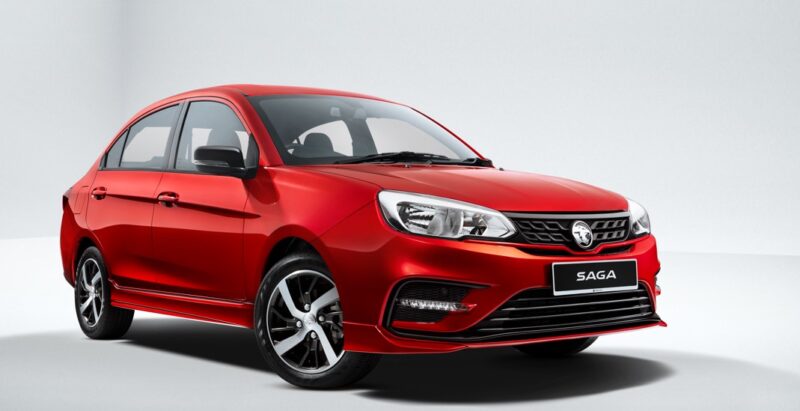
Proton recently signed a memorandum of agreement (MoA) with Grab Malaysia, offering exclusive benefits to e-hailing drivers when they purchase a Proton Saga.
This collaboration aims to enhance the driving experience and support the growing needs in the e-hailing industry.
The initiative is also expected to provide benefits to drivers, users, and further strengthen the positions of both companies in the market.
The MoA was signed by Roslan Abdullah, Deputy Chief Executive Officer of Proton, and Rashid Shukor, Director of Operations and National Mobility for Grab Malaysia.
Starting from November 4, the “Saga Power Up for Grab Drivers” campaign will grant priority access to Grab driver partners to own a Proton Saga.
The campaign includes incentives and offers such as cash rebates and a 5% service discount valid for the first two years or up to 40,000 km.
Eligible drivers can purchase as many Proton Sagas as they qualify for under Grab Malaysia’s terms.
In addition to the Proton package, Grab also offers up to RM500 for new driver partners who purchase a Proton Saga and activate their Grab Driver account.
“PROTON is excited to collaborate with Grab Malaysia in supporting the e-hailing industry by offering our iconic model, the Proton Saga, to our Grab driver partners. Reliability and reasonable maintenance costs are crucial factors for entrepreneurs who use cars as their primary work tool.”
“Furthermore, this partnership provides exclusive privileges to those who accept this offer while supporting our vision for more accessible transportation for the people of Malaysia,” said Roslan Abdullah, Deputy Chief Executive Officer, PROTON.
“This collaboration reflects our commitment to providing flexible opportunities to the people of Malaysia in an ever-changing economy. By facilitating access to income opportunities, we support our partners who play a vital role in meeting the daily needs of society.
“With the increasing demand for travel, we are constantly striving to increase and optimize our active driver supply to meet these needs. This initiative encourages more people to take advantage of the opportunities offered by the digital economy,” said Rashid Shukor, Director of Operations and National Mobility, Grab Malaysia.
The mid-size pickup truck segment is set to be enlivened by the arrival of a new contender from mainland China.
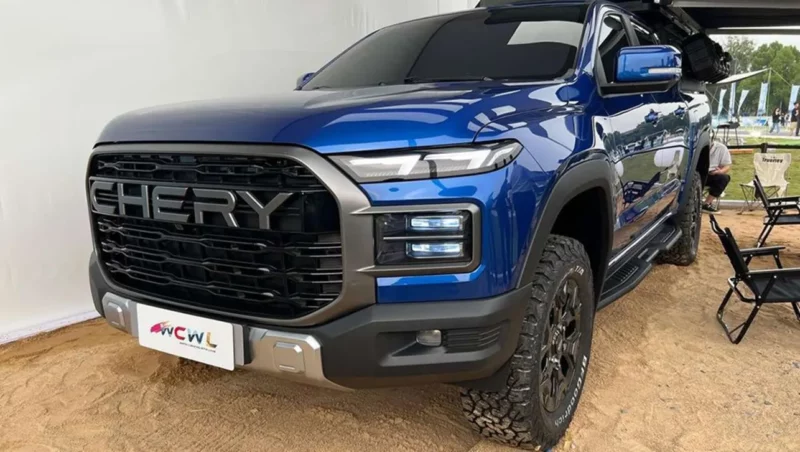
In conjunction with the Chery International User Summit held in Wuhu, Chery showcased a prototype model of the pickup truck known by the codename KP11.
At first glance, one might assume that the Chery KP11 is a model infused with various design elements from well-known pickup trucks.
For example, the front end features layered main headlight designs with L-shaped daytime running lights, reminiscent of the new Mitsubishi Triton pickup truck.
Meanwhile, Ford pickup truck elements can be observed through the front grille structure with a prominent CHERY wordmark, the use of blue color, rear lights, and the presence of side step bars on the rear bumper.
To further accentuate the versatile character of this pickup truck, Chery has incorporated various camping accessories, including a rack on the rear bed and a rooftop tent.
According to local media reports, the Chery KP11 is expected to be offered with a choice of a 2.4-liter turbo petrol engine with plug-in hybrid (PHEV) configuration or a range extender version.
The Chery KP11 is set to be launched in the Asia-Pacific, South America, and Europe markets next year, joining the already competitive pickup truck segment populated with models such as the Ford Ranger, GWM Cannon, Mazda BT-50, Mitsubishi Triton, Nissan Navara, and Toyota Hilux.
At the Philippine International Motor Show, Mitsubishi Motors unveiled a three-row seating SUV concept named DST.
Mitsubishi announced that the DST Concept will be realized as an actual production model, set to be launched in 2025.
With the introduction of the DST, Mitsubishi aims to further expand its SUV product portfolio (including Pajero Sport, Xforce & Xpander Cross) in the ASEAN market, and it is not designed to replace existing products.
Here are some facts you need to know about the Mitsubishi DST Concept:
1. Monocoque Chassis SUV
The Mitsubishi DST is built on a unibody platform and does not rely on a ladder-frame platform.
It is likely to share the same platform used in the Xforce B-segment SUV model.
2. Gravitas & Dynamism Theme
In addition to the Dynamic Shield elements that are the hallmark of Mitsubishi vehicles, the exterior of the DST Concept also emphasizes the Gravitas & Dynamism design theme.
This design concept is presented through the boxy body shape offering spacious and comfortable cabin space, even with the presence of the third-row seats.
The use of contoured fenders, large-diameter tires, and high ground clearance further accentuate the rugged and athletic character of this SUV, especially on the road.
3. Elements unlikely to exist in the actual production model
Typical of a concept car, the DST possesses several unique features.
These include frameless door design, absence of door handles, digital side mirrors with a special display screen on the dashboard, and an extended roof solar panel.
It is highly likely that all of these features will be revised to suit the specifications of the actual production model.
4. Premium cabin space
For the interior, Mitsubishi employs soft-touch materials on the door panels and dashboard.
The trend of a digital screen with a single curved display is also used in the DST Concept, followed by a somewhat futuristic center console and a new two-spoke steering wheel design.
There is no information available regarding the cargo space capacity, possibly limited based on the third-row seating image provided by Mitsubishi.
5. Front-wheel-drive SUV, 5 driving modes
Mitsubishi has not disclosed the powertrain that will be used in the actual production version of the DST Concept.
However, it is certain that the DST will have a front-wheel-drive (FWD) system complemented with five driving modes: Normal, Tarmac, Gravel, Mud, and Wet.
For reference, the previously launched Mitsubishi Xforce was equipped with a 1.5-liter engine producing 103 hp paired with a CVT transmission driving the front wheels.
WTC Automotif (M) Sdn Bhd, a subsidiary of Warisan TC Holdings, officially opened a top-notch 3S exhibition center showcasing the GAC and AION brands in Glenmarie.
The GAC showcase room spans 456 square meters, accommodating three vehicles for display, while the AION showcase room covers 644 square meters, housing customer lounge areas and display spaces for up to six cars.
Both showcase rooms operate seven days a week from 9:00 AM to 7:00 PM on weekdays, closing at 6:00 PM on Saturdays and 5:00 PM on Sundays and public holidays.
Meanwhile, the GAC and AION Glenmarie service center spans 10,878 square meters, featuring 10 work bays supported by certified technicians, service consultants, and after-sales support teams.
The service center operates from 8:30 AM to 5:00 PM, Monday to Saturday only.
There are special play areas for children, a coffee lounge, and a dedicated space for exclusive GAC and AION merchandise.
In conjunction with the Deepavali celebration, the GAC & AION Glenmarie exhibition center will host a special event on October 26-27 from 10:00 AM to 5:00 PM where customers can test drive the latest lineup and experience demonstrations of various modern features present in GAC and AION models.
Customers can also view the showcased standard variant of the GAC GS3 EMZOOM, as well as the debut of the AION Hyptec HT electric SUV displaying ‘falcon’ rear doors.
Malaysia’s Leading Automotive News | ENGEAR ENGLISH