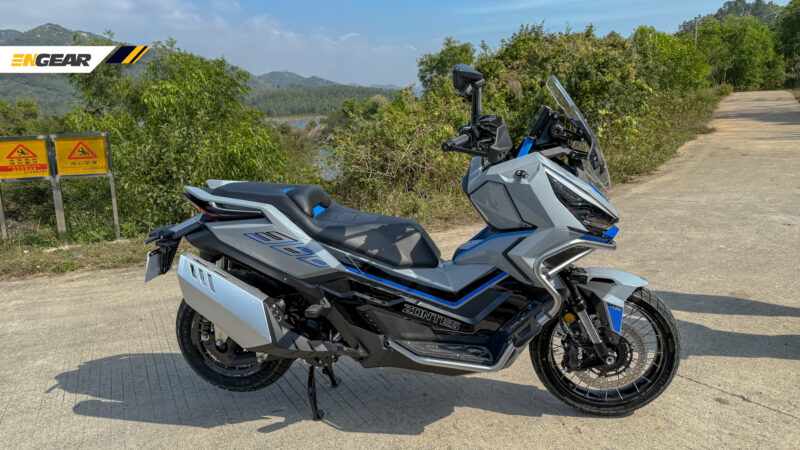
Good news for adventure scooter enthusiasts, Zontes Malaysia has confirmed that the Zontes 368G ADV model will enter the Malaysian market in early 2025.
Specifications
According to the specifications, the Zontes 368G ADV is powered by a single-cylinder liquid-cooled SOHC engine generating 38 hp at 7,500 rpm and 40 Nm of torque at 6,000 rpm, with two available modes: Eco and Sport.
Riding aspects are enhanced by the use of a 41 mm upside-down (USD) front fork suspension with compression/rebound adjustability, dual shock absorbers at the rear with preload adjustment, and a J.Juan braking system.
It also features a two-channel ABS, traction control, and a tire pressure monitoring system (TPMS) as standard features.
This ADV scooter is equipped with a 17.5-liter fuel tank, under-seat storage that can accommodate two full-face helmets, an adjustable windscreen with five levels, and a seat height of 790 mm (or 770 mm for the lower version).
All essential information and additional function settings can be accessed via an eight-inch TFT display.
Interestingly, Zontes also offers several standard features for the 368G ADV model.
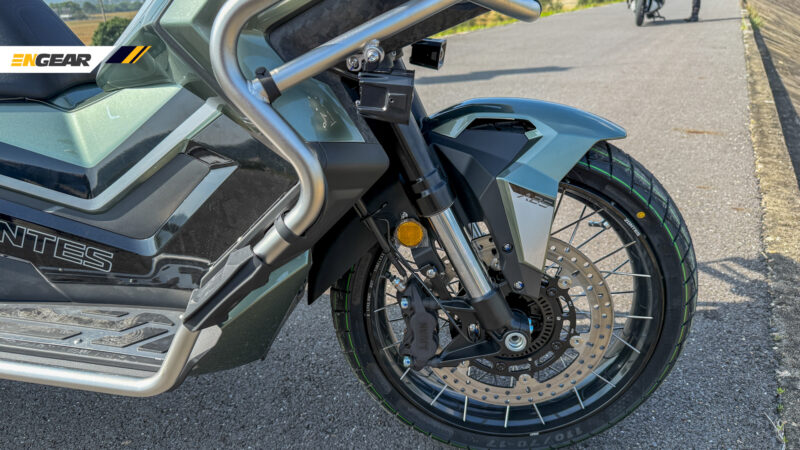
For instance, there are crash bars and handguards on the handlebars, as well as fog lights with various beam settings to enhance the stylish ADV scooter image.
For rider comfort, the 368G is fitted with grip heating functions that are very useful during winter or rainy rides.
Finally, there’s a front and rear dashcam featuring a Sony Starvis sensor capable of capturing HD 1080p video and storing up to 128 GB.
First Impressions
We had the opportunity to take a closer look and test the capabilities of this ADV scooter during a visit to the Zontes factory located in Jiangmen, China, this week.
At first glance, adventure scooter fans may fall in love at first sight due to its stylish appearance, complete with crash bars, fog lights, and spoked wheels (17 inches front, 14 inches rear).
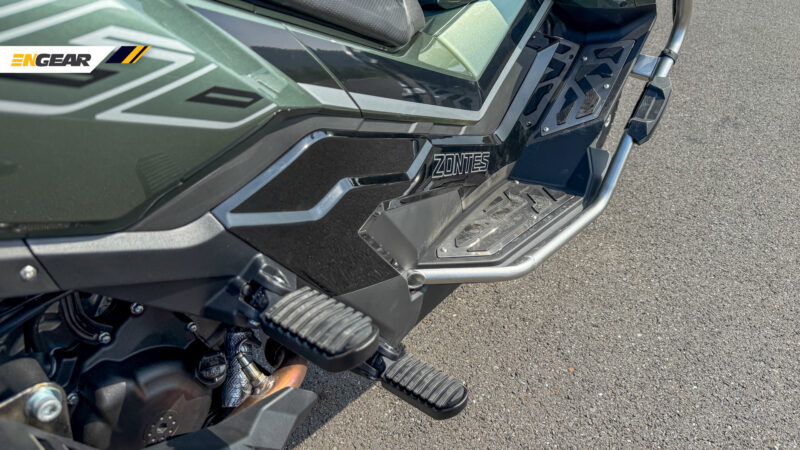
We were also particularly impressed by the relatively spacious floor design, which offers multiple comfortable riding positions and includes additional foot pegs in the middle to facilitate standing riding on off-road paths.
Based on a few hours of riding, we can say that the Zontes 368G ADV offers a good power delivery that is easy to control, with the author taking little time to get accustomed to the throttle response of this scooter.
Its dimensions, which are not overly wide, make the scooter easier to maneuver, especially in heavy urban traffic.
The braking performance does not disappoint, and importantly, with its slightly stiff suspension system, you can enjoy a somewhat aggressive riding experience when tackling corners on rural roads.
For those who remain skeptical about Chinese-made motorcycles, the Zontes 368G may leave you momentarily speechless.
With impressive build quality, it is hard to find any loose parts or poorly finished areas; in fact, while riding, there is virtually no noticeable vibration that could disrupt your journey.
The large TFT display is very easy to read, even when riding under the scorching sun at midday.
Another aspect that excites us is the sharp and clear quality of the dashcam recording, which captures all necessary evidence in case you (heaven forbid) encounter any unwanted situations.
Price
We were informed that the selling price of the Zontes 368G ADV will be around RM28,000 when it launches next year.
This is a price that offers excellent value considering the specifications and features packed into this adventure machine, making Honda ADV350 owners feel a bit challenged.
The Leapmotor C10, a segment D electric SUV, has recently been awarded a five-star rating in the European New Car Assessment Program (Euro NCAP).
In the tests, the Leapmotor C10 scored 89 percent for adult occupant protection, 85 percent for child passenger protection, 77 percent for pedestrian protection, and 76 percent for driving assistance.
This electric SUV features a high-strength body structure designed to effectively absorb and dissipate energy in the event of a collision.
Additionally, the Leapmotor C10 comes standard with 17 advanced driver assistance system (ADAS) functions, including automatic emergency braking, lane keeping assistance, blind spot detection, and adaptive cruise control.
For the Malaysian market, the Leapmotor C10 is offered in a single variant powered by a single electric motor producing 214 hp/320 Nm, with a 69.9 kWh LFP battery pack that provides a range of up to 424 km.
This segment D electric SUV is priced at RM159,000.
Our first test drive report of the Leapmotor C10 can be read via the link below:
Mitsubishi Motors Corporation (MMC) has announced that the Mitsubishi Triton pickup truck has won the Best Design award at the Japan Car of the Year (COTY) 2024-2025.
This marks the second time Mitsubishi Motors has received this award, following a similar achievement with the Mitsubishi Delica kei car in the 2023-2024 JCOTY edition.
The judges unanimously selected the Mitsubishi Triton for its captivating image as a four-wheel drive (4WD) model, encouraging customers to explore a new lifestyle.
The sixth-generation Mitsubishi Triton was successfully launched in the Malaysian market last October, with five variants available, including a single cab variant.
This all-new Triton not only boasts a ‘Beast Mode’ image but also benefits from a new platform, engine, suspension setup, and a cabin design that emphasizes both modern aesthetics and practicality.
For more details about the Mitsubishi Triton, you can read the link below:
Fans of the Land Cruiser 70 Series in Australia can breathe a sigh of relief as this modern classic off-road SUV is now available again with a manual transmission.
Due to stricter emissions regulations, Toyota had previously ceased sales of the LC70 equipped with the 4.5-liter V8 engine, thus ending the availability of the manual transmission model.
However, Toyota has now reintroduced the manual transmission option for the Land Cruiser 70 Series, which is powered by a turbocharged 2.8-liter diesel engine producing 201 hp and 450 Nm of torque.
Despite having four fewer cylinders, the 2.8-liter engine offers nearly the same horsepower and torque as the V8 model.
In the Australian market, the LC70 is also available in a six-speed automatic version, which increases torque to 500 Nm at an earlier engine speed of around 1,600 rpm, compared to 2,400 rpm in the manual version.
The manual model features a unique gear ratio, with shorter ratios for gears one through three to enhance performance, while the fifth gear has a longer ratio for improved fuel efficiency and reduced engine noise.
Toyota has also installed a new flywheel component but had to remove the hill descent control feature.
The manual version of the Land Cruiser 70 Series starts at a price of AU$77,800 (RM221,033).
In addition to the Australian market, the 40-year-old Land Cruiser 70 Series is also offered in Japan and the United Arab Emirates.
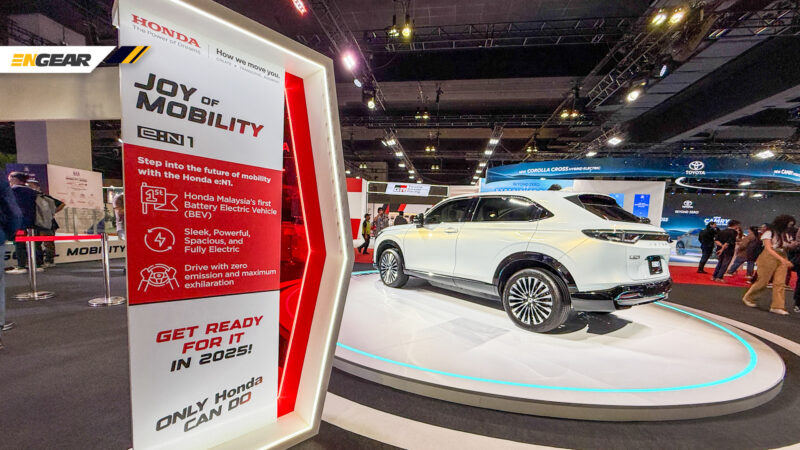
At KLIMS 2024, Honda Malaysia not only showcased the concept coupe model, Honda Prelude, but also unveiled an electric SUV – the Honda e:N1.
Despite sharing a similar appearance to the Honda HR-V, the e:N1 utilizes the e:N Architecture F platform, which offers a more rigid body structure, a lower center of gravity, and a more aerodynamic underbody.
It is powered by a front-wheel-drive electric motor that delivers 201 hp and 310 Nm of torque, paired with a 68.8 kWh battery pack.
With a full charge, the e:N1 can travel up to 412 km.
What sets the e:N1 apart from the standard HR-V is the presence of a charging port that replaces the front grille structure, along with the words “Honda” displayed in a more modern font at the rear.
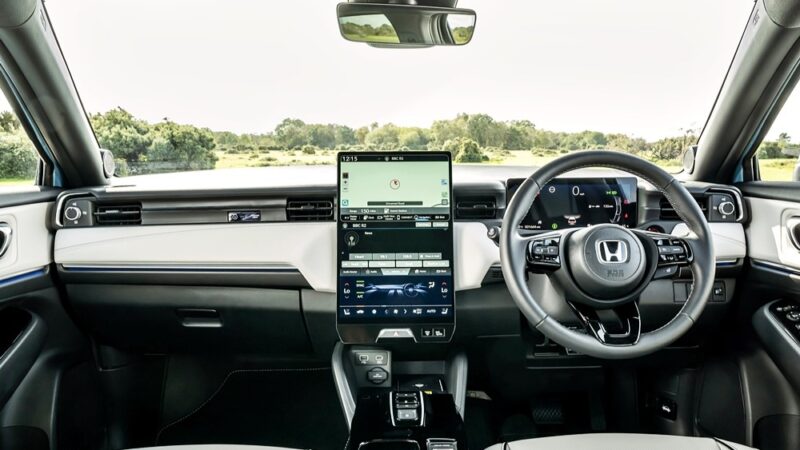
The layout of the e:N1’s cabin also appears quite different from the HR-V, featuring a 15-inch central screen, a 10.25-inch digital cluster screen, and support for Apple CarPlay and Android Auto.
At this time, Honda Malaysia has not officially revealed the detailed specifications for the e:N1 in the local market.
However, it is expected to be the first electric vehicle officially brought into the country by Honda Malaysia, with its launch scheduled for next year (2025).
For your information, Honda has already started production of the Honda e:N1 electric SUV at the Rojana Industrial Park in Prachinburi Province, Thailand by the end of 2023.
The real question is, what will be the selling price set by Honda Malaysia for the e:N1 model? Currently, the Honda HR-V e:HEV variant available in the Malaysian market is priced at RM140,800.
Seven-time world champion Sir Lewis Hamilton is set to leave the F1 Mercedes-AMG Petronas team after the conclusion of the 2024 season.
Inspired by the greatness displayed by Sir Lewis Hamilton, a tuning company from Germany, HOF, has produced a custom G-Wagen named “Sir Class.”
Using the G63 AMG as the base, the factory-standard 4.0-liter twin-turbo V8 engine has been modified with high-performance components such as connecting rods, forged aluminum pistons, turbocharger units, and an aluminum airbox.
With a recalibrated ECU, the V8 engine now generates an impressive 1,063 hp and 1,300 Nm of torque.
This power allows the vehicle to achieve a top speed of 299 km/h.
Additionally, HOF has matched the vehicle with a new coil suspension system that lowers the ground clearance by 1.2 inches, thereby enhancing aerodynamics and handling.
A carbon ceramic braking system is also employed to ensure the vehicle stops effectively.
The overall body of this square SUV is finished in a color inspired by the Silver Arrows, featuring Petronas green accents in several places, with a rather unique carbon fiber body kit.
In the cabin, green Petronas accent trims complement bucket seats, enhanced by the use of leather and Alcantara materials, along with a “Starry Sky Ceiling” feature.
Meanwhile, the steering wheel has been replaced with a rectangular unit reminiscent of a Formula 1 steering wheel.
Only 11 units of the “Sir Class” will be produced, each priced at £540,000 (approximately RM3.05 million).
At KLIMS 2024, the all-red Honda Prelude Concept made its debut in Asia, outside of Japan.
For those who may not know, particularly the younger generation, the iconic name Prelude has already existed through five generations since its inception in 1978, before its production ended in 2001.
After a long period of silence, Honda surprised everyone by showcasing the Prelude concept model at the Japan Mobility Show 2023.
The Honda Prelude Concept has been confirmed to enter production in 2025-2026, aiming to replace the coupe models from the Civic and Accord families.
For the full news regarding the Honda Prelude, you can read more at the link below:
On a global scale, the trend of electric vehicle ownership appears to be slowing down.
Major automotive manufacturers worldwide are starting to pull the handbrake and make a U-turn to resume producing fossil fuel vehicles for their customers.
What is certain is that this “ancient” technology has not yet reached its end point and is now being enhanced with the help of hybrid systems for longer ranges compared to battery electric vehicles (BEVs) and certainly compared to pure internal combustion engine (ICE) cars.
One of the hybrid vehicles made in China that has already entered the Malaysian market is the Haval H6 HEV.
Officially launched a few months ago, the Haval H6 HEV is a newcomer in the C-segment SUV category, competing against rivals such as the Honda CR-V, Mazda CX-5, and Proton X70.
Apart from its size, the Haval H6 HEV also comes with an attractive price package—RM139,800—making it as more affordable compared to the Toyota Corolla Cross Hybrid.
Will this low pricing strategy be enough to attract buyers away from the Corolla Cross, or the more sophisticated CR-V?
We managed to obtain a test drive unit of the Haval H6 HEV for a few days, and here are our findings:
1. Exterior Design
Among the C-segment SUVs available, the Haval H6 HEV features a relatively safe design.
There are no aggressive sharp lines; the design is rounded, but not excessively so like the Proton X70.
The front end looks fierce with the presence of LED headlights and a wide ‘Star Matrix’ grille, though the 19-inch wheels appear somewhat small beneath the SUV’s wheel arches.
At the rear, it boasts a full-width LED light bar, along with a cluster of four brake lights positioned on the spoiler.
In short, the design is quite ordinary. There is nothing really “wow” about it, except for the HEV badge indicating that it is not an SUV that lumbers along like a baby elephant.
This rather conservative appearance also successfully conceals the fact that it is actually a fairly large SUV!
Measuring 4,683 mm x 1,886 mm x 1,730 mm, the Haval H6 is significantly wider and taller than the Honda CR-V, benefitting from a longer wheelbase.
2. Interior Design
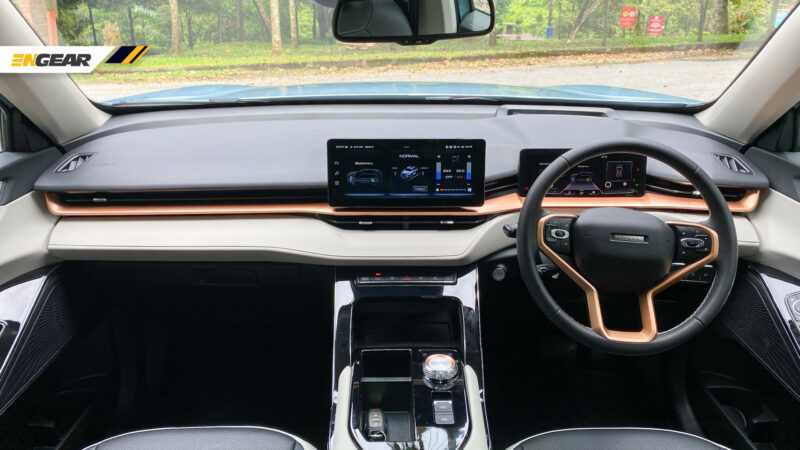
Following current trends, the Haval H6 HEV presents a more minimalist cabin layout.
Its features are comprehensive, with a 10.25-inch digital screen in front of the driver, a 12.3-inch infotainment screen complete with Apple CarPlay and Android Auto support (important features for a modern car!), dual-zone climate control, wireless device charging slots, a panoramic sunroof, a head-up display, and an audio system with eight speakers.
On the central console, there are several important function buttons, but unfortunately, it lacks a more crucial feature—controls for temperature and fan speed.
You have to navigate these functions through the central screen. This could be inconvenient, especially when driving alone.
The author also isn’t particularly fond of the three-tone finish featuring rose gold, which feels somewhat distracting while driving.
Moving to the front screen, we appreciate GWM’s decision not to clutter it with various logos and symbols that can be visually overwhelming.
The layout and graphics are sharp and easy to read, though it is unfortunate that there are fewer customization options available for those who prefer an analog speedometer display.
3. Exciting Power Package
This is one of the most powerful hybrid SUVs in its class.
The Haval H6 HEV is equipped with a hybrid engine system producing 243 PS and 530 Nm of torque, consisting of a 1.5-liter turbocharged inline-four engine (150 PS/230 Nm) and a single electric motor (177 PS/300 Nm), a two-speed Dedicated Hybrid Transmission (DHT), and front-wheel drive.
With the available Sport mode, the Haval H6 HEV can accelerate from a standstill to 100 km/h in just 7.75 seconds.
In comparison, the Corolla Cross Hybrid features a naturally aspirated 1.8-liter Atkinson cycle engine producing 98 PS/142 Nm and a single electric motor generating 72 PS/163 Nm, for a combined output of 122 PS.
Meanwhile, the CR-V e:HEV has a 2.0-liter naturally aspirated hybrid engine paired with two electric motors for a total output of 181 PS and 335 Nm.
4. Driving Experience
On paper, it certainly looks powerful, but the power delivery of the Haval H6 HEV is not as aggressive as that of sports cars or electric vehicles (EVs) with their intense torque.
When you press the accelerator pedal firmly to the floor, you can feel the responsive and smooth acceleration without straining your neck from high G-forces.
This power is particularly needed when driving with a cabin full of passengers and cargo, especially when overtaking a slow-moving eighteen-wheeler on a busy road due to overloading.
One thing we can commend about this SUV is the remarkable lack of engine vibrations felt inside the cabin.
Even at times when this SUV requires extra power, the operation of the 1.5-liter turbo engine is very efficient, devoid of the noise and vibrations mentioned earlier.
Despite its considerable size, this SUV remains easy to control, although the steering wheel feels somewhat oversized—it almost feels like driving a truck.
The handling is also satisfactory, as it is more tuned for the comfort of all passengers.
The Haval H6 HEV’s suspension system works effectively to absorb all the bumps and potholes from the road surface, while also avoiding excessive swaying on winding roads.
The braking system functions well to bring this heavy SUV to a stop; however, at low speeds, it takes a while to get used to the pedal response to avoid sudden stops.
According to GWM, a full tank of the Haval H6 HEV can cover distances of up to 1,000 km.
This figure has indeed been achieved by some media colleagues who have tested this SUV.
Based on personal experience, I managed to achieve a driving range exceeding 700 km—an impressive figure that can be attained even without driving conservatively to maximize fuel savings.
This is certainly beneficial for long-distance driving, where you won’t need to stop as frequently for refueling.
5. Comfort
While I am quite satisfied with the power delivery from this hybrid SUV, there is a key area that GWM needs to focus on—comfort.
For short drives, what the Haval H6 HEV offers won’t cause significant discomfort.
However, for families who often make long journeys (for instance, returning to their hometowns), this SUV may be a difficult choice.
What I noticed is that the seats in the Haval H6 HEV do not provide sufficient thigh support.
As a result, the legs of both the driver and passengers may feel dangling, leading to quicker fatigue.
The spacious dimensions allow the Haval H6 to provide ample legroom and headroom, but this is not complemented by comfortable upholstery.
There is a ‘boss switch’ feature that allows the driver to adjust the position of the front passenger seat if the passenger dozes off due to fatigue—a much-needed feature for any dedicated husband.
In terms of practicality, the Haval H6 HEV provides a cargo space of 560 liters, which is ample for carrying items such as luggage and shopping bags from major retailers.
If you need more space, simply fold down the second-row seats, and you will have a cargo space of 1,485 liters.
Finally, we found the NVH (Noise, Vibration, and Harshness) aspect of the Haval H6 HEV to be quite satisfactory.
With the use of quieter tires, it somewhat contributes to making the cabin of the Haval H6 more comfortable, effectively filtering out wind noise as well.
However, one point to note is that, despite being quiet, the standard tires on the Haval H6 HEV are not suitable for those who prefer aggressive driving styles.
A significant investment in higher-performance tires would be necessary to enjoy a more balanced driving experience in the Haval H6 HEV.
6. Hybrid, Yet Drives Like an EV!
You might be wondering why the Haval H6 HEV is equipped with only a two-speed gearbox.
The answer is simple: the Haval H6 HEV relies almost entirely on the electric motor for propulsion that doesn’t need too much gear ratio.
While the 1.5-liter turbo engine only engages when the driver requires extra power for aggressive driving.
The battery pack capacity is relatively small, at around 1.7 kWh, but it is sufficient to allow the Haval H6 HEV to behave like a pure EV!
The available electric range is not particularly long, stretching just a few kilometers, but I noticed that the Haval H6 HEV does not use engine power at all when driving in the city at low speeds.
In fact, some have even asked, “Is this SUV electric?” due to its remarkably quiet operation.
7. Value for Money
Currently, the selling price of the Haval H6 HEV in the Malaysian market starts at RM139,800, making it slightly cheaper than the Toyota Corolla Cross Hybrid (RM142,000).
Another popular C-segment SUV, the Honda CR-V e:HEV RS, is priced at RM195,900, offering a more aggressive appearance but less power compared to the Haval H6 HEV.
This indirectly positions the Haval H6 HEV as a formidable contender against those two Japanese models, with advantages in price, power, and practicality.
The question remains, with these advantages mentioned, can the presence of the Haval H6 HEV shake the foundations established by those two Japanese manufacturers?
For me, the true answer to this question may be difficult to please everyone.
This is because, after evaluating all three SUVs, I prefer the driving experience offered by the Japanese models, which feel more lively and connected to the driver, provide much better passenger comfort, and feature essential functions that are easier to operate without relying completely on the central screen.
I do not entirely dismiss the advantages present in the Haval H6 HEV; however, the factor of driving satisfaction is more important, far outweighing what GWM tries to promote with this model.
Specifications of the Haval H6 HEV:
Engine: 1.5-liter turbo inline-4 Power: 150 PS/230 Nm Electric motor: 130 PS/300 Nm Total power: 243 PS/530 Nm Transmission: Dedicated Hybrid Transmission (DHT) with two speeds Acceleration 0-100 km/h: 7.7 seconds Top speed: 175 km/h
As a prominent name that encompasses popular brands like Alfa Romeo, Citroën, Maserati, and Peugeot, it may seem rather odd to see Leapmotor under the Stellantis umbrella.
For clarification, Leapmotor (or Ling Pao) is a Chinese automotive company founded in 2015.
In 2023, Stellantis acquired a 20% stake in Leapmotor, aligning it with the previously mentioned European brands.
Without further ado, Stellantis Malaysia announced the introduction of Leapmotor to the local market in April 2024, positioning it as an affordable EV brand.
The first model for sale is the D-segment SUV, the Leapmotor C10, which was officially launched six months later with a selling price of RM159,000.
Recently, Stellantis Malaysia invited automotive media practitioners to experience the Leapmotor C10 on a drive to Gambang, Pahang.
Here’s our notes after driving this SUV for two days:
1. Dimensions
Unlike other EV models (mostly hatchbacks, SUVs, or sedans) available in the market, the Leapmotor C10 is more suited to be classified as a family-oriented electric vehicle.
Its relatively large size measures 4,739 mm in length, 1,900 mm in width, 1,680 mm in height, with a wheelbase of 2,825 mm.
Within the same price range, the Leapmotor C10 competes with combustion-engine models such as the Chery Tiggo 8 Pro and Proton X90.
While the sizes are similar, the C10 comes with a five-seat configuration, compared to the seven seats found in the two previously mentioned models.
2. Power
Only one variant is offered in Malaysia, featuring a single rear-wheel drive electric motor producing 215 hp and 320 Nm of torque.
Though the figures appear high, after testing the drive of this electric SUV, the acceleration is not as aggressive as that of many EVs available on the market.
However, this doesn’t mean the C10 is an “elephant baby” reluctant to move; rather, you can expect smoother power delivery to ensure no family members complain of neck pain at the start of the journey.
Even on the highway, I had no issues ensuring that this electric SUV could safely overtake any slow-moving trailers in the left lane without causing fast-moving cars behind to flash their high beams—even when fully loaded with passengers.
With a 69.9 kWh battery pack, the Leapmotor C10 can travel up to 420 km on a full charge.
Based on our drive, we reached our destination with about 112 km of range remaining, averaging an energy consumption of around 20.1 kWh/100 km, slightly higher than the official figure of 19.8 kWh/100 km.
3. Driving Experience
We took the opportunity to test the handling of this SUV while traversing the KL-Karak highway and Genting Highlands.
It was surprising to find that this large-sized SUV handled well through every turn and uphill stretch of the very popular road.
Returning to the desired speed posed no problems, without causing passengers to feel dizzy from sudden acceleration.
However, although the C10 features a suspension system that excellently absorbs impacts and Dunlop e-Sport Maxx tires that keep this SUV grounded in curves, it is not matched by a satisfying steering response.
Most of the time, the vehicle obeyed every command made by the driver, but conditions became less enjoyable when the Advanced Driver Assistance Systems (ADAS) such as Emergency Lane Keeping Assistance (ELKA) and Lane Centering Control (LCC), started to intervene.
These systems would aggressively attempt to correct the steering direction if they detected that the driver was not maintaining proper control of the vehicle.
This constant ‘interference’ could make driving more exhausting than usual, as the driver must counteract the corrections attempted by the system.
Therefore, I found it easier to simply disable these functions from the start, allowing the more critical systems to operate to ensure this SUV’s safety on the road.
I would prefer if the system could remember the initial settings so that the driver wouldn’t have to waste time staring at the screen every time they needed to drive the C10.
One aspect that made driving the C10 less reassuring is the feeling of a spongy brake pedal.
This issue wasn’t as noticeable during high-speed driving, where the braking system operated effectively, but at lower speeds, there were times when it felt as if the SUV didn’t want to stop, even when the brake pedal was pressed firmly to the floor.
It felt as though there was no bite from the brakes—completely unresponsive. Surely, we can’t rely on the emergency braking system every time we need to stop, right?
4. Interior
For this test drive session, I began my journey as a passenger in the second row.
Typically, I experience dizziness and nausea when I’m not behind the wheel; however, this time I was able to relax (and even take a nap) comfortably throughout the ride.
This is because the rear seats feature adjustable backrests (with two angles) for added comfort during the journey.
Perhaps the use of silicone leather upholstery, known as Oeko-Tex, significantly contributes to a more comfortable ride due to its soft and back-friendly material.
It also has waterproof properties and does not contain any toxic substances that could be harmful to infants—a highly beneficial feature for many families in Malaysia with small children.
In addition to ample legroom, rear passengers won’t feel cramped as there is generous headroom, thanks to the spacious panoramic roof, which also has a shade to block out the intense midday sun.
While black upholstery may sound somewhat conventional, there is an option for a brighter Criollo Brown finish, should you be interested in that beautiful Glazed Green color.
The NVH (Noise, Vibration, and Harshness) aspects are also satisfactory, with wind noise from outside being well-filtered, and tire noise is less noticeable from within the cabin.
Another advantage is the cargo space of 435 liters, which can be expanded to 1,410 liters when the second-row seats are folded flat.
5. Overly Minimalist Dashboard
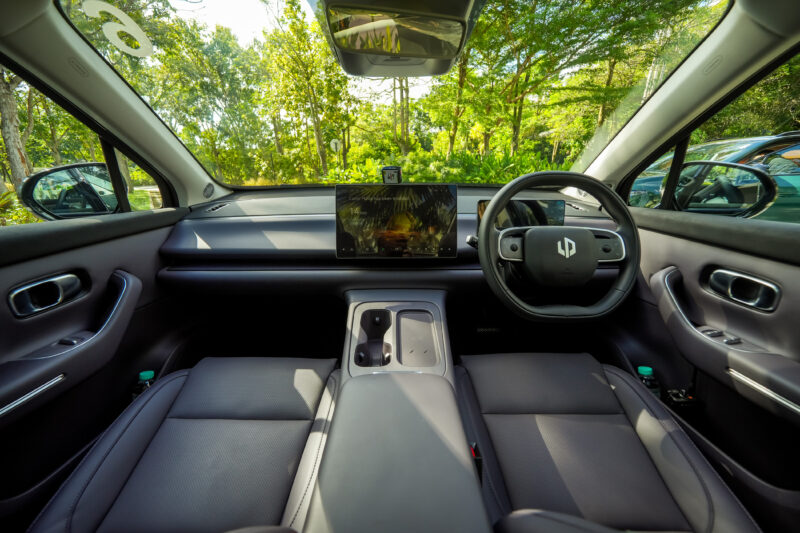
For someone used to a plethora of buttons and controls in a vehicle, entering the Leapmotor C10 creates a somewhat uncomfortable feeling.
This discomfort stems from the dashboard layout, which is overly simplistic and minimalistic, relying heavily on the menu embedded in the display screen, making it easier for the driver’s focus to be distracted on the road.
Therefore, if you’re interested in the C10, it’s best to avoid driving alone, so you can appreciate all the assistance provided when you wish to change a setting.
For example, adjusting the direction of the air conditioning, temperature settings, turning off the headlights, or simply disabling specific functions in the ADAS.
It is also unfortunate that side mirror adjustments must be accessed through the main screen.
Fortunately, Leapmotor has not adopted Tesla’s approach of eliminating the turn signal stalk entirely in favor of a button on the steering wheel.
Additionally, if you’re accustomed to pressing a start button, you will need to learn a new method on the C10, which involves scanning a card-shaped key on the center console before shifting the transmission lever to the D position.
Yes, you must do this every time before you begin your journey.
Another drawback that we find hard to accept is the absence of Apple CarPlay/Android Auto support.
6. ‘Healing’ mode inside
An interesting feature that can be beneficial for drivers after each trip is the Nap Mode.
When this mode is activated, you can enjoy ambient sounds such as rain, flowing river water, crickets, and ocean waves while you relax.
You can also set the desired nap duration, and the system will wake you up once the session ends.
With the ventilation function in the seats, your brief nap will be more comfortable while you wait for prayer time or for your spouse to finish shopping.
At the end of the day, in a market flooded with various EV models, the Leapmotor C10 certainly stands out with its spaciousness, making it suitable for everyday family use.
That is, if you don’t mind the overly minimalist dashboard design and the routine needed every day before starting your journey.
With a selling price below RM160,000, is it a worthwhile purchase? Perhaps, yes.
Leapmotor C10 Specifications
Electric Motor: Single, rear-wheel drive (RWD)
Power: 215 hp, 320 Nm
Acceleration: 0-100 km/h in 7.5 seconds
Top Speed: 170 km/h
Battery: LFP 69.9 kWh
Range: 424 km (WLTP data)
Suspension: MacPherson/Multi-Link
Ground Clearance: 180 mm
Cargo: 435 liters/1,410 liters
Peugeot Malaysia has announced its latest campaign, the “Peugeot Weekender Experience,” which allows customers to enjoy test drive sessions lasting up to three days.
This first-of-its-kind campaign enables customers to choose from three different models: the Peugeot 408 crossover sedan, the Peugeot 2008 SUV, and the Landtrek pickup truck, to use throughout the weekend or on regular weekdays.
Customers can also take advantage of the integrated ChatGPT feature on the microsite to create a personalized itinerary based on their interests and preferences.
According to Jamie Francis Morais, Managing Director of Stellantis Malaysia, “For many years, we have relied on traditional methods where customers walk into showrooms and spend a few minutes driving around the vicinity. This approach does not showcase the true capabilities of the vehicles or the ownership experience of a Peugeot.
“With the Peugeot Weekender Experience, we want to change how our customers experience our vehicles. We want to give them the freedom and flexibility for several days to enjoy the true experience and see how a Peugeot can meet their lifestyle and mobility needs.”
Open to all Malaysians with a valid driving license, the Peugeot Weekender Experience can be participated in by visiting any authorized Peugeot showroom and scanning the provided QR code.
Alternatively, you can visit the microsite peugeotweekenderexperience.com, fill in your personal information, and select a nearby showroom.
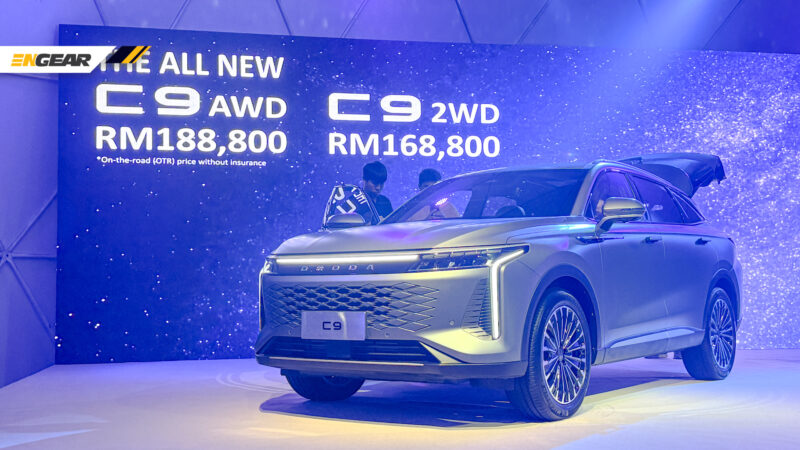
Jaecoo Malaysia has officially launched the premium off-road coupe SUV model, the C9, for the local market.
Two variants are offered, with the front-wheel drive (2WD) version starting at RM168,800, while the all-wheel drive (AWD) variant is priced at RM188,800.
Jaecoo Malaysia also announced a promotional package for early buyers, which includes a 10-year warranty on the engine and suspension components or a mileage limit of 1,000,000 km, valid until December 8.
In terms of size, the C9 measures 4,775 mm in length, 1,920 mm in width, 1,671 mm in height, with a wheelbase of 2,800 mm, and a ground clearance of 165 mm.
Additionally, the C9 is capable of wading through water up to 450 mm deep.
The cargo space is a generous 660 liters, or up to 1,783 liters when the second-row seats are folded down.
Both variants are powered by a 2.0-liter turbocharged inline-four engine producing 261 PS and 400 Nm of torque, paired with an eight-speed automatic transmission.
Exterior features include hidden door handles, 20-inch alloy wheels, sigma LED DRL lights, a diamond matrix grille structure, and a rear spoiler inspired by fighter jets.
Inside, the cabin is equipped with a 12.3-inch cluster display and infotainment screen, Apple CarPlay and Android Auto support, dual-zone climate control, driver’s seat with memory function, seat ventilation and heating features, and an audio system with eight speakers.
For the 2WD variant, there are three driving modes: Eco, Normal, and Sports, while the AWD variant includes additional modes for Sand, Mud, Snow, and Off-Road.
The AWD variant also comes with a 14-speaker audio system, including two embedded in the headrest units.
As standard, both variants are equipped with Level 2 ADAS, which includes features such as Adaptive Cruise Control (ACC), Traffic Jam Assist (TJA), Automatic Emergency Braking (AEB), Front Collision Warning (FCW), and Rear Collision Warning (RCW), as well as a 540-degree panoramic monitoring system (AVM).
Additionally, there are nine airbags, ABS, EBD, traction control, Hill Start Assist (HAC), Hill Descent Control (HDC), a Tire Pressure Monitoring System (TPMS), Multi-Collision Brake (MCB) system, and a Driver Monitoring System (DMS).
It has been over a year since Mazda first showcased the concept model, Iconic SP, at the Japan Mobility Show 2023.
In exciting news for rotary sports car enthusiasts, Mazda has finally confirmed the company’s commitment to making the Iconic SP a reality in the future.
In an interview with Auto News, Mazda CEO Masahiro Moro provided the much-anticipated update regarding the production version of the Iconic SP.
He stated, “We are working to make it a reality, and we are progressing step by step towards that goal.”
The enthusiasm for realizing the concept was evident from the beginning when the Iconic SP model created a buzz in the digital world.
During last year’s Japan Mobility Show, the CEO described the model as a commitment to Mazda’s future.
This was further reinforced by a statement from Mazda’s chief designer, Masashi Nakayama, who emphasized, “This concept is not just an empty show car. It has been designed with the genuine intention of becoming a production model in the future.”
Mazda will also develop a new hybrid powertrain unit featuring two rotors to meet the demands of users in the United States who crave power.
Unlike the conventional rotary engine operations we know, this hybrid two-rotor engine will act as a power generator for the electric motors that drive the wheels, rather than directly powering the wheels.
With a combined power output of around 365 hp, it is significantly more powerful than the rotary engines found in the RX-7 and RX-8 models.
This configuration of the hybrid rotary engine is seen as a solution to the weight issues present in today’s electric vehicles, allowing Mazda to use a smaller battery pack to keep the weight to a minimum—an essential aspect for any sports car.
For your information, Mazda established a special team to develop the rotary engine in February.
Comprising 36 engineers, the RE Development Group will be responsible for creating cars that excite Mazda customers, especially fans of rotary-powered sports cars.
In addition to the Mazda CX-60, another SUV model showcased at 2024 KLIMS is the Mazda CX-80.
Like the Mazda CX-60, the Mazda CX-80 is a mid-size SUV built on the Large Group Product platform, but features a three-row seating configuration.
The exterior design of the CX-80 also incorporates design elements similar to those of the CX-60.
The dimensions of the CX-80 are larger than those of the CX-60, measuring 4,995 mm in length, 1,890 mm in width, and 1,710 mm in height, with a wheelbase of approximately 3,120 mm.
The cabin of the CX-80 also includes features and amenities consistent with the CX-60, such as a digital cluster display, a 12.3-inch central screen, a head-up display, and a Bose audio system.
The unit displayed at KLIMS is equipped with a 2.5-liter e-Skyactiv G engine generating 328 PS and 500 Nm of torque, paired with an eight-speed automatic transmission.
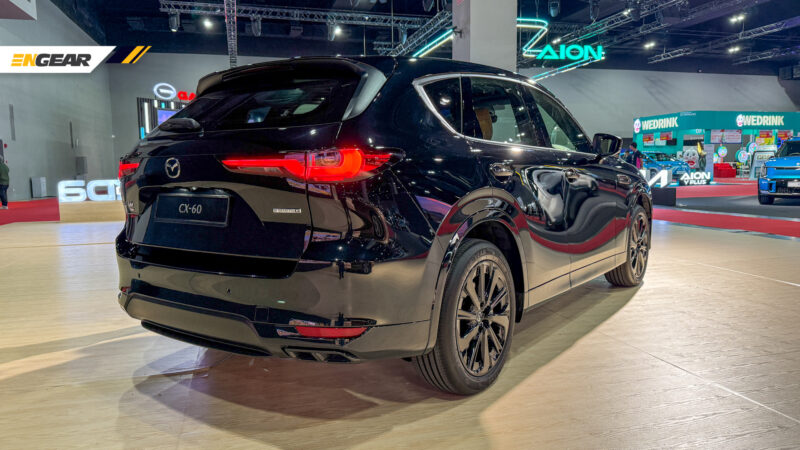
At 2024 KLIMS, Bermaz Motor also took the opportunity to showcase two models from the Mazda Large Product group, namely the Mazda CX-60 and Mazda CX-80.
The Mazda CX-60 is a mid-size SUV that has been available in the global market since 2022.
It features dimensions of 4,745 mm in length, 1,890 mm in width, 1,685 mm in height, and a wheelbase of 2,870 mm, making it larger than the CX-50.
The exterior of the CX-60 embodies the design philosophy of ‘Kodo – Soul of Motion’ with a sharp front grille, smaller headlight units, and L-shaped daytime running lights that connect to the grille.
The cabin showcases a digital cluster display, a 12.3-inch infotainment screen, a head-up display, dedicated climate control buttons, and a cargo space of 570 liters.
The unit displayed at KLIMS is equipped with a 3.3-liter inline-six e-Skyactiv G engine with a hybrid system, producing 280 hp and 450 Nm of torque.
At the 2024 Kuala Lumpur International Mobility Show 2024 (2024 KLIMS), Bermaz Motor has launched the MS Limited Edition package, specifically designed for Mazda CX-5 SUV owners.
The MS Limited Edition package features glossy black finishes on the signature front wing grille, bumper, side mirrors, wheel arches, front and rear rocker panels, as well as 19-inch rims.
Additionally, Mazda offers a rear spoiler matched to the vehicle’s body color, complemented by MS exhaust tips for a sportier appearance.
The package also includes upgrades to handling, as the Mazda CX-5 now comes equipped with a black front strut bar that enhances the vehicle’s structural stability.
Inside the cabin, drivers will be welcomed by seats adorned with the MS logo, red stitching accents, sporty pedals, MS-branded floor mats, and suede finishes on the steering wheel, seats, and door panels.
The MS Limited Edition package for the Mazda CX-5 is priced at RM12,000 and includes a one-year warranty for genuine Mazda accessories.
Mitsubishi Motors Malaysia is providing special promotions throughout the 2024 Kuala Lumpur International Mobility Show (2024 KLIMS) held from December 5 to December 11, 2024.
Malaysians are invited to visit the Mitsubishi Motors Malaysia booth located on Level 2, where the theme “Drive Your Ambition” will be showcased, reflecting the brand’s commitment to innovation, challenges, and customer-centric values.
Additionally, customers who book and register a brand-new Mitsubishi Triton or Xpander at the MMM booth or any MMM exhibition center will receive a package that includes fuel subsidies and free maintenance for two years.
According to MMM CEO Ikeda Shinya, “We want to offer fuel to our customers so they can go further, ensuring they reach their destinations without worry during the year-end festive season.
“Furthermore, we aim to provide a free maintenance package, giving our customers peace of mind and allowing them to enjoy a hassle-free ownership experience.”
In addition to showcasing the latest models, MMM will also display a variety of genuine accessories for the Triton and Xpander models that cater to the lifestyle needs of Mitsubishi Motors customers.
MMM has also announced the launch of the MAX Leasing vehicle leasing program in collaboration with ALD MHC Mobility Services Malaysia.
This program offers a more manageable alternative to direct vehicle purchases, featuring more stable interest rates and a comprehensive service network to support the growth of vehicle leasing.
In addition to the launch of the D-segment sedan, the Toyota Camry, UMW Toyota Motor has also unveiled the C-segment crossover, the 2025 Toyota Corolla Cross facelift.
Unlike the previous model, the Corolla Cross facelift features more significant design changes, particularly at the front end.
It boasts an entirely new bumper structure, a front grille with a honeycomb design, Bi-LED headlights with Lexus-style DRL graphics, and sequential turn signals.
The GR Sport variant comes with an exclusive two-tone black roof design for a sportier appearance.
The two highest variants, the 1.8 HEV and the GR Sport HEV, are powered by a 1.8-liter 2ZR-FXE engine producing 98 PS and 142 Nm, paired with a 72 PS electric motor generating 163 Nm, resulting in a combined output of 122 hp matched to an eCVT transmission.
The 1.8V variant continues to offer the 1.8-liter 2ZR-FBE engine, which produces 140 hp and 177 Nm.
Meanwhile, the cabin is equipped with a 12.3-inch digital cluster screen, a 10.1-inch audio display screen with support for Apple CarPlay and Android Auto, an electric parking brake, a vehicle telematics system, and a remote engine start function for convenience and lifestyle comfort.
In terms of safety, the Corolla Cross facelift comes equipped with Toyota Safety Sense 2.0 (TSS 2.0), which includes a pre-collision system, lane departure warning (LDA), lane tracing assist (LTA), dynamic radar cruise control (DRCC), and automatic high beam assistance (AHB).
Additionally, it features a blind spot monitoring system (BSM), rear cross-traffic alert (RCTA), and Drive-Start Control to prevent unintended acceleration.
The sales prices for the 2025 Toyota Corolla Cross are as follows:
At the 2024 Kuala Lumpur International Mobility Show 2024 (2024 KLIMS), Perodua took the opportunity to showcase the eMO-II electric prototype model this afternoon.
According to Dato’ Sri Zainal Abidin Ahmad, the President and CEO of Perodua, this prototype unit is a continuation of the previous prototype model and has been improved in terms of styling and features.
As revealed in a teaser video earlier, the Perodua eMO-II boasts a much sportier design compared to the eMO model.
From the front, the eMO-II features an aggressive bumper design, a full-width LED light bar, a illuminated Perodua logo on the front hood, and the eMO-II branding on the lower bumper.
On the sides, there are sharp air intakes, followed by aerodynamic wheel rims and side cameras that will typically be replaced with side mirrors for the actual production model.
The sporty theme continues at the rear, where the bumper components are adorned with a sizable diffuser design, a single brake light at the center of the bumper, a full-width LED light bar, and the presence of LED graphics resembling traditional songket patterns.
The interior design of the eMO-II deviates from the typical layouts seen in Perodua’s production cars.
In addition to the sporty seating, the eMO-II features a more modern steering wheel design, a wide digital cluster screen, PRND buttons positioned at the top of the center screen, and geometric graphics on the central console.
Currently, Perodua has not revealed the full specifications of the eMO-II, but based on preliminary information, this electric vehicle (EV) is powered by a single front-wheel-drive electric motor with an output of 68 PS and 220 Nm of torque, offering a range of 450 km on a full charge.
However, Dato’ Sri Zainal Abidin Ahmad confirmed that Perodua’s first EV will be priced within a range not exceeding RM90,000.
UMW Toyota Motor has launched the ninth-generation Toyota Camry 2025 in conjunction with the Kuala Lumpur International Mobility Show 2024 (KLIMS 2024).
The sedan is powered by a Dynamic Force 2.5-liter engine (186 PS/221 Nm) paired with an electric motor producing 136 PS/208 Nm, together resulting in a combined power output of 230 PS with an eCVT transmission.
With its advanced fifth-generation hybrid system, the 2025 Toyota Camry is capable of achieving a total driving range of 1,250 kilometers.
The exterior design of the new Camry features an aggressive theme inspired by the Hammerhead shark, luxurious elements from the Toyota Crown, and air curtains for enhanced handling stability, complemented by 18-inch alloy wheels.
The cabin layout has also been revamped to present a more minimalist and luxurious look, featuring a 12.3-inch digital cluster display, a 12.3-inch central infotainment screen equipped with wireless Apple CarPlay and wired Android Auto, a JBL audio system, and a head-up display.
Additionally, the car offers ventilated seating for the driver and front passenger with lumbar support, an elegant steering wheel design, rear seats that can recline up to eight degrees, control panels in the center armrest, three-zone climate control, wireless smart device charging, and USB charging ports.
There are six color options available: Cement Grey, Dark Blue Mica, Precious Metal, Emotional Red, Platinum White Pearl, and Attitude Black.
In terms of safety, the Camry 2.5 HEV is equipped with the Toyota Safety Sense 3.0 (TSS 3.0) system, which includes features such as a pre-collision system, dynamic radar cruise control (DRCC), lane departure alert (LDA), lane tracking assist (LTA), road sign assist (RSA), automatic high beam (AHB), safe exit assist (SEA), as well as additional features like seven airbags, a panoramic view monitor (PVM), and a blind spot monitoring system (BSM).
The starting price for the 2025 Camry is RM248,800.
Many have praised the sleek design of the Tesla Model 3 Highland electric sedan, while others have criticized it for features that complicate life for traditional drivers.
One such feature is the absence of a physical turn signal stalk, which has been replaced with a touch-sensitive button located on the steering wheel.
This change has not been well-received by those accustomed to using a physical turn signal stalk.
The good news is that you can find a solution to this unnecessary issue by purchasing S3XY Stalks from Enhance Auto.
This aftermarket option allows owners to install the device directly onto the steering column without the need to remove the steering wheel.
S3XY Stalks require no wiring and communicate directly with the car’s system using Bluetooth technology.
According to Enhance, this Bluetooth stalk has a battery life of at least a year before it needs to be replaced.
In addition to the function of activating the turn signals, there is a special button at the end of the stalk for user-customizable functions.
The retail price ranges from $343.69 to $363.69 (RM1,537-RM1,626), depending on the selected Tesla model.
In addition to the Tesla Model 3 Highland, these stalks are also compatible with the Model S and Model X.
In our view, this is a prime example of a solution for a problem that should not exist.
We are concerned that one day, manufacturers may offer turn signal stalks as an option rather than as standard factory equipment—a welcomed development for those who refuse to signal on the road.
Malaysia’s Leading Automotive News | ENGEAR ENGLISH