All posts by Hanif Su'ib

Someone who loves driving manual cars but prefers riding an automatic scooter. Maybe it's an age thing.

Honda and Nissan initiate merger talks; will Mitsubishi join?

Honda Motor Co. and Nissan Motor Co. have confirmed in a statement that discussions are ongoing to establish a new company, which is expected to be finalized by 2026.

According to a report by Mainichi JP, this move is seen as a way to create the world’s third-largest automotive group, behind Toyota and Volkswagen, to compete against American and Chinese manufacturers in the electric vehicle segment.

Honda and Nissan, the second and third largest manufacturers in Japan, aim to finalize the discussions by June.

Meanwhile, Mitsubishi Motors Corporation will decide by the end of January 2025 whether to join the new company or not.

In an effort to become more competitive in the market, Honda and Nissan have agreed to collaborate on research and development (R&D), standardize vehicle platforms, and share components across various product segments, in addition to optimizing existing production systems and facilities.

Proton e.MAS 7 vs BYD Atto 3: which one should you choose?

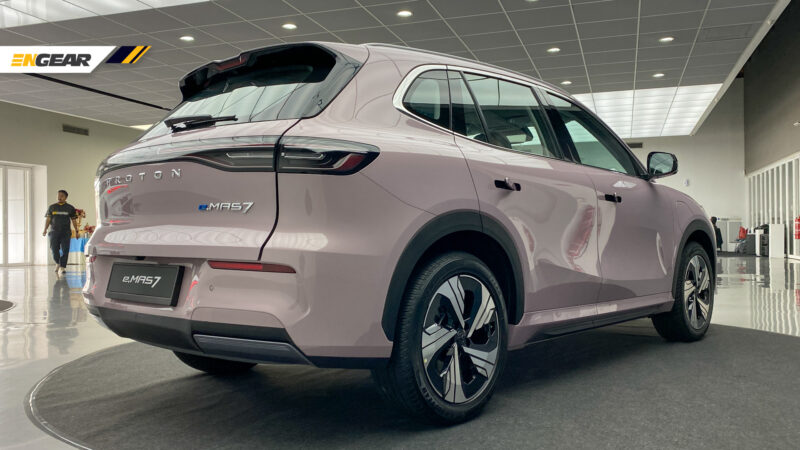
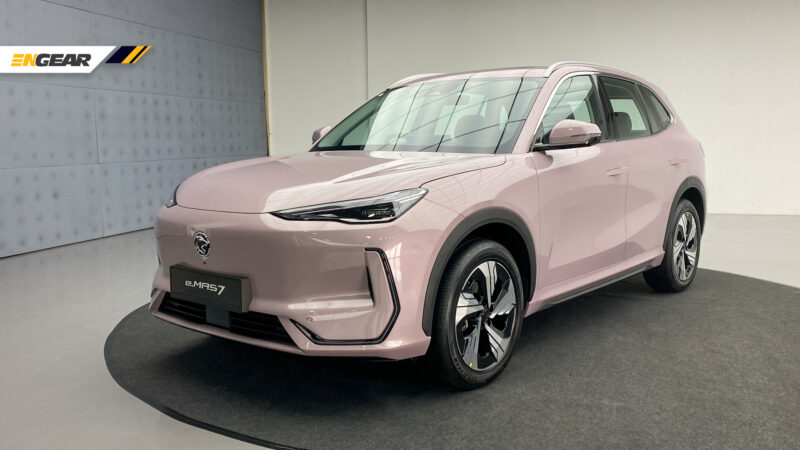
Last week Proton has officially launched its first electric SUV, the Proton e.MAS 7 2025, featuring an attractive price and design package.

Two variants have been announced: Prime and Premium; however, in this article, we will focus on the Premium variant, which comes with significantly better features.

If you are at a crossroads deciding between the e.MAS 7 and the popular BYD Atto 3 Extended Range electric SUV, you might want to read the comparison we’ve prepared below:


1. Dimensions

In terms of size, the Proton e.MAS 7 is larger, measuring 4,615 mm in length, 1,901 mm in width, and 1,670 mm in height, compared to the BYD Atto 3 (4,455 x 1,875 x 1,615 mm).

The wheelbase of the e.MAS 7 is also 30 mm longer (2,750 mm) than that of the Atto 3 (2,720 mm), contributing to a more spacious cabin.

Additionally, the e.MAS 7 offers larger cargo space, with 461 liters, while the Atto 3 provides about 440 liters.


2. Power

Both SUVs are equipped with a single electric motor as standard.

However, the power outputs differ slightly, with the e.MAS 7 generating up to 215 hp and 320 Nm of torque, compared to the Atto 3, which produces 201 hp and 310 Nm.

This difference allows the e.MAS 7 to achieve faster acceleration (6.9 seconds) compared to the Atto 3 (7.3 seconds).


3. Driving Range

The BYD Atto 3, recently updated a few months ago, comes with a 60.48 kWh LFP battery pack, offering a driving range of up to 420 km.

Its DC charging has been enhanced to 88 kW, allowing the battery to charge from 10-80% in approximately 40 minutes.

In comparison, the e.MAS 7 offers a driving range of 410 km, thanks to its 60.22 kWh battery pack.

However, with fast DC charging of up to 100 kW, the e.MAS 7 can charge from 30-80% in just 20 minutes.


4. Exterior

On the exterior, both SUVs are equipped with LED projector headlamps, LED taillights, and side mirrors with integrated turn signal indicators.

While the Atto 3 comes with 18-inch rims fitted with Continental EcoContact 6 tires, the e.MAS 7 features 19-inch rims shod with Goodyear Efficient Grip Performance SUV tires.

Aesthetically, the Proton e.MAS 7 has its own unique advantages, as its design appears fresher compared to the Atto 3, which has been on the global market for two years.

However, beauty is subjective and depends on personal taste.


5. Cabin

Not many changes have been made to the Atto 3’s dashboard layout, except that the central infotainment screen is now 15.6 inches, adjustable in orientation, alongside a five-inch cluster screen, a nine-speaker audio system, and a dual-tone color scheme.

One advantage of the Atto 3 is its support for Apple CarPlay and Android Auto.

In contrast, the Proton e.MAS 7 features a more minimalist layout, with a 10.2-inch cluster screen, a 15.4-inch central screen, a six-speaker audio system, and front seat ventilation.

The two models share several features, such as single-zone air conditioning, a panoramic glass roof, rear seats that fold in a 60:40 ratio, wireless smartphone charging, USB charging ports, and a 360-degree surround camera system.


6. Safety

Both the Proton e.MAS 7 and the BYD Atto 3 come with Level 2 Advanced Driver Assistance Systems (ADAS), which includes essential features like Autonomous Emergency Braking (AEB), Adaptive Cruise Control (ACC) with stop & go functionality, Lane Centering Assistance (LCA), Blind Spot Monitoring (BSD), Rear Cross Traffic Alert (RCTA), collision warnings, and seatbelt reminders.

While the e.MAS 7 is equipped with six airbags, the BYD Atto 3 offers up to seven airbags as standard.


7. Pricing

The Proton e.MAS 7 is priced starting from RM123,800, while the BYD Atto 3 Extended Range starts at RM149,800.

The BYD Atto 3 comes with a six-year/150,000 km vehicle warranty, an eight-year/160,000 km high-voltage battery warranty, and an eight-year/150,000 km powertrain warranty.

On the other hand, the Proton e.MAS 7 offers a manufacturer warranty of six years with no mileage limit and an eight-year or 160,000 km warranty for high-voltage battery components.

Which one is more worthwhile? It ultimately depends on your personal assessment.

2025 Hyundai Palisade, for those who are allergic to minivans

Whether one realizes it or not, the Hyundai Palisade has now entered a new generation after making its debut in 2018.

Unlike its predecessor, the second generation of the Hyundai Palisade 2026 boasts a sturdier design without overly busy body lines.

In terms of dimensions, the Hyundai Palisade 2026 is now 5,060 mm long (+65 mm), 1,980 mm wide (+5 mm), 1,805 mm tall (+55 mm), and has a wheelbase of 2,970 mm (+70 mm).

From the side profile, the added dimensions result in a shorter front overhang and a longer rear overhang.

It resembles a Range Rover.

This luxurious appearance is further enhanced by a relatively large and wide grille, followed by a cluster of gigantic LED daytime running lights that also serve as turn signal indicators visible from a distance.

The layered lighting theme continues at the rear, though without the transverse LED bar that is currently in trend.

Inside the cabin, the Palisade features a layout that is far more luxurious, akin to a Genesis brand vehicle.

The dashboard houses a twin 12.3-inch screen in a single curved panel, adorned with wooden trim, ambient lighting, a steering wheel similar to the Range Rover model, and a cluster of controls for the infotainment and cabin temperature systems.

In Korea, the Hyundai Palisade is also available in a nine-seat version, where the ninth seat is a small bench between the front seats that can be converted into a center console.

For other markets, the Palisade remains available in seven- or eight-seat versions.

In the seven-passenger version, the second-row seats come with electric adjustability (including reclining and folding), massage functions, and a tilting walk-in feature for easy access to the third row.

Cargo space can also be maximized to 615 liters simply by moving the third-row seats slightly forward.

Drivers are also given the freedom to adjust the position and angle of the second and third-row seats through the infotainment screen menu.

It is worth noting that the Hyundai Palisade 2026 still retains the same unibody platform as its predecessor, although it has been upgraded.

Despite sharing the same platform, the new Hyundai Palisade does not retain the 3.8-liter V6 engine, instead replacing it with a 2.5-liter turbocharged inline-four engine that produces 277 hp and 422 Nm of torque.

The hybrid version, which consists of the 2.5-liter turbo engine, a single electric motor (72 hp/264 Nm), and a 1.65 kWh lithium-ion battery pack, can generate up to 330 hp, with a driving range exceeding 1,000 km!

In addition to the new engines, the Hyundai Palisade is the first Hyundai SUV to feature a technology known as Electronic Controlled Suspension (ECS).

This ECS system uses navigational data and sensors to adjust vehicle movements throughout the journey, prioritizing enhanced passenger comfort.

Furthermore, the new Palisade offers a quieter cabin using thicker glass and additional sound insulation around the windows.

The second-generation Hyundai Palisade 2026 is set to be sold in the Korean market starting at ₩43,830,000 (approximately RM135,724).

Toyota Alphard/Vellfire PHEV launched in Japan, 73 km EV range, starting from RM306k

Toyota has announced its latest update, introducing the 2025 model year Alphard/Vellfire with a plug-in hybrid (PHEV) engine option.

This PHEV configuration combines a 2.5-liter engine (A25A-FXS) with an electric motor and a lithium-ion battery, capable of providing an electric driving range of up to 73 km on a full charge.

Overall, the system can generate a power output of up to 306 PS.

Like Toyota’s conventional hybrid vehicles, the BEV mode is prioritized to achieve lower fuel consumption rates of 16.7 km/liter (or 5.98 liters/100 km).

According to Toyota, the lithium-ion battery pack is positioned under the floor to maximize cabin space and lower the center of gravity by 35 mm compared to the HEV model.

Charging the battery (up to 80 percent) takes approximately 38 minutes.

In addition to offering a quieter driving experience (with added sound insulation), enhanced comfort, and reduced vibrations, Toyota has introduced the Smooth Stop control feature, which prevents nose-dive effects during deceleration to ensure passenger comfort.

The PHEV model also features “My Room Mode,” allowing users to enjoy a comfortable cabin space for working, resting, or engaging in other activities while charging.

Along with the Vehicle-to-Load (V2L) function, both the Alphard and Vellfire PHEVs are equipped with a Vehicle-to-Home (V2H) feature for emergency purposes, where a full tank of fuel and a charged battery can provide power for up to 5.5 days.

Other enhancements include a Digital Inner Mirror system and front and rear dash cameras as standard features, followed by a premium JBL audio system with 15 speakers and a 14-inch rear infotainment system for the Z and Z Premier trims.

Toyota Auto Body also offers the Alphard Spacious Lounge, a four-seat version that provides more legroom and is equipped with various luxurious amenities.

In Japan, the retail price of the Alphard PHEV starts at JPY 10,650,000 (RM306,177), while the Vellfire PHEV is priced from JPY 10,850,000 (RM311,927).

Elderly woman returns manual RX-7 to Mazda Japan on her 80th birthday

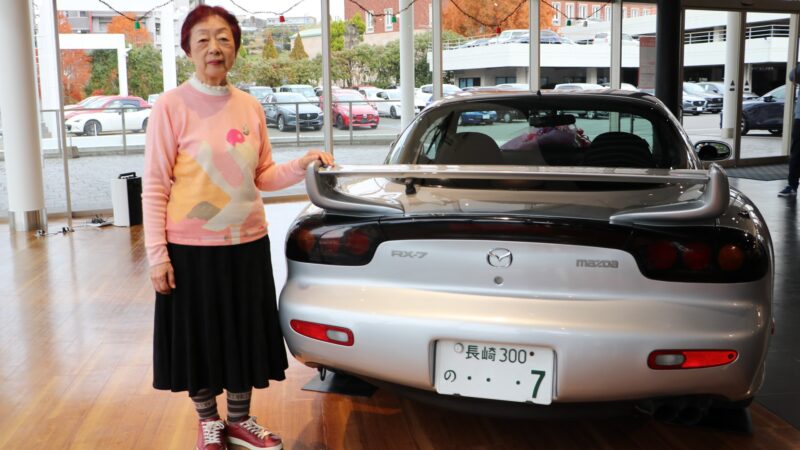
Did you know that this silver Mazda RX-7 was owned and driven for 25 years by an elderly woman, Naoko Nishimoto?

In conjunction with her 80th birthday celebration on December 18, Naoko decided to voluntarily surrender her driver’s license and return her beloved RX-7 to Mazda Japan.

Her intention to sell the RX-7 captured public attention when it was featured on YouTube on September 2024, creating a significant phenomenon.

After her story aired, Naoko received over 400 emails, including one from Mazda’s Public Relations department.

Coincidentally, an engineer at Mazda watched the program and immediately contacted the PR department, stating, “Mazda should take over this (RX-7)!”

When Naoko read the email from Mazda, she remarked, “It was an email filled with enthusiasm and sincerity, and it seemed to shine for me.”

It is understood that the sender of the email also had a strong attachment to the Mazda RX-7.

Naoko’s story of her love for driving the manual RX-7 began when she was 55, at which point her Corona Coupe, owned for nearly a decade, started to have issues.

Coincidentally, she watched the animated series Initial D with her son and fell in love at first sight with the design of the Mazda RX-7 (FD3S).

She then promptly went to the nearest Mazda dealership to place an order, where at that time (1999), the price was around 3.2 million yen (approximately RM91,855).

Initially, Naoko wanted to choose a blue color as shown in the product brochure, but the Mazda salesperson suggested she opt for Highlight Silver Metallic.

“Looking back, I feel relieved that I chose that color,” she stated.

Thanks to the care and maintenance provided by Kyushu Mazda Akasako, Naoko’s RX-7 never experienced major problems during her 25 years of ownership.

The mileage of 77,592 km is evidence of her passion for the unique driving experience of the RX-7, which never made her feel fatigued, even on long journeys.

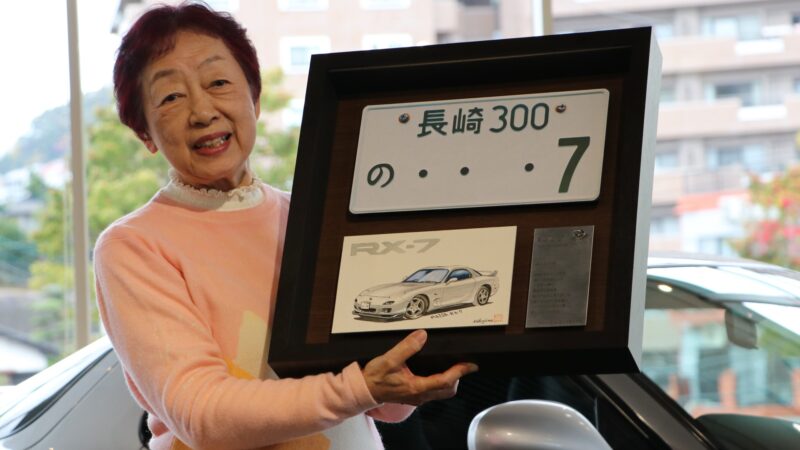
According to Naoko, she particularly loves the design of this sports car’s rear, especially the rear wing and the number seven on the license plate.

During the purchase process, the staff at Kyushu Mazda kindly handled all registration procedures, successfully obtaining the number 7 from the Land Transportation Bureau for the RX-7.

As a result, this became one of Naoko’s favorite features of the car.

Naoko also never found it difficult to drive the manual RX-7 in her hilly neighborhood in Nagasaki.

“When I first bought it, I felt nervous; however, now I have gotten used to it, and it is no longer a problem,” she expressed.

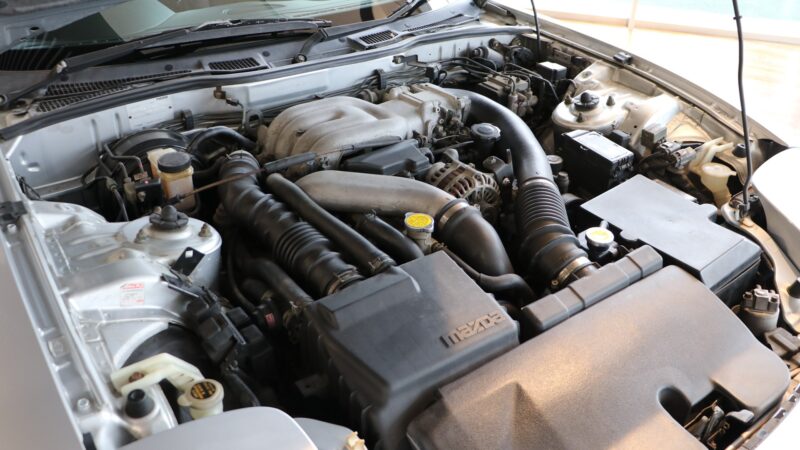
This Mazda RX-7 Type RB S package is powered by a 13B-REW engine with sequential twin turbocharging, capable of generating up to 265 PS and 294 Nm of torque.

Her story also captured the attention of Mazda President and CEO Moro Masahiro, who sent an appreciation letter read by Kosuke Doi, General Manager of Mazda’s Domestic Sales Division.

In the letter, Moro mentioned, “The RX-7 is the first model I was responsible for marketing after joining Mazda, so it holds special memories for me.”

“We will cherish this car, along with the stories of your (Naoko) joyful and vibrant life experiences.”

After the handover event, Naoko then proceeded to the Urakami police station in Nagasaki Prefecture to voluntarily return her driver’s license.

Mazda Japan promised to take excellent care of the RX-7 and plans to transfer the model to the R&D center in Yokohama for use as a public relations vehicle or to be exhibited at official events.

Liberty Walk launches the world’s first JDM mechanical keyboard, limited to just 500 units

Last year at the Tokyo Auto Salon 2023, the renowned Japanese tuning company Liberty Walk unveiled the most controversial wide-body project to be fitted onto the classic supercar, the Ferrari F40.

While some people appreciate the approach taken by Liberty Walk, others have taken to criticizing it.

What is certain, however, is that the wide-body Ferrari F40 project has successfully drawn public attention, especially with its striking white finish and the presence of Japanese flag graphics on the sides.

The spirit of the Ferrari F40 Liberty Walk is continued with the introduction of a new product—a mechanical keyboard in collaboration with Original Konbini.

Described as the world’s first JDM mechanical keyboard, it is limited to only 500 units and will officially launch on December 31.

The keyboard’s frame is constructed from two blocks of aluminum, finished in a faded white color with red accents, Japanese flag graphics, RGB lighting, and features a USB-C wired connection.

Each purchase of this compact keyboard will come bundled with a mouse pad that can be used to showcase personal diecast car collections on your desk.

Liberty Walk has not disclosed the actual retail price of the mechanical keyboard; however, the term “limited edition” is enough to suggest that it will likely make a significant dent in your wallet.


Ferrari F40 Liberty Walk

ETCM extends Early Bird offer for first 1,000 bookings of the Nissan Kicks e-Power

Edaran Tan Chong Motors Sdn Bhd has extended its Early Bird promotion for the all-new Nissan Kicks e-Power, which is now available to the first 1,000 customers.

The Early Bird promotion offers an introductory discount of RM5,000, as well as a ten-year guarantee on EV components or a mileage limit of 160,000 km.

With this rebate, the selling price of the Kicks e-Power starts at RM108,800 for the VL variant, RM116,800 for the VLT variant, and RM120,800 for the two-tone VLT variant.

The Nissan Kicks e-Power was officially launched this month, powered by a second-generation e-Power system that combines a 1.2-liter three-cylinder inline engine, which acts solely as a power generator, with an electric motor and a 2.1 kWh lithium-ion battery.

Overall, the Kicks e-Power is capable of producing up to 129 PS and 280 Nm of torque, promising immediate torque response and smooth acceleration.

On a full tank, the Kicks e-Power can travel up to 900 km, with a fuel consumption figure of approximately 21.7 km/liter.

Nissan Kicks e-Power pricing announced, from RM113,800-RM121,800

Honda develops new generation hybrid engines

Due to a slowdown in global demand for electric vehicles (EVs), Honda has decided to refocus its efforts on the production of hybrid engines.

Recently, Honda has reportedly been developing several new generation e:HEV technologies for use in upcoming electric hybrid vehicles.


1. New 1.5L & 2.0L Engines

Both the new 1.5-liter and 2.0-liter Atkinson cycle engines will be paired with a front-wheel drive unit and integrated cooling system in a more compact package.

Honda aims for the new engine’s fuel consumption to be 10 percent more efficient when combined with a new generation midsize platform currently under development.

By extending the RPM range where the engine operates most efficiently, the new 1.5-liter engine can achieve fuel savings that are 40 percent better compared to the existing 1.5L engine.

Both engines will share the same hybrid components to reduce manufacturing costs.


2. New Mid-size Platform

In addition to the e:HEV system, Honda will also be refreshing its midsize platform for their electric hybrid vehicles.

This modular platform promises high chassis stability, sporty driving dynamics, and an overall weight that is 10 percent lighter compared to existing e:HEV models.

Additionally, Honda aims to develop the lightest platform in its class, reducing weight by 90 kg compared to the existing platform through a new design approach.

Achieving over 60 percent commonality across all midsize models will contribute to more efficient and cost-effective production of various models.


3. Honda S+ Shift

Honda S+ Shift is a new function introduced to enhance the driving pleasure and amplifies the sense of oneness between the driver and the vehicle.

According to Honda, S+ Shift precisely controls engine RPM during acceleration and deceleration to realize direct driving response and accurate gear shifting.

The resulting engine sound will be synchronized with the Active Sound Control (ASC) system, where the sound quality will be enhanced through speakers to further enrich the exciting driving experience.


4. Electric AWD System

Starting with the new generation e:HEV models, Honda will employ an electric all-wheel drive (AWD) system (E-AWD).

Compared to mechanical AWD systems, E-AWD can increase maximum traction and contribute to more powerful initial acceleration performance.

The E-AWD system can also optimize the distribution of front-to-rear driving energy based on tire-ground contact during acceleration, deceleration, and cornering.

Interestingly, the e-AWD system can also be shared with any EV.

With this new technology, Honda is determined to reduce production costs for each electric hybrid model by up to 50 percent for the 2027 model year, compared to similar models launched in 2018.

ECRL EMU train design unveiled, featuring blue and white theme, comes with batik patterns

Malaysia Rail Link Sdn Bhd, the operator of the East Coast Rail Link (ECRL) project, yesterday (18th December) unveiled the design of the EMU (Electric Multiple Unit) trains that will connect Port Klang to the East Coast.

These EMU trains, manufactured by China Railway Rolling Stock Corp (CRRC) Dalian, feature six carriages with a passenger capacity of 430 people at any given time.

The trains also include facilities for passengers with disabilities, a prayer room, and designated areas for ablution.

In terms of external design, the EMU trains showcase a two-tone theme of white and blue, complete with a wau motif that is closely associated with the East Coast states.

According to Anthony Loke, a total of 11 six-car EMU trains have been allocated for operations, with the first set expected to arrive by the end of 2025.

In addition to the EMU trains, the ECRL project will also acquire 12 sets of E-Loco units from CRRC Dalian for cargo transport, with the first set also slated to arrive in Malaysia by the end of next year.

The ECRL project, which is set to commence operations in 2027, will feature 20 stations, comprising 14 passenger stations, 5 combined stations, and one freight station.

DRB-Hicom, Geely sign two MOUs with MIDA, MARii to make AHTV a global NxGV hub

DRB-HICOM Berhad and Zhejiang Geely Holding Group have signed two agreements to develop the Automotive Hi-Tech Valley (AHTV) in Tanjong Malim, Perak, into a global hub for Next Generation Vehicles (NxGV) and Energy Efficient Vehicles (EEV).

The first agreement signed with the Malaysian Investment Development Authority (MIDA), will focus on cooperation to attract investments specifically for the development of AHTV, with the aim of fostering growth, capabilities, and competitiveness in the national automotive industry.

The key focus of this cooperation is to encourage the transformation of the local automotive industry and Industry 4.0 to help Malaysia become a leading country for EEVs in ASEAN.

It also aims to transform AHTV into a global automotive hub, focusing on the production of NxGVs, smart manufacturing of high-tech automotive components, and an export base for a comprehensive global supply chain for vehicles and spare parts.

The second agreement made with the Malaysia Automotive, Robotics and IoT Institute (MARii), will concentrate on collaboration in research and development (R&D) and talent development for AHTV.

The scope of cooperation includes building testing and R&D centers for NxGVs, as well as establishing a National Testing and Homologation Centre specifically for EEV testing and autonomous driving.

Additionally, the parties involved have agreed to develop local expertise in critical components such as electric motors, battery management systems, and power distribution units with assistance from Geely Holding.

In the area of talent development, the collaboration will also include developing training programs focusing on NxGV and smart manufacturing, R&D, smart equipment, and production and marketing services supported by partnerships with institutions in China and Malaysia.

This includes establishing national standards for automotive SKM and TVET certification, implementing an automotive apprenticeship program, creating educational modules for high school through university levels, and conducting certification programs for digitalization and Industry 4.0 skills in manufacturing and supply chains.

Toyota Hilux Champ SUV to be sold in Indonesia, estimated starting price below RM111k

The Toyota Hilux Champ is a budget version of the truck produced by Toyota as a more affordable alternative to the mid-size Hilux pickup.

In addition to serving as a workhorse, the Hilux Champ also has the potential to function as a passenger vehicle — providing an alternative to the Toyota Fortuner.

In Indonesia, the Hilux Rangga (another name for the Hilux Champ) will be officially offered by Toyota Astra Motor in an SUV version, featuring a three-row, seven-seat configuration.

The construction of the body for this new SUV will be handled by New Armada.

It can be said that the front section of this SUV still retains the original design of the Hilux Rangga; however, everything changes from the B-pillar backward.

Angular design elements dominate the sides and rear of the Hilux Rangga SUV, and if you notice, the roof structure is higher compared to the Hilux Rangga pickup version.

At the rear, the word “RANGGA” appears on the tailgate, accompanied by more basic-design rear lights.

The interior of the Rangga SUV features a 2+3+2 seating arrangement upholstered in leather-like material.

Due to the presence of a third-row seat, the cargo space is somewhat limited, even though the overall size is larger than the pickup version.

The Rangga SUV model is set to go on sale in Indonesia next year, with an estimated starting price below Rp 400,000,000 (approximately RM 111,000).

For comparison, the cheapest Hilux Rangga pickup carries a price tag of Rp 188,700,000 (approximately RM 53,000), while the larger Toyota Fortuner is priced from Rp 573,700,000 (approximately RM 160,000).


2026 Honda Prelude: more than just a Civic coupe

Honda has previously confirmed that the upcoming concept model Prelude will be built using the existing Civic platform.

Now, there is good news coming from Japan, where a group of Japanese media representatives were given the opportunity to test a pre-production prototype unit on a test circuit.

This test drive session revealed several interesting details to share with readers, especially for those who got a closer look at the model during the KLIMS 2024 event held last few weeks.

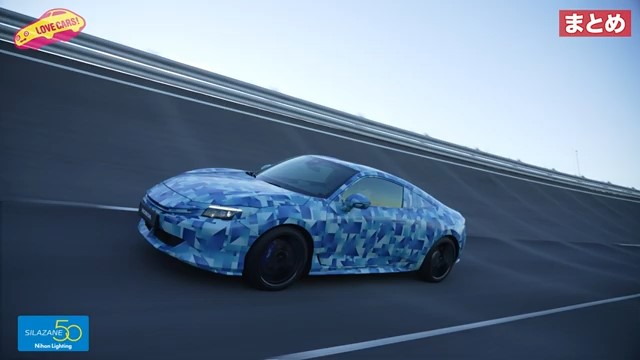
The prototype model, still heavily camouflaged, showed few significant differences, apart from the presence of ADAS sensors and more practical-sized side mirrors.

Here are the new features expected to appear on the Honda Prelude 2026:


1. New generation hybrid system

Interestingly, the Honda Prelude will be the first model equipped with a new generation dual-motor hybrid system.

No further details have been announced at this time, but Honda claims that this new setup promises a 10 percent efficiency improvement over the existing e:HEV system without compromising power.

It is highly likely that the Prelude will feature an all-new 2.0-liter Atkinson cycle engine paired with a new, more compact, and efficient electric drive unit.

Typical for a hybrid car, you can expect the Prelude to come with a simpler e-CVT transmission, but it will also include a new feature dubbed S+ Shift.


2. Honda S+ Shift system

source: LOVECARS!TV! YouTube

Set to be included in all future e:HEV Honda models, the S+ Shift system promises a more dynamic and exciting driving experience.

By pressing a special button, it will simulate gear shifting through small vibrations when downshifting, thanks to altered torque mapping in the electric drive unit.

The Active Sound Control feature will enhance the sporty engine sound through audio feedback provided by the speaker unit, synchronized with the RPM display on the digital cluster.

The Honda Prelude 2026 is also equipped with paddle shifters, allowing drivers to experience simulated gear changes in a hybrid vehicle.


3. Civic platform

source: LOVECARS!TV! YouTube

As previously announced, the Honda Prelude will utilize the existing Civic platform but with a stiffer chassis, improved steering stability, and, most importantly, 10 percent less weight.

Unlike the Civic, the Prelude has a shorter wheelbase but a wider track width.

The suspension system has also been recalibrated for a sportier and more comfortable ride akin to a GT.

The YouTube channel Ride Now reports that the Prelude will feature an adaptive suspension system and a dual-axis steering system from the Civic Type R, designed to reduce torque steer effects.


4. Interior space

source: LOVECARS!TV! YouTube

Stepping inside the cabin, you will notice a dashboard layout that closely resembles that of the current Civic model, but it has been refined with a taller center console design, featuring new control buttons for gear shifting, as well as the S+ Shift button.

For the driver and front passenger, the Prelude offers sporty bucket seats, complete with contrasting white and blue stitching.

The coupe design with a lower roofline and shorter wheelbase makes the headroom and legroom in the Prelude seem smaller and more cramped compared to the Honda Civic, especially for rear passengers.


5. What do Japanese media say?

Overall, the feedback received from the test drive session conducted in Japan is quite positive.

Some claimed that the Prelude promises a sportier drive compared to the Civic (hopefully not just the Civic Type R), while remaining smooth and comfortable like a GT.

One test driver mentioned that the steering and adaptive suspension setup of the Prelude reminded him of the Civic Type R.

Another media outlet revealed that the Prelude offers smooth and linear stopping power, thanks to Brembo brake systems behind the 19-inch black rims and Continental Premium Contact 6 tires.

This all-new Honda Prelude is set to be launched in 2025 and will serve as a replacement for the discontinued Civic and Accord coupe models.

We expect the Prelude 2026 to make its official debut at the 2025 Tokyo Auto Salon, scheduled for January 10-12 next year.

EPMB celebrates 1,000th production milestone, plans to assemble GWM, BAIC models next year

EP Manufacturing Berhad (EPMB) recently celebrated an important milestone with the production of its 1,000th vehicle at the Pegoh assembly plant in Melaka.

According to Mr. Hamidon Abdullah, the Executive Chairman of EPMB, “Today marks the beginning of a new era for EPMB. Reflecting on the challenges during the COVID-19 pandemic, we remained resilient and are now building a solid foundation for the future.

“The first phase of the vehicle assembly plant in Pegoh, Melaka, is a testament to our vision. Our collaboration with GWM has achieved significant success, and this momentum will continue as we prepare to assemble additional GWM models.

“We expect the capacity of Phase 1 to be fully utilized by the end of 2025. For Phase 2, production capacity will be enhanced by an additional 30,000 units per year, while Phase 3 will focus on vehicle body manufacturing and painting processes.”

It is understood that EPMB plans to assemble several GWM models, including the Jolion HEV (Q2 2025) and Wey 80 (Q4 2025), as well as two BAIC models, the Beijing X55 and BJ40 (Q1 2025).

The plant, located in Alor Gajah, has an annual production capacity of 15,000 units and a workforce of 160 employees.

EPMB is also prioritizing the localization of vehicle components to strengthen the local automotive industry.

Through facilities in Kulim, Tanjung Malim, Batang Kali, Shah Alam, and Melaka, EPMB has begun the localization of essential components for GWM vehicles, including seats, steering column frames, rear axles, suspension systems, brakes, instrument panels, center consoles, and door trim panels.

Proton e.MAS 7 achieves five-star score in ASEAN NCAP

Coinciding with the official launch of the Proton e.MAS 7 electric SUV in the Malaysian market, the ASEAN NCAP organization also announced the score achieved by this SUV in the new vehicle assessment tests that were conducted.

Overall, the e.MAS 7 successfully earned a five-star score with a total of 92.57 points.

As Proton’s first electric vehicle, it was evaluated based on the following four categories:

  • Adult Occupant Protection (AOP) – 39.00/40.00
  • Child Occupant Protection (COP) – 17.32/20.00
  • Safety Assistance (SA) – 20.00/20.00
  • Motorcycle Safety (MS) – 16.25/20.00

Standard features of the e.MAS 7 include six airbags, Electronic Stability Control (ESC), Anti-lock Braking System (ABS), and Seat Belt Reminder (SBR).

Advanced safety features included are city and inter-urban Autonomous Emergency Braking (AEB), Blind Spot Detection (BSD), High Beam Assist (HBA), Forward Collision Warning (FCW), Lane Keeping Assistance (LKA), Lane Departure Warning (LDW), Rear Cross Traffic Alert (RCTA), and Rear Cross Traffic Braking (RCTB).

The Proton e.MAS 7 is equipped with a single electric motor that produces 218 PS/320 Nm, paired with two options for LFP battery packs: 49.52 kWh (with a range of 345 km) or 60.22 kWh (with a range of 410 km).

The selling price of the e.MAS 7 starts at RM105,800 for a limited time.

2025 Proton e.MAS 7 – 2 variants, range up to 410 km, starting at RM105,800

2025 Proton e.MAS 7 – 2 variants, range up to 410 km, starting at RM105,800

After several rounds of previews including test drives, Proton through its Pro-Net division has officially launched the first electric SUV, the e.MAS 7, for the local market.

Here are seven key facts you should know:


1. Dimensions

The Proton e.MAS 7 is an electric SUV in the C-segment, measuring 4,615 mm in length, 1,901 mm in width, 1,670 mm in height, and with a wheelbase of 2,750 mm.

Its turning radius is a compact 5.4 meters.

Standard features include a MacPherson strut setup at the front, complemented by a multilink configuration at the rear.


2. Power

The e.MAS 7 is powered by a single electric motor delivering 215 hp and 320 Nm of torque.

It can accelerate from 0 to 100 km/h in just 6.9 seconds, reaching a top speed of 175 km/h.


3. Two Battery Pack Options

For the local market, the Proton e.MAS 7 is available in two variants: Prime and Premium.

The Prime variant comes equipped with an LFP battery pack of 49.52 kWh, allowing a range of 345 km on a full charge (WLTP data), while the Premium variant features a 60.22 kWh battery pack with a range of 410 km.

This short blade Aegis battery supports AC charging at 11 kW and DC fast charging at 100 kW (80 kW for the smaller capacity battery), enabling the battery to be charged from 30% to 80% in just 20 minutes.


4. Exterior Features

Proton has made few changes to differentiate the e.MAS 7 from its donor model, the Geely Galaxy E5.

Standard exterior features of this electric SUV include LED headlights and taillights, 18-inch alloy wheels with 225/55 R18 tires, roof rails, and adjustable side mirrors with a heating function.

The Premium variant adds features such as a panoramic glass roof, powered tailgate, and Active Grille Shutter functionality.


5. Cabin Space

Similar to the exterior, the interior equipment closely resembles that of the Geely model.

Inside, you will find features such as a 10.2-inch digital cluster display, a central 15.4-inch screen without Apple CarPlay or Android Auto support, a Flyme OS system, and a head-up display.

Additionally, the e.MAS 7 offers a six-way adjustable driver’s seat (four-way for the front passenger), ventilation functions, leatherette upholstery, ambient lighting with 256 color options, and several USB charging ports.

In the rear, the e.MAS 7 provides cargo space of 461 liters, which expands to 1,877 liters with the second-row seats folded down.

There is also 14 liters of storage space under the seats and a 10.8-liter center console drawer.


6. ADAS

For the first time, Proton offers Level 2 Advanced Driver Assistance Systems (ADAS) as standard across all e.MAS 7 variants.

This includes essential features such as an Automatic Emergency Braking (AEB) system, Forward Collision Warning (FCW), Lane Departure Warning (LDW), Lane Keeping Assist (LKA), Rear Cross Traffic Alert (RCTA), Lane Change Assist (LCA), and Adaptive Cruise Control (ACC).

Additionally, the e.MAS 7 comes equipped with six airbags, an auto hold function, front and rear radar, and a 360-degree camera system.


7. Pricing

The retail prices for the Proton e.MAS 7 are as follows:

  • e.MAS 7 Prime – RM109,800
  • e.MAS 7 Premium – RM123,800

For the first 3,000 customers, Proton is offering a rebate promotion worth RM4,000, bringing the starting price down to RM105,800 for the Prime variant, and up to RM119,800 for the Premium variant.

Here are the packages that buyers of the Proton e.MAS 7 will receive:

  • A 7kW home charging unit (valued at RM1,500)
  • V2L adapter (valued at RM500)
  • Financing package with interest rates starting as low as 1.98% (valued at RM3,000)
  • Unlimited internet data package for five years (valued at RM1,800)
  • RM1,200 rebate for existing Proton owners
  • Vehicle warranty of six years with no mileage limit, and a warranty for the high-voltage battery components of up to eight years or 160,000 km.

Renault 5 Turbo 3E – electric hot hatch with 500 hp!

Three years after the concept model was introduced, Renault has finally unveiled the actual production version of the R5 Turbo 3E, which will be available for purchase by the public.

Built on a bespoke carbon fiber monocoque platform, the R5 Turbo 3E is a hot hatch that does not feature a turbocharger, following in the footsteps of the Porsche Taycan.

Instead, it is powered by two electric motors positioned on the rear axle, producing an impressive 500 hp!

With its lightweight platform and powerful electric motors, the R5 Turbo 3E promises acceleration from 0 to 100 km/h in under 3.5 seconds.

In terms of exterior design, the R5 Turbo 3E incorporates elements inspired by the classic R5 Turbo I and II rally cars from the 1980s, featuring angular wide fender flares and a more aggressive rear bumper.

The LED headlights present a more streamlined appearance, reminiscent of the classic R5 lights but modernized, while the LED taillights are borrowed from the R5 E-Tech model.

The R5 Turbo 3E is expected to enter production in 2026, likely in very limited quantities, with a selling price expected to exceed £100,000 (RM563,000).

Ford Escort Mk1 RS has been reborn with 296 hp, limited to only 150 units

Ford has finally given the green light to Boreham Motorworks to reproduce the iconic classic Ford Escort Mk1 RS model.

Although it is built using the original 1970s blueprints, Boreham has injected several modern elements into this model.

Only 150 units of the Escort RS will be produced, and buyers will be given two engine options.

The most powerful version features a naturally aspirated 2.1-liter inline-four engine paired with a five-speed dogleg gearbox, producing an impressive 296 hp and capable of reaching engine speeds of 10,000 rpm.

This new engine showcases components such as steel connecting rods, a billet crankshaft, a fuel injection system, and a custom titanium exhaust.

Those seeking a more ‘authentic’ package can opt for the base version, which comes with an upgraded Twin-Cam 1,845 cc engine featuring a new fuel injection system.

With power reaching 182 hp, this is transmitted to the rear wheels via a four-speed straight-cut manual transmission.

In terms of exterior design, the Escort RS retains the spirit of the original model, but is enhanced with modern elements such as LED headlights, wider wheel arches, and custom 15-inch four-spoke rims.

According to Boreham, the car has a weight distribution ratio of 55:45, a coil spring suspension system, a limited-slip differential at the rear, and a floating-style aluminum and titanium rear axle.

The braking system consists of four-piston calipers and 260 mm rotors at the front, followed by two-piston calipers and 264 mm rotors at the rear.

The cabin space is quite basic, as it is free from the presence of a large screen.

Instead, it features a carbon fiber dashboard complete with analog gauges, air conditioning, and a very simple audio system.

Additionally, there is a three-spoke Alcantara steering wheel, bucket seats, as well as options for installing a roll cage and a four-point harness system, plus storage space for racing helmets.

As mentioned earlier, only 150 units of the Escort MK1 RS will be produced, each carrying a price tag starting from £295,000 (approximately RM1.66 million) with a two-year warranty or a limit of 20,000 miles.

R32 Nissan Skyline GT-R EV to be displayed at 2025 TAS

With just a few weeks left until the Tokyo Auto Salon 2025 opens its doors, Nissan is set to unveil something special.

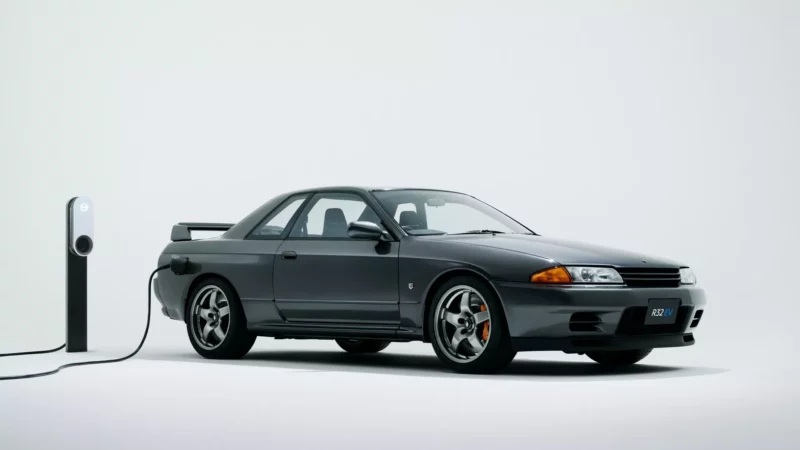
It isn’t a new generation GT-R; rather, it is a Nissan Skyline GT-R R32 without the iconic RB26DETT inline-six engine.

More precisely, it is an R32 EV!

This project actually began back in March 2023, when the legendary RB26 engine – highly regarded among JDM enthusiasts – was retired to make way for a full-time electric power unit.

At this time, Nissan has not yet disclosed details about the modifications made to this iconic model.

In terms of outward appearance, it is quite difficult to detect any changes, except for the removal of the fog lights and the absence of exhaust pipes at the rear.

What do you think about Nissan’s R32 GT-R EV project?

Zontes ZT 703 RR, 110 hp sportsbike, set to arrive in Malaysia next year

In addition to the adventure tourer 703 F Adventure, Zontes Malaysia is set to introduce another model with a three-cylinder engine: the ZT 703 RR sportsbike.

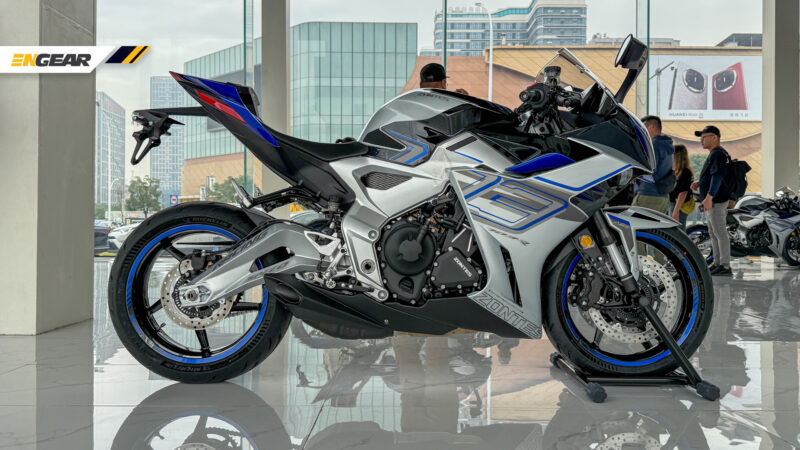
Unlike the 703 F, the Zontes 703 RR features a three-cylinder engine with a different power tuning, capable of producing up to 110 hp, albeit with slightly lower torque at 75 Nm.

The 703 RR uses an aluminum frame and swingarm, complemented by a suspension system that includes Marzocchi upside front forks and a single shock absorber, along with J.Juan brake systems.

We have also received information that owners will be given the option for Brembo brake systems.

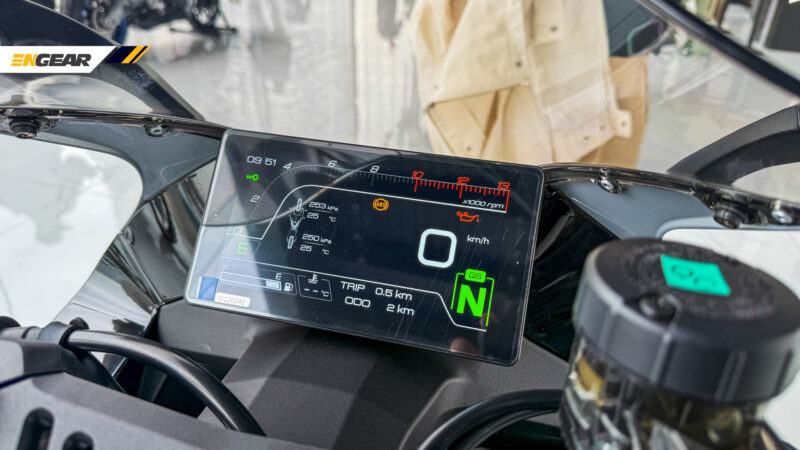
Other features include LED daytime running lights (DRL), footpegs positioned for aggressive riding, a digital TFT display, an aggressive front fairing, and winglet structures at the front.

As of now, Zontes Malaysia has yet to reveal the launch date and pricing for the 703 RR sportsbike model.

However, it is certain that the arrival of the 703 RR will provide strong competition to models such as the Aprilia RS 660, Honda CBR650R, and Triumph Daytona 660.

Zontes ZT 703 F Adventure, to be launched mid-2025

Another motorcycle model set to be launched by Zontes Malaysia next year is the ZT 703 F Adventure adventure tourer.

According to the specifications, the ZT 703 F Adventure is powered by a 700 cc inline three-cylinder engine that can produce a maximum power of 97 hp at 10,000 rpm and a torque of 76 Nm at 7,500 rpm.

This power is transmitted to the rear wheel via a six-speed manual transmission with a quickshifter assist.

The bike features an aluminum frame construction, including the swingarm, supported by a suspension system consisting of upside-down (USD) front forks and a single rear shock absorber, both from Marzocchi.

The braking system utilizes J.Juan components with dual disc rotors at the front, a single disc rotor at the rear, and a two-channel ABS for added safety.

It comes equipped with 21-inch front and 18-inch rear spoked wheels.

Other features include a 22-liter fuel tank, electronically adjustable windscreen, seat height of approximately 845 mm, heated handlebar grips, a 6.75-inch TFT display, USB charging port, and a keyless ignition system.

In addition to electronic features like traction control, the 703 F Adventure also includes a blind-spot warning system that employs radar sensors at the rear.

More details, including the retail price, will be announced ahead of its official launch next year.