When talking about electric vehicles (EVs), there are three acronyms that you are likely to encounter: WLTP, NEDC, and CLTC.
What do these three acronyms mean?
For your information, these acronyms refer to testing standards used to calculate the range of EVs.
What are the differences between WLTP, NEDC, and CLTC? Let’s break it down one by one.
WLTP (Worldwide Harmonised Light Vehicle Test Procedure)
The WLTP system was introduced in 2017 to replace the NEDC testing method. It implemented new procedures designed to test vehicles under more realistic conditions, resulting in outcomes that are closer to real-world driving.
WLTP takes into account several factors, including varying driving speeds, acceleration rates, and temperature. One of the main differences between WLTP and NEDC is that WLTP involves a longer driving cycle, a wider speed range (47-132 km/h), and the use of electronics such as air conditioning, radios, and so on.
This makes WLTP more accurate compared to NEDC, which tends to overestimate the range by 25% to 30%.
NEDC (New European Driving Cycle)
The NEDC was introduced in the early 1980s, with its last update occurring in 1997. Indeed, this testing method is outdated and considered obsolete. It is also regarded as inaccurate, as data is collected under ideal laboratory conditions.
It comprises two parts. The first part, lasting 13 minutes, simulates stop-and-go driving in urban areas. The second part involves extra-urban driving at a maximum speed of 120 km/h.
Due to the fact that NEDC tests are conducted at lower speeds and do not factor in elements such as air conditioning and uphill driving, many users find that the NEDC range is higher than what they experience in real-world situations.
CLTC (China Light-Duty Vehicle Test Cycle)
The CLTC was developed by the China Automotive Technology and Research Centre (CATARC) to replace European testing procedures. It is designed based on driving habits in China and the country’s conditions, and it often yields a more optimistic range.
It consists of three phases of testing: slow, moderate, and fast driving. The testing process lasts for 30 minutes, covering a total distance of 14.5 km.
There are several differences between WLTP and CLTC. One notable distinction is that the duration of driving in the CLTC test is reportedly twice as long as in WLTP. Furthermore, the CLTC test cycle includes more stops, while its maximum speed is also lower, at 114 km/h.
Neta Auto and KCM Group recently launched Neta’s first flagship store in Malaysia, located in Ampang.
The state-of-the-art showroom is part of Neta’s mission to make smart electric vehicles more accessible while elevating the entire car-buying experience.
Located in the heart of Kuala Lumpur’s embassy district, the 2,322 square metre showroom features a minimalist aesthetic with glass curtain walls and finishes in tech-inspired grays and Nordic wood tones.
In addition to the vehicle display area featuring the latest Neta models, the new facility also includes a variety of other amenities, such as a merchandise area, a coffee lounge, and dedicated after-sales services.
According to Neta Auto, the opening of the Ampang flagship showroom marks a milestone in its expansion strategy for the Malaysian market.
The company aims to establish 20 dealerships by the end of this year, reaching key areas such as Kuala Lumpur, Selangor, Johor, Penang, and East Malaysia.
In addition, Neta is upgrading its existing dealerships to 3S facilities to enhance the customer experience across both sales and service channels.
“Each new location represents a vital step in achieving our goal: to make intelligent mobility accessible to everyone,” said Zhou Jiang, Vice President of Neta Auto.
Coinciding with the showroom launch, Neta Auto also held a ceremony for the delivery of the first 50 units of the Neta X to customers in Malaysia.
Launched last July, the Neta X is available in three variants: 400 Comfort (RM119,888), 400 Luxury (RM127,888), and 500 Luxury (RM135,888).
The 400 variants come with a 52 kWh battery providing a driving range of up to 323 km, while the 500 variant, equipped with a 62 kWh battery, can travel up to 410 km on a full charge.
Customers choosing the Neta X will receive a complimentary Neta Wallbox charger or one year of free charging credit from chargeEV.
Additionally, it also comes with a free service package for two years or 40,000 km. This special promotion is valid until 31 October 2024.
Mazda has announced the sale price for the EZ-6 sedan model, designed as the spiritual successor to the Mazda6 for the Chinese market.
The EZ-6 sedan is essentially a badge-engineered version of the Deepal SL03 model produced by Changan Automobile.
There, buyers can acquire an electric sedan powered by a single rear-wheel-drive electric motor delivering 255 hp and 320 Nm of torque, paired with two battery capacity options.
The base version comes with a 56.1 kWh lithium iron phosphate battery pack, offering a range of 480 km, while the 68.8 kWh battery pack allows for a range of over 600 km on a full charge.
There is also a range-extender version, where the Mazda EZ-6 range extender comes equipped with a 215 hp and 320 Nm electric motor supported by a 1.5-liter engine producing 94 hp to charge the battery pack.
Two battery capacity options are available for the range-extender version: 18.9 kWh or 28.4 kWh, with the smaller version enabling a zero-emission range of 105 km, while the larger unit increases the range to 160 km.
Most notably, thanks to the additional engine, the overall range of the EZ-6 range extender sedan can reach up to 1,300 km!
In terms of dimensions, the Mazda EZ-6 measures 4,921 mm in length with a wheelbase of approximately 2,895 mm, making it longer than its competitor, the Toyota Camry.
Other features include a 10.1-inch digital cluster screen, a 14.6-inch central screen, leather or Nappa leather upholstery, dual-zone automatic climate control, wireless device charging, a 64-color ambient lighting system, and a premium Sony audio system with 14 speakers.
The sale price starts at 139,800 yuan (RM85,531) for the range-extender variant, while the pure EV version starts at 159,800 yuan (RM97,768)
Pro-Net has finally revealed the details and specifications for the first national electric vehicle, the Proton e.MAS 7.
We know that the e.MAS 7 is developed using the Global Modular Architecture (GMA) platform and measures 4,615 mm in length, 1,901 mm in width, 1,670 mm in height, and has a wheelbase of 2,750 mm.
Recent testing results indicate that the e.MAS 7 can traverse water up to a depth of 400 mm, which is higher than the Geely Galaxy E5.
Now, Pro-Net has confirmed that there will be two variants of the e.MAS 7 available: Prime and Premium. Both are equipped with the same electric motor but differ slightly in battery capacity and features.
The e.MAS 7 is powered by a “12-in-1” electric motor on the front axle, producing 218 PS (160 kW) and 320 Nm of torque, enabling it to accelerate from 0 to 100 km/h in 6.9 seconds and achieve a top speed of 175 km/h.
As previously reported, the e.MAS 7 features an Aegis short blade battery, claimed to have higher energy density, greater safety, and longer lifespan.
The Prime variant comes with a 49.52 kWh version of said battery, offering a range of 345 km, while the Premium model is equipped with a 60.22 kWh version, reaching a distance of up to 410 km. Both figures are according to WLTP standards.
For charging, the e.MAS 7 supports DC fast charging of up to 80 kW for Prime and 100 kW for Premium—both requiring 20 minutes to charge from 30% to 80%.
There is also an onboard AC charger capable of up to 11 kW that can recharge the battery from 30% to 80% in 4.9 hours for Prime and 6.1 hours for Premium.
The equipment list for both variants is largely similar. The e.MAS 7 comes standard with LED headlights featuring Follow-me Home and Active High Beam Control, roof rails, power windows with anti-trap, rain sensors, electrically adjustable and heated side mirrors.
Wheel sizes differ, with the Prime variant featuring 18-inch wheels fitted with 225/55 Giti tyres, while the Premium comes with 19-inch wheels and 235/50 Goodyear tyres. Additionally, a panoramic roof, powered tailgate, and Active Grille Shutter are exclusive to the Premium variant.
Inside, both variants are fitted as standard with a 10.2-inch LCD instrument cluster, multifunction steering wheel, leatherette upholstery, and six-way power adjustment for the driver’s seat.
The Premium variant gains several additional features such as an auto-dimming rear-view mirror, memory function for the driver’s seat, four-way power adjustment for the front passenger seat, ventilation for the front seats, and 256-colour ambient lighting.
Convenience features include Intelligent Keyless Entry and Start, Walk Away Auto Lock, wireless charging, automatic climate control with N95 filtration, and Vehicle-to-Load (V2L) capabilities.
Infotainment-wise, the e.MAS 7 comes standard with the Flyme Auto system alongside a 15.4-inch touchscreen with 2.5K resolution; however, only the Premium variant receives a head-up display (HUD) and Wanos audio system with 16 speakers.
In terms of safety, ADAS is equipped as standard on the e.MAS 7. It includes the following features:
Intelligent Cruise Control (ICC)
Adaptive Cruise Control (ACC)
Automatic Emergency Braking (AEB)
Forward Collision Warning (FCW)
Dynamic Brake Support (DBS)
Lane Departure Warning (LDW)
Lane Departure Prevention (LDP)
Emergency Lane Keeping Assist (ELKA)
Rear Collision Warning (RCB)
Rear Cross Traffic Alert (RCTA)
Rear Cross Traffic Braking (RCTB)
Lane Change Assist (LCA)
Blind Spot Detection (BSD)
Door Open Warning (DOW)
Traffic Sign Identification (TSI)
Both variants also include a 360-degree camera and rear radar, with the front radar available exclusively on the Premium variant.
The Proton e.MAS 7 is expected to launch in Q4 this year. It is now open for booking with an estimated price of RM120,000.
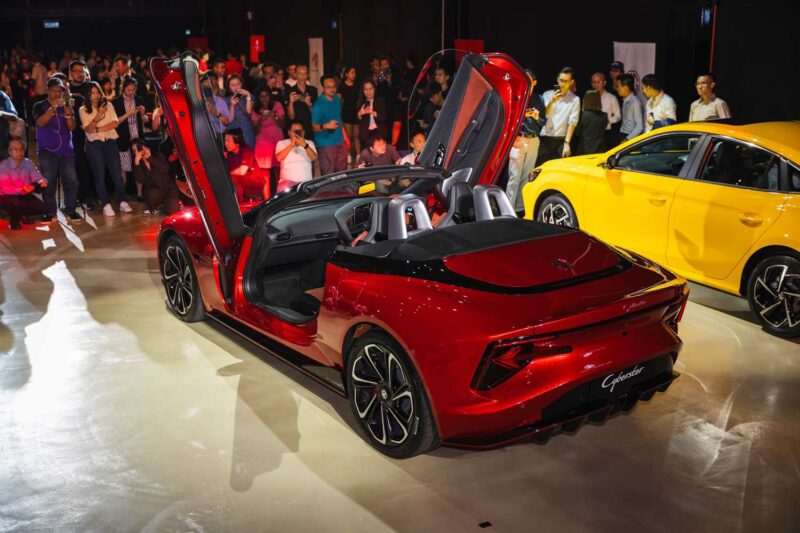
SAIC Motor Malaysia has announced that bookings are now open for the MG Cyberster, with its estimated price expected to be below RM350,000.
The Cyberster is available in one variant, featuring a dual motor, all-wheel-drive (AWD) setup boasting a total output of 503 PS (375 kW) and 725 Nm of torque. This allows the all-electric roadster to accelerate from 0 to 100 km/h in just 3.2 seconds.
Equipped with a 77 kWh battery, the Cyberster offers a driving range of 446 km on a full charge based on the WLTP testing standard.
Charging from 10% to 80% takes 38 minutes via a 150 kW DC fast charger. An AC charger of 7 kW, on the other hand, requires approximately 10.5 hours to charge from 10% to full.
Design-wise, the Cyberster features a broad, low-profile silhouette with a retractable soft top. Equipment includes 20-inch Jetstream alloy wheels, red brake calipers, and automatic LED headlights with daytime running lights (DRL).
Inside, there are sporty seats adorned with Alcantara inserts, a Nappa leather-wrapped steering wheel, a seven-inch central touchscreen, a 10.25-inch instrument panel, two seven-inch auxiliary screens, and an 8-speaker Bose audio system.
For safety, the Cyberster comes equipped with ADAS under the MG Pilot brand, which includes the following features:
Front Collision Warning (FCW)
Automatic Emergency Braking (AEB) with Pedestrian and Bicycle Detection
Adaptive Cruise Control (ACC)
Traffic Jam Assistance (TJA)
Lane Departure Warning (LDW)
Lane Keeping Assistance (LKA)
Blind Spot Detection (BSD)
Lane Change Assist (LCA)
Rear Cross Traffic Alert (RCTA)
Intelligent High Beam Assist
The Cyberster is available in four colours, namely Dynamic Red, Camden Grey, Inca Yellow, and English White. Dynamic Red and Camden Grey feature black and red interiors, while Inca Yellow and English White come with grey interiors. All colour options are complemented by a black roof.
Minister of Investment, Trade and Industry Tengku Datuk Seri Zafrul Abdul Aziz said that MITI will assist in producing Malaysia’s first electric vehicle (EV) priced below RM100,000.
Tengku Zafrul further remarked that the ministry is confident Perodua will achieve this target by the end of 2025.
“The reason why we want to assist and facilitate Perodua is because we want to make EVs affordable.
“Perodua has been in discussion with MITI, and we are optimistic with its plan of achieving its target by the end of 2025,” he said.
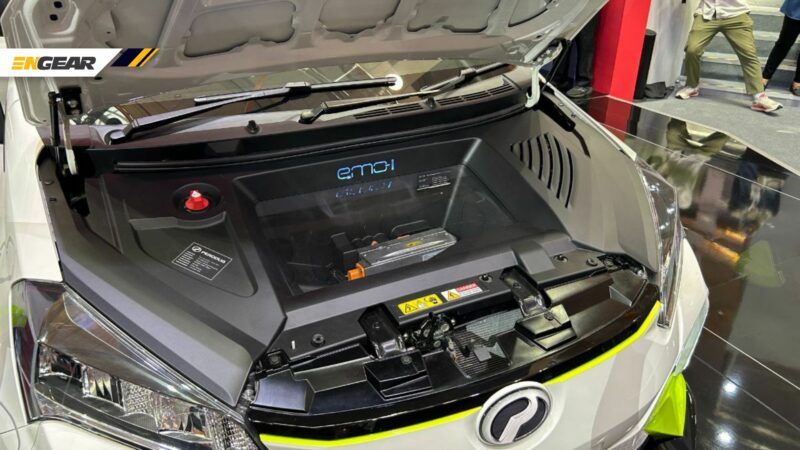
Details regarding Perodua’s EV have yet to be announced. However, the emo-1 (Electric Motion Online) prototype showcased in May offers some hints at the specifications of the finished product.
The prototype, built on the Myvi platform, is equipped with a 55.7 kWh battery pack, allowing for a driving range of up to 350 km. It features a front-wheel drive electric motor with an output of 161 hp and 220 Nm of torque.
Tengku Zafrul also said that as of September 2024, nearly 16,000 battery electric vehicles (BEVs) had been registered in Malaysia, surpassing the approximately 13,000 units registered in 2023.
“This positive momentum brings us closer to our target of achieving 20 per cent EVs of total industry sales by 2030,” he stated.
On charging infrastructure, he mentioned that in just three months, 565 new chargers have been added, bringing the total number of public charging stations to nearly 3,200 by the end of September.
“We aim to have 10,000 public chargers, reducing the ratio of chargers to EVs to one-to-nine (1:9) by the end of 2025” he added.
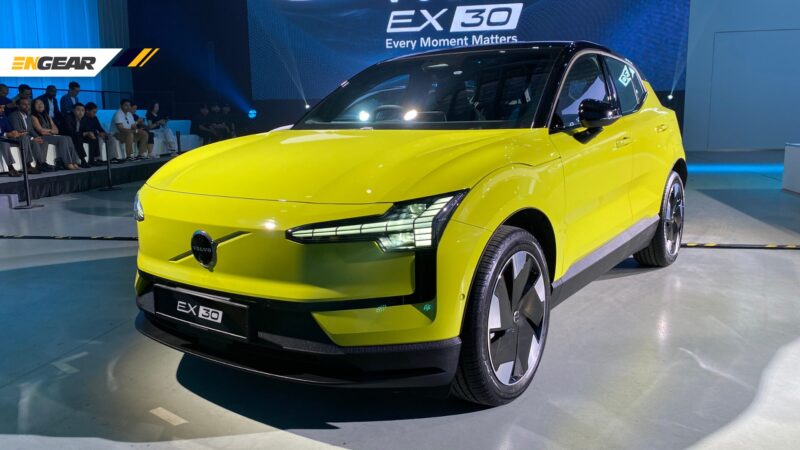
Launched in Malaysia last September, the Volvo EX30 is, without a doubt, an exciting electric vehicle. Firstly, it is a small car (it’s the smallest Volvo to date) and this makes it perfectly suited for urban driving.
Secondly, with its pixelated Thor hammer lights, short front and rear overhangs, and wide stance complemented by large wheels, the EX30 presents a modern and sporty appeal that is sure to attract younger buyers.
Thirdly, if you opt for the top variant, the Ultra Twin Performance, you can outperform most modern sports cars and supercars in 0-100 km/h acceleration without breaking a sweat. The EX30 achieves this impressive feat in just 3.6 seconds but first, you’ll need to activate the Performance AWD mode buried somewhere in the infotainment system.
However, there are still three aspects of the EX30 that the writer finds less than ideal. Let’s take a look at them:
Overreliance on the screen
Similar to other Volvo models, the EX30’s cabin design emphasises a minimalist concept. However, unlike the C40, XC90, and several other Volvo models that still feature physical buttons for audio controls and gear levers, the EX30 has no physical buttons apart from two power window switches on the center console.
This means that control for the infotainment system and climate control must be done through the touchscreen. While this isn’t unusual for an EV, as many other manufacturers follow suit, with the EX30, users may find it awkward since they also have to use the touchscreen to adjust the side mirrors and open the glove box.
Lack of head-up display
Perhaps in an effort to maintain a clean and tidy dashboard consistent with its minimalist design, the EX30 lacks a digital instrument panel. One might expect Volvo to offer a head-up display (HUD) as an alternative, but strangely that’s not the case.
Instead, all driving-related information (speed, gear position, and ADAS functions) is displayed on the touchscreen. This arrangement has two drawbacks: first, you have to divert your attention from the road to check this information; and second, all of it is displayed at the top of the screen in relatively small font.
Soundbar not as good as we expected
The EX30 does not come with conventional speakers on the front and rear door panels to create additional storage space. Instead, Volvo has placed a Harman Kardon soundbar that covers the entire width of the dashboard.
While it certainly looks appealing— and as we know, Harman Kardon audio quality is among the best in the industry— the absence of speakers in the rear diminishes the overall music listening experience, as the sound is concentrated only at the front of the cabin.
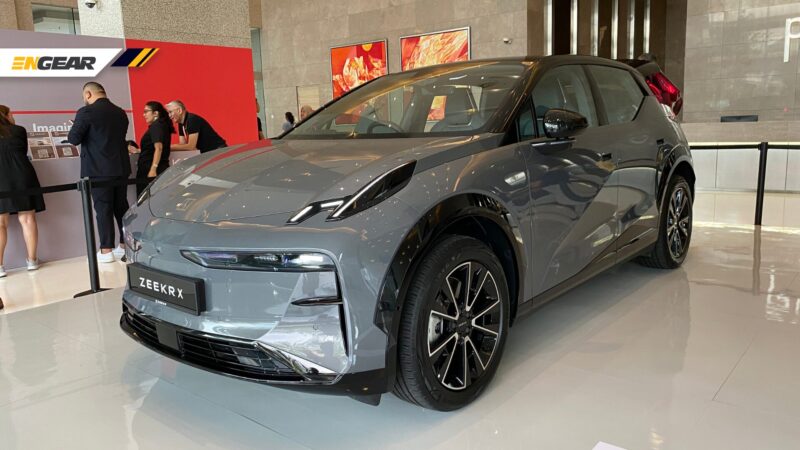
Introduced for the first time at the Beijing Autoshow in April, the Mix is Zeekr’s fifth model and the first built on the SEA-M architecture.
According to Zeekr, the SEA-M platform is a derivative of the original SEA platform, designed to support a wide range of mobility products from passenger vehicles like robotaxis and MPVs to commercial vehicles used for logistics.
The company stated that the development of this new platform involved an investment of over RMB 7 billion (approximately RM4.2 billion).
In terms of size, the Mix measures 4,688 mm in length, 1,995 mm in width, and 1,755 mm in height, with a wheelbase of 3,008 mm, providing ample and flexible cabin space.
Highlights on the inside include two swiveling front seats that can rotate 270 degrees, and a centre console that can be adjusted and transformed into a small table. The rear seats also feature leg rests and can be reclined.
What’s more, Zeekr claims that the Mix has the flattest in-cabin floor in the industry, offering users over 20 different cabin scenario modes.
Additionally, drivers can enjoy an advanced cockpit that includes a flat-bottom steering wheel, a digital instrument panel, a large touchscreen, wireless charging, and ambient lighting.
The Mix is powered by a single electric motor on the rear axle, generating an impressive 422 hp. With a 77 kWh battery supplied by CATL, the electric MPV can travel up to 712 km on a full charge.
However, it is important to note that the range is based on the CLTC cycle, which is less realistic compared to the NEDC and WLTP testing standards.
Reports indicate that Zeekr plans to launch the Mix in its home market on 23 October.
Driving an electric vehicle (EV) that is too quiet and smooth without any mechanical vibrations may not be suitable for everyone, especially those with an old-school soul.
So, Honda wants to ensure that their EV models to come will have unique driving characteristics and experiences.
During the recent 0 Tech Meeting 2024, Honda demonstrated a simulated driving concept that can mimic the characteristics of the brand’s high-performance iconic models.
Among them are the first generation Honda NSX, the hot hatch Civic Type R, the roadster S2000, the F1 machine, Honda CRX, and not forgetting the HondaJet personal jet!
In addition to displaying instrument panel themes based on the selected vehicles, this Honda e Digital UX Concept system can simulate the engine notes of the aforementioned models.
Fans of the loud VTEC engine roar will definitely not miss the chance to try this feature when it becomes available.
Honda will also use cabin vibration systems to create a driving experience akin to that of internal combustion engine cars.
According to The Drive, aside from the instrument panel themes and engine sound profiles, Honda is also experimenting with offering a more comprehensive experience, including introducing different tuning on the steering wheel, adjusting the pedal mapping, and the suspension system’s height.
Not to be missed, the simulated gear shifting feature using paddle shifters like those found in the Hyundai Ioniq 5 N model.
Stellantis Malaysia has officially launched the Leapmotor C10 electric SUV, marking the brand’s entry into the local market.
The C10 is available in a single variant powered by a rear-mounted electric motor. It is offered at an introductory price of RM149,000 until 30 November, after which the retail price will start from RM159,000.
As previously reported, the C10 is a five-seat battery electric SUV measuring 4,739 mm in length, 1,900 mm in width, 1,680 mm in height, and featuring a wheelbase of 2,825 mm.
Standard equipment includes LED “angle-winged” headlamps with daytime running lights, air intakes with an active grille shutter, 20-inch ‘Trident’ wheels, and flush door handles.
In keeping with the minimalist design of the exterior, the C10’s cabin also features a virtually button-free layout. All functions are controlled via a voice command system and a 14.6-inch touchscreen infotainment display powered by a Qualcomm Snapdragon chip. However, Apple CarPlay and Android Auto are not included.
Additional features include a 10.2-inch instrument panel, a 15W wireless charger, four USB ports (both Type A and Type C), a 12V socket, a panoramic glass roof, ambient lighting, and a 12-speaker audio system equipped with AI sound effects, four concert hall modes, and an 800W amplifier.
According to Leapmotor, the cabin dimensions of the C10 are 1.8 metres in length and 1.2 metres in width. In Camp Mode and Nap Mode, the seats fold flat into a double bed, transforming the interior into a space suitable for various activities.
At the rear, the boot offers 435 litres of space, expanding to 1,410 litres with the rear seats folded flat. This space can be accessed through a powered tailgate with customisable opening height options.
The C10 is propelled by an electric motor located on the rear axle, delivering 214 hp (160 kW) and 320 Nm of torque, enabling it to accelerate from 0 to 100 km/h in just 7.5 seconds.
It features a 69.9 kWh LFP battery that offers a range of 424 km based on the WLTP cycle. Besides a 6.6 kW AC charger, the battery supports DC fast charging at a maximum rate of 84 kW, allowing it to replenish power from 30% to 80% in just 30 minutes.
Moreover, this battery pack comes with a Vehicle-to-Load (V2L) feature with an output capacity of 3.3 kW.
In terms of safety, the C10 is equipped with seven airbags and a Level 2 ADAS known as Leap Pilot, which includes the following features:
Adaptive Cruise Control (ACC)
Lane Centering Control (LCC)
Traffic Jam Assist (TJA)
Front Collision Warning (FCW)
Autonomous Emergency Braking (AEB)
Blind Spot Detection (BSD)
Door Opening Warning (DOW)
Emergency Lane Keeping (ELK)
Lane Departure Warning (LDW)
Lane Keep Assist (LKA)
Rear Collision Warning (RCW)
Rear Cross-Traffic Alert and Braking (RCTA + RCTB)
Intelligent Speed Assist (ISA)
Driver Drowsiness Alert Warning (DDAW)
Advanced Driver Distraction Warning (ADDW)
For the Malaysian market, the C10 is offered in four exterior colours: Glazed Green, Pearly White, Canopy Grey, and Tunda Grey. The interior is available in Criollo Brown (available only for Glazed Green) and Midnight Aurora.
It comes with a six-year or 150,000 km warranty, and a 8-year or 160,000 km battery warranty, whichever comes first. Service intervals are fixed at one-year or 20,000 km, whichever comes first.
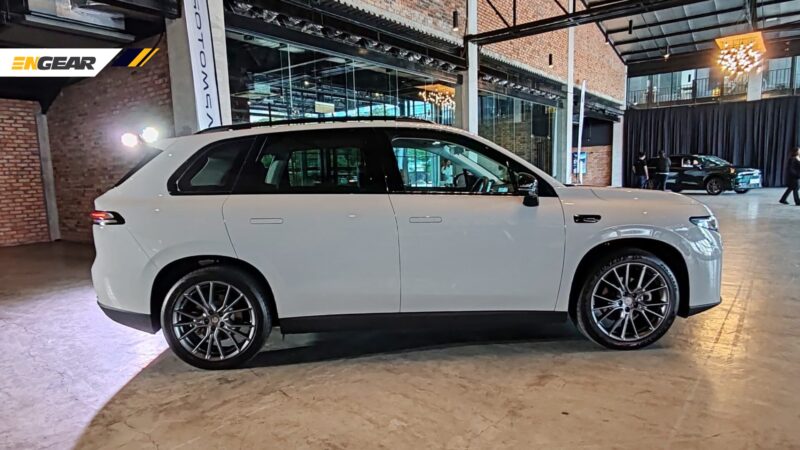
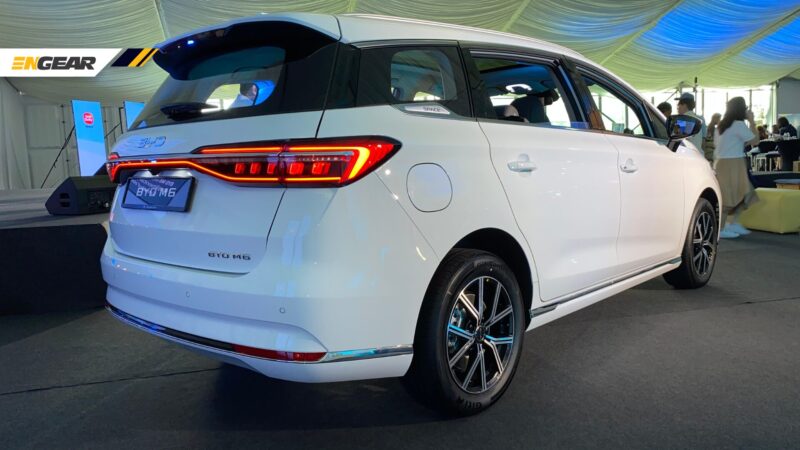
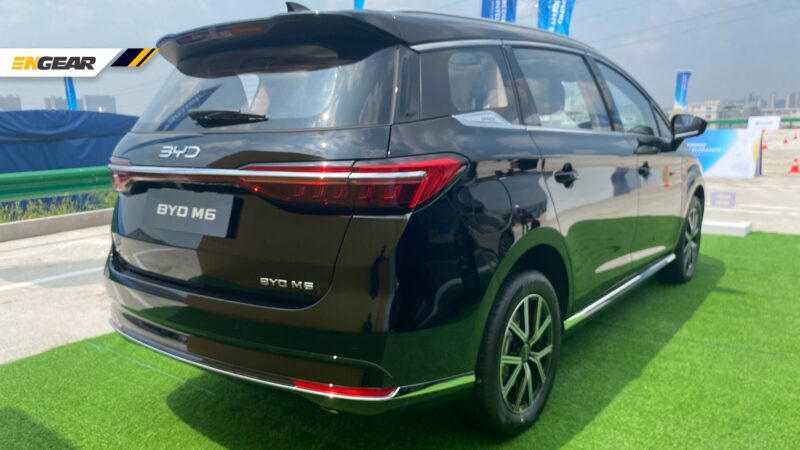
Sime Darby Motors has launched the fourth BYD electric vehicle for the Malaysian market – the all-new BYD M6.
The M6, which is an MPV, is offered in a seven-seat configuration with two variants to choose from, namely Standard and Extended.
Both variants are equipped with a single electric motor driving the front wheels.
The Standard variant has a total power output of 161 hp and 310 Nm of torque, enabling it to accelerate from 0 to 100 km/h in 10.1 seconds.
On the other hand, the Extended variant, with 201 hp and the same amount of torque, is capable of completing the 0-100 km/h acceleration in 8.6 seconds.
In addition to output, the battery capacities between the two variants also differ.
The M6 Standard comes with a Blade LFP battery with a capacity of 55.4 kWh, offering a range of 420 km based on the NEDC cycle.
The Extended variant is equipped with a larger battery with a capacity of 71.8 kWh, providing a driving range of 530 km on a full charge.
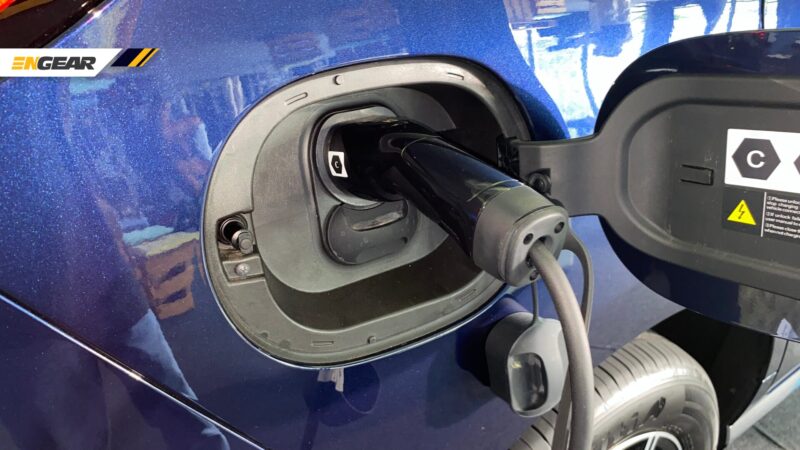
The maximum fast charging rates also vary between the variants, with 89 kW for the Standard and 115 kW for the Extended. The latter requires 40 minutes to charge from 10% to 80%.
Despite the difference in battery capacity, the Vehicle-to-Load feature is included as standard across the range.
In terms of equipment, the M6 comes with ‘floating’ LED headlights and taillights, 17-inch alloy wheels, a 12.8-inch rotating touchscreen with Apple CarPlay and Android Auto, a karaoke system, and an NFC digital key.
A panoramic roof, 15W wireless charger, and electric tailgate are also included.
On the safety front, the M6 comes standard with six airbags, a Tyre Pressure Monitoring System, Isofix, ABS, an Electric Parking Brake, Electronic Stability Control, Traction Control, and a 360-degree View Monitor.
The Extended variant gains ADAS technology, which includes Autonomous Emergency Braking, Intelligent Cruise Control, Front and Rear Collision Warning, Blind Spot Detection, and Lane Departure Assist.
Pricing starts from RM109,800 for the M6 Standard and RM123,800 for the M6 Extended.
The electric MPV is offered with a warranty of six years/150,000 km for the vehicle, eight years/160,000 km for the battery, and eight years/150,000 km for the drive unit.
In addition to the luxurious MPV 009, Zeekr Malaysia is also set to launch an electric crossover known as the X to heat up the competition in the local EV market.
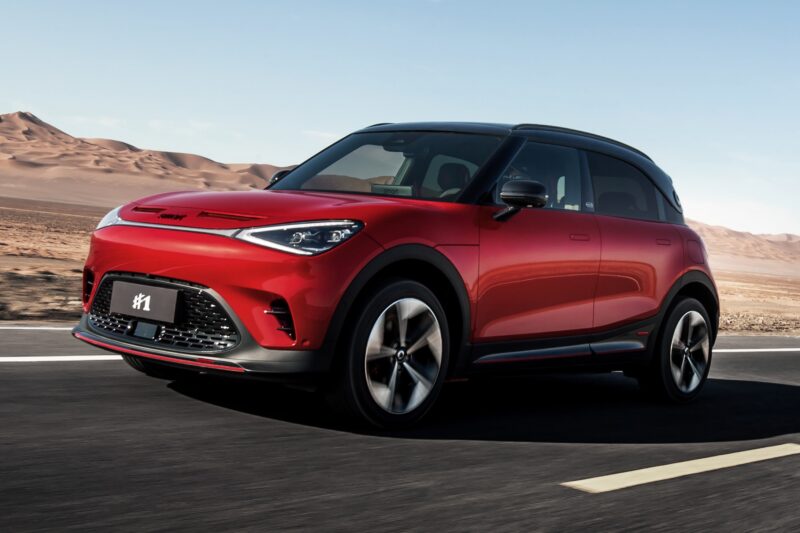
For your information, the X actually has ‘siblings’ that have already been launched in Malaysia, specifically the smart #1 and #3, along with the Volvo EX30.
What is the connection between the X and these three models? Interestingly, despite their very different designs, all of them share the same ‘skeleton’ that is the Sustainable Experience Architecture (SEA) platform developed by Geely.
This is not surprising, as smart, Volvo, and Zeekr all operate under the Geely umbrella and platform sharing is arguably the easiest way to reduce costs.
In this article, we will compare the four models to help you choose the one that best fits your budget and needs:
Dimensions
Although they utilise the same platform, all four EVs have slightly different dimensions. The smart #1 is the smallest, measuring 4,270 mm in length, 1,820 mm in width, and 1,636 mm in height, with a wheelbase of 2,750 mm.
The #3 is slightly larger, with a length of 4,400 mm, width of 1,844 mm, height of 1,556 mm, and a wheelbase of 2,785 mm.
The EX30, Volvo’s smallest car to date, measures 4,223 mm in length, 1,837 mm in width, 1,555 mm in height, and has a wheelbase of 2,650 mm.
Meanwhile, the X stands out as the longest model, measuring 4,450 mm in length, 1,836 mm in width, and 1,572 mm in height. However, its wheelbase is identical to that of the #1, also at 2,750 mm.
Powertrain
For this category, we will compare the twin electric motor variants. Interestingly, all four have the same power output of 422 hp (315 kW) and 543 Nm of torque.
However, looking at the acceleration time from 0 to 100 km/h, the EX30 Ultra Twin Performance is the fastest at 3.6 seconds. The #3 Brabus follows closely at 3.7 seconds, with the X at 3.8 seconds, and finally, the #1 at 3.9 seconds.
The maximum speed for all four models is capped at 180 km/h.
Battery and Range
In terms of battery, the #1 Pro and #3 Pro come equipped with LFP 49 kWh batteries, offering ranges between 315 km and 325 km. The Premium variants of both models use nickel manganese cobalt (NMC) 66 kWh batteries, with ranges from 440 km to 455 km.
The highest variant, Brabus, uses the same battery but with a shorter range of 400 km for the #1 and 415 km for the #3.
The EX30 features a 69 kWh NMC battery, providing a range of 476 km for the single motor variants (Plus and Ultra) and 450 km for the Ultra Twin Performance variant with twin motors.
Meanwhile, the X is equipped with a 66 kWh NMC battery, promising a range of 440 km based on the WLTP cycle.
Price
This may be the most crucial aspect when comparing these four electric crossovers.
Starting with the #1, the Pro variant is priced at RM169,000, the Premium at RM209,000, and the Brabus at RM249,000.
The #3 Pro retails for RM175,000, the Premium for RM215,000, and the Brabus at RM255,000.
For the EX30, the base variant (Plus) is priced at RM188,888, the Ultra at RM208,888, and the Ultra Twin Performance at RM228,888.
As of the time of writing, the official price for the Zeekr X has yet to be announced. However, according to the company, it is expected to be priced below RM180,000.
R&A Greentech Solutions Sdn Bhd, a subsidiary under the Sendok Group, has introduced another electric-powered commercial truck, the JAC i40, to the local market.
The JAC i40 is available in four body configurations, namely wood cargo, refrigerated box, corrugated box, and standard box van.
In terms of dimensions, the i40 measures 5,300 mm in length, 1,750 mm in width, 1,990 mm in height with a wheelbase of 3,100 mm, and a gross vehicle weight (GVW) of around 3,700 kg.
It is powered by a single 141 hp electric motor delivering 300 Nm of torque, with power sourced from a 63.75 kWh battery pack.
The range is approximately 230 km according to WLTP data, or up to 300 km at a maximum speed of 60 km/h.
The JAC i40 supports AC charging (20-100% in 8.5 hours) and fast DC charging at 90 kW enabling 20-80% battery charging in just 40 minutes.
Inside, the JAC i40 features amenities such as a 5-inch TFT cluster screen, a seven-inch central display with Bluetooth support and a reverse camera, and a rotary knob in the center.
Safety features include ABS, EBS, Hill Start Assist, Electronic Stability Control, and Low-Speed Pedestrian Alert System.
For the Malaysian market, the selling price of the JAC i40 starts from RM155,600 (on the road without insurance) for the base version and can go up to RM223,800 for the refrigerated box version.
The International Greentech and Eco Product Exhibition and Conference Malaysia (IGEM), held at the Kuala Lumpur Convention Centre, showcased a variety of electric vehicles for commercial use.
Among them is the CAM EC35 electric van, which is available in three versions: panel van, semi-panel van, and window van. The displayed unit is a window van that has been modified into an ambulance.
All three versions share the same dimensions, measuring 4,500 mm in length, 1,680 mm in width, and 1,985 mm in height, with a wheelbase of 3,050 mm. The gross weight is 2,600 kg, while the payload capacity ranges from 1,025 to 1,090 kg.
The panel van accommodates two seats, the semi-panel van has five seats, while the window van features a configuration for six or eight seats.
The EC35 is powered by a single electric motor located on the rear axle, generating 80 hp (60 kW) and 200 Nm of torque. Energy is supplied by a 38.7 kWh battery, which allows for a range of 268 km based on the WLTP cycle.
Standard AC charging takes approximately five hours to recharge the battery from 20% to 80%, while DC fast charging requires 80 minutes to charge from 20% to 80% or 2.5 hours for a full charge.
Additional features of the EC35 include power windows, ABS, EBD, reverse sensors, and a reverse camera with the feed displayed on an eight-inch screen.
Needless to say, several modifications must be made to convert it into an ambulance.
These include installing a LED light bar, siren, loudspeakers, PA system, and eight units of LED warning lights (two on the front grille, four on the side of the roof, and two on the rear of the roof). All rear windows are tinted with a VLT of 95%.
Inside, the vehicle features an 18 mm thick waterproof plywood floor, aluminum cabinets, and an oxygen pipeline along with related components. It is also equipped with a fire extinguisher, AC inverter, three-pin socket, USB ports, LED ceiling lights, and two stretchers.
The EC35 is priced starting at RM135,000 for the panel van, RM138,500 for the semi-panel van, and RM145,000 for the eight-seat window van.
The ambulance version will set buyers back RM199,000. It comes with a warranty of five years or 120,000 km for the vehicle, and a one-year warranty for the installation.
Denza, a premium sub-brand under BYD, is set to enter the Malaysian market through Sime Darby Auto Imports as the official importer, alongside BYD Malaysia, which will serve as the official distributor.
An official signing ceremony for the importation and distribution of Denza was held yesterday between BYD Auto Industry and both companies.
This marks a new journey and further enhances the relationship between BYD and Sime Darby as a group, expanding the partnership with the latter as an official importer.
The signing will be the first step for Denza entering into Malaysia. The luxury electric vehicle sub-brand is set to bring a new dimension to Malaysia’s EV market with premium cutting-edge technology, features and driving experience.
Through Denza, BYD aims to provide Malaysians a more diverse, innovative and premium EV experience.
Liu Xueliang, General Manager of Asia-Pacific Auto Sales Division at BYD said they are excited to partner with Sime Darby Auto Imports to bring Denza to the Malaysian market, marking a significant milestone for BYD in its journey to expand its electric vehicle offerings in Southeast Asia.
“Being at the forefront of innovation, we are proud to bring our advanced EV technology to Malaysia where the appetite for sustainable mobility continues to grow.
With Denza, we will be able to offer our customers a better experience through our premium technology and features within the EV industry. We believe Denza will redefine the premium EV experience and set new standards for Malaysian drivers,” he said.
Dennis Ho, Managing Director, Assembly and Strategic Businesses at Sime Darby Motors, added: “We are committed to a pivotal role in accelerating the growth of electric vehicles in Malaysia and we believe that bringing in Denza will be a significant part of this journey.”
Eagle Zhao, Managing Director of BYD Malaysia Sdn. Bhd., highlighted the brand’s commitment to enhancing Malaysia’s EV landscape.
“BYD’s mission has always been to make electric vehicles accessible to more people, and with the introduction of Denza, we are offering Malaysian drivers a premium choice that embodies both luxury and sustainability. The rapid adoption of EVs in Malaysia is a testament to the country’s progress in embracing a cleaner, greener future,” he said.
Sime Darby Motors (SDM) has announced that it has sold over 10,000 BYD vehicles nationwide since being appointed the official distributor of the brand in September 2022.
To celebrate this achievement, Sime Darby Motors recently organised the ‘BYD Dream Drive Melaka 2024’ convoy, which was joined by over 60 BYD vehicles.
According to the company, Melaka was chosen to coincide with this year’s 50th anniversary of diplomatic relations between Malaysia and China, making it an apt destination given its historical connections with China dating back to the 15th century.
Jeffrey Gan, the Managing Director of Southeast Asia at Sime Darby Motors, stated the milestone reflected the growing adoption of electric vehicles in the region and Sime Darby’s strong position as a leader in EV.
“Our commitment to providing the best experience and services through this strategic partnership with BYD has contributed to this success,” he added.
Eagle Zhao, the Managing Director of BYD Malaysia, added, “This milestone reflects the trust and support of our customers who embrace the future of mobility with BYD. It’s been an incredible journey with Sime Darby Motors and we look forward to elevating sustainable driving experiences in Malaysia.”
BYD Malaysia said it has set its sights on reaching the next 10,000 cars milestone in a shorter timeframe.
Meanwhile, Sime Darby Motors plans to expand the BYD network in Malaysia to 30 showrooms by the end of this year. Currently, there are 26 BYD showrooms nationwide. This consists of 19 dealer partners, with 16 3S centres and 10 1S centres.
If you recall from last August, we listed the top five electric vehicles (EVs) available for prices between RM100,000 and RM150,000.
Notably, all five EVs in that list were from Chinese brands. However, this isn’t necessarily a drawback, as many EVs from that country offer impressive performance, technology, and features at affordable prices.
In this article, we present the top five EVs priced between RM150,000 and RM200,000, which still includes candidates from Chinese brands. But this time, there’s good news for those wanting to try EVs from European brands, as there are three models that may suit their preferences:
Volvo EX30 Plus (RM188,888)
Recently launched in the Malaysian market, the Volvo EX30 may not be entirely European, as it uses a platform made by Geely—also employed in the smart #1 and Zeekr X—and is assembled in China. However, it is undoubtedly a true Volvo.
The Thor Hammer LED lights signify that it is a Volvo, and the minimalist interior showcases various sustainable materials, which is in line with the brand’s strategy. For performance enthusiasts, you’ll be pleased to know that the Plus variant can accelerate from 0 to 100 km/h in just 5.3 seconds. Want something faster? You can opt for the Ultra Twin Performance variant but that is priced above RM200,000.
BYD Seal (RM163,800 – RM199,800)
In this writer’s opinion, no EV list would be complete without BYD. Within the price range of RM150,000 to RM200,000, you can acquire the flagship Seal sedan, which is available in three variants: Dynamic, Premium, and Performance.
These variants differ in performance (with the Performance being the fastest at 0-100 km/h in 3.8 seconds) and range (the Premium can travel the farthest at 570 km). Interestingly, regardless of the chosen variant, buyers get a nearly identical list of features and specifications.
XPeng G6 (RM165,000 – RM185,000)
XPeng is a new EV brand from China introduced in Malaysia by Bermaz, alleviating concerns about after-sales service, as Bermaz is well-experienced in this area.
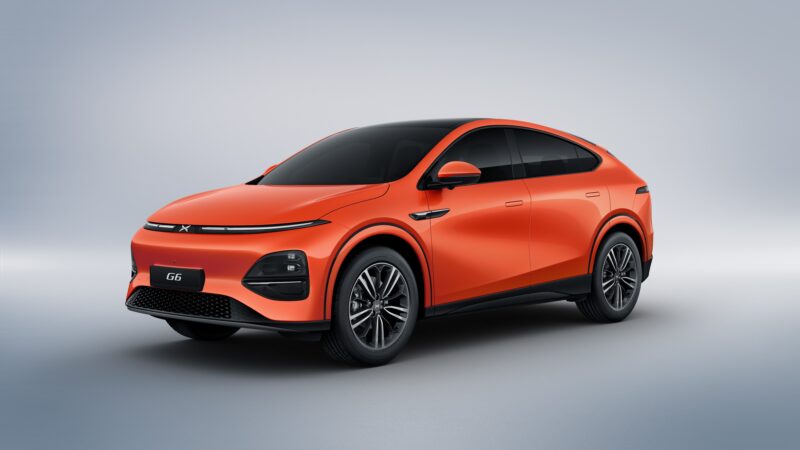
The G6 is XPeng’s first ever model available in Malaysia, offering a premium coupe SUV design along with advanced technologies such as the Smart Electric Platform Architecture 2.0 with an 800V architecture, the XOpera surround sound system, and XPILOT 2.5 safety features for well under RM200,000.
smart #3 Pro (RM175,000)
Similar to the Volvo EX30, the smart #3 could be seen as an Eurasian blend, combining technology from an Asian company (Geely) with European design (specifically German, as it was designed by Mercedes-Benz).
The Pro is the entry-level variant in the #3 lineup. At RM175,000, it offers good value for those interested in the smart brand as it packs 272 PS and 343 Nm of torque, can reach 0 to 100 km/h in a scant 5.8 seconds, and has a range of up to 325 km on a full charge, which is 10 km further than the #1 Pro.
MINI Electric Cooper SE (RM193,888)
This writer believes many readers of Engear TV are fans of MINI. The second generation of the MINI Electric Cooper is viewed as a more worthwhile investment, featuring not only a more modern design but also vastly increased power and range.
Launched in Malaysia last July, the new Cooper SE is powered by a single electric motor on the front axle, producing 218 PS and 330 Nm (an increase of 34 PS and 60 Nm), allowing it to accelerate from 0 to 100 km/h in 6.7 seconds. With a larger battery capacity of 54.2 kWh, it provides a range of 402 km on a full charge, almost double the range of the previous model.
BYD is set to further expand its electric vehicle lineup in Malaysia with a new MPV called the M6.
In a recent media Q&A session in Changsha, China, Liu Xueliang, General Manager of BYD Asia-Pacific Auto Sales Division, confirmed that the fully-electric MPV will enter the Malaysian market this year.
However, the exact launch date is still unknown, along with the specifications and variants that will be offered.
It is expected that the specifications for the Malaysian market will not differ significantly from those available in Indonesia and Thailand.
In Indonesia, the M6 can be hand in six- or seven-seat configurations, while in Thailand, it is available only as a six-seater.
Both markets offer two output variants. The base variant, powered by a front axle electric motor, has 163 PS and 310 Nm of torque, whereas the more powerful variant (known as Superior in Indonesia and Extended in Thailand) gets 204 PS and 310 Nm from the same single-motor setup.
As with other BYD EVs, juice for the motor is supplied by an LFP battery, with a capacity of 55.4 kWh for the base variant and 71.8 kWh for the Superior/Extended variants. This equals to an NEDC range of up to 420 km for the former and 530 km for the latter.
The base M6 supports 85-kW DC fast charging, while the Superior/Extended can accommodate up to 115 kW, allowing the battery to be charged from 10% to 80% in just 40 minutes. Meanwhile, AC charging is limited to 7 kW for both variants.
The M6 can be considered a replacement for the e6, which was supposed to launch in Malaysia after the Atto 3. Compared to the e6, its exterior design aligns more closely with recent BYD models, featuring a silver grille that connects to the projector LED headlights.
On the side, chrome trim is generously applied on the window frames and side skirts, while the rear boasts a full-width light strip accompanied by a chrome strip. Unlike the Atto 3, the M6 ditches the “Build Your Dream” wording with the more understated “BYD” badge.
While the interior is evidently more conventional compared to the Atto 3 or Dolphin, the M6 still offers a comprehensive equipment list, which includes a 12.8-inch rotating screen, dual wireless charging, keyless entry, a panoramic glass roof, and automatic air conditioning, to name a few.
In terms of safety, the M6 comes equipped with six airbags and plenty of ADAS features such as Autonomous Emergency Braking, Adaptive Cruise Control, Lane Centring Assist, Emergency Lane Keeping Assist, and Blind Spot Monitoring.
As for pricing, the M6 is sold for between 379 million to 429 million rupiah (approximately RM102,968 to RM116,481) in Indonesia, while in Thailand, it starts from 829,900 baht to 929,900 baht (around RM106,014 to RM118,788).
Last week, the Proton Centre of Excellence (COE) served as the final destination for Geely’s Galaxy E5 world tour, which kicked off in China.
Despite being dubbed a ‘world tour’, the convoy, consisting of several left-hand drive Galaxy E5 units, actually traversed just three Southeast Asian countries: Laos, Thailand, and Malaysia.
Nevertheless, the 3,700 km journey was deemed sufficient to showcase the Galaxy E5’s capabilities and durability in real-world conditions.
According to a representative from Geely, the convoy successfully completed the journey without issues, with each unit arriving at the COE in good condition, despite having to face floods in Laos caused by Typhoon Yagi.
Taking advantage of the cars being here, Proton invited media representatives to test drive the Proton e.MAS 7 twin on its famed test track at the COE. Additionally, select media personnel were also given the opportunity to drive the EV on public roads for a more realistic driving experience.
From my observation, the test drive session provided clear hints as to the design, technology, and performance of the e.MAS 7, which will soon be launched in the local market.
Is the Exterior Design Similar?
Proton previously emphasised that the e.MAS 7 is not merely a rebadged Galaxy E5. This claim holds true on a technical front, as the e.MAS 7 was developed concurrently with the Galaxy E5. According to Proton, over 100 of their engineers were involved in this project.
However, in terms of exterior design, it is fair to say that Proton may not have all the freedom to make significant changes to the e.MAS 7, aside from altering the logo and badges. Elements like the Infinite Weave design found in other Geely-based models are also absent, as the e.MAS 7 lacks a front grille.
It is also interesting to note that the Galaxy E5 that we test drove came with 19-inch wheels, one inch bigger than that of the e.MAS 7.
A Spacious Yet Luxurious Interior
Similar to its exterior, the cabin design of the e.MAS 7 is expected to be quite similar to that of the Galaxy E5. This is a good thing, as the interior design of this Chinese EV is quite impressive in terms of layout and materials used.
The leather upholstery appears luxurious and feels soft to the touch. Importantly, it is applied extensively, not only on the seats but also covering a substantial part of the dashboard and door panels.
In addition to white, Geely offers choices in brown-red and dark blue. Will Proton offer the same colour options with the e.MAS 7? We look forward to finding out.
Roomy and Practical—Perfect for Malaysians
With a wheelbase of 2,750 mm, the Galaxy E5 offers a spacious and comfortable cabin. I was quite impressed with the rear legroom, which is comparable to that of D-segment vehicles, even though this is a C-segment SUV.
The rear seats provide adequate thigh support, but what’s more intriguing is the front passenger seat, which comes with Ottoman functionality—a feature typically found only in luxury MPVs.
For those who often carry a lot of items, fret not: the Galaxy E5 includes 33 storage compartments, including a drawer beneath the rear seats. Although the trunk space is modest (461 litres) for an SUV, there is an additional 51 liters of storage under the trunk floor.
Packed with Technology
Both the Galaxy E5 and the e.MAS 7 are powered by the same operating system, Flyme Auto, driven by the 7 nm Longying One Chip, which is touted as the first smart cockpit chip from China. Besides smartphone integration, this OS also offers voice command features for various tasks—think of it as your personal assistant.
The EV also boasts a Flyme Sound audio system with a capacity of 1,000 watts and 16 speakers, including those in the headrests. Additionally, there are external speakers useful for playing music during a gathering.
You can also use the external speakers to issue warnings to pedestrians or other road users. Notably, the sound choices available are quite unconventional, featuring sounds like “Hi,” roar of a tiger, a cat’s meow, supercar engine revving, and more.
The Galaxy E5 is Designed for Comfort—What About the e.MAS 7?
While brief, the driving session on both the Proton test track and public roads effectively revealed the character of the Galaxy E5. It was clear that the EV is tuned for a more relaxed driving experience, unlike other Chinese EVs I have tried, such as the smart #1.
The Galaxy E5 is equipped with a single electric motor at the front axle, generating 218 PS and 320 Nm of torque, enabling it to accelerate from 0 to 100 km/h in 6.8 seconds and reach a top speed of 184 km/h.
In today’s landscape, where EVs can easily match supercars, these figures may not seem impressive. However, I believe that the Galaxy E5 is sufficiently fast for the average driver. The throttle response is calm and unhurried, even when depressed aggressively.
Moreover, the Galaxy E5’s suspension system is very soft. During our drive to Puncak Alam, the vehicle proved adept at soaking up bumps from uneven surfaces almost seamlessly within the cabin. Nevertheless, the Galaxy E5 tend to bounce when cruising at high speeds or being driven on undulating roads.
Conclusion
As mentioned, the test drive session was valuable as it provided considerable insight into the upcoming Proton e.MAS 7.
In terms of exterior and interior design, as well as infotainment systems and technology, I personally do not expect significant changes, as the Galaxy E5 package is already appealing.
However, regarding driving dynamics—particularly throttle response and suspension tuning—Proton will undoubtedly apply its expertise to ensure the e.MAS 7 is well-suited for Malaysian road conditions while meeting the expectations of local EV buyers.
Developed on Geely’s SEA platform, which also underpins the smart #1 and Zeekr X, the EX30 is the smallest vehicle from Volvo to date.
That being said, don’t let its compact size fool you. The EX30 encompasses everything buyers in this segment desire—style, technology, practicality, and of course, performance.
Thanks to the well-thought-out though (though slightly unusual) activities organised during a recent media test drive by Volvo Car Malaysia, we gained a clear insight into the true capabilities of the EX30 and why it stands out in the market.
But before delving into the whole experience, let’s first explore the exterior and interior of this rather interesting EV. With dimensions of 4,223 mm in length, 1,837 mm in width, and 1,555 mm in height, it is indeed smaller than both the #1 and X.
Nevertheless, the EX30 boasts well-balanced and sporty proportions, featuring equally long front and rear overhangs, a lengthy wheelbase of 2,650 mm, and large wheels to complete the look.
Even though the test units were wrapped in camouflage, it’s easy to pinpoint it as a Volvo at first glance, thanks to the prominent Thor’s Hammer LED daytime running lights. Of course, the brand logo is also clearly displayed on the front of the car.
As one would expect from the Swedish marque, the interior of the EX30 is stylish and well-organised. In line with its sustainability efforts, Volvo has chosen to apply generous amounts of renewable and recyclable materials throughout nearly every nook and cranny of the cabin.
Aside from the window controls on the center console, you won’t find any physical buttons in the EX30. In fact, there’s no traditional gauge cluster in this vehicle. All functions and information—like vehicle speed and gear position—must be accessed through a 12.3-inch portrait-oriented touchscreen.
The minimalist approach effectively creates a spacious cockpit; however, those accustomed to conventional controls will take some getting used to. Even adjusting the side mirrors and opening the glovebox must now be done via the touchscreen.
While the interior of the EX30 is undeniably compact, I don’t believe most users will struggle to store their belongings. This is because Volvo has creatively maximised storage space. Firstly, instead of conventional door-mounted speakers, you’ll find a Harman Kardon soundbar covering the entire width of the dashboard to make room in the door panels.
Furthermore, the cupholders in the center console can be slid out fully. Located below this is another substantial storage area where you can place items like a wallet. Interestingly, the floor of this compartment can be opened to create a deeper space, right behind which is a removable tray.
Now, returning to the previously mentioned media test drive. From Volvo Malaysia’s headquarters in Petaling Jaya, we departed for the old airport in Sungai Besi where we did two driving activities: a drag race and a slalom run.
While slalom isn’t new to me, this time it was a bit different as we had to perform it in reverse. The bright and clear video feeds from the exterior cameras helped me avoid the cones.
Next, racing against a Volvo V60 T8 demonstrated the true potential of the EX30 on a straight line. The Twin Motor Performance variant we drove has a ‘secret’ Performance All-Wheel Drive mode that, when activated, generates a maximum power output of 428 PS and 543 Nm.
Just like that, the EX30 blasts from 0 to 100 km/h in a scant 3.6 seconds, surpassing the plug-in hybrid wagon that is actually significantly more powerful.
After the activities in Sungai Besi, we moved to Bamboo Hills for a demonstration of the Park Pilot Assist feature. The feature is incredibly user-friendly and can instantly detect available parking spaces. You simply need to select your desired spot, and the car will handle the rest for you.
Next, we headed to Ikea Damansara for a unique shopping experience. Each team, composed of six media members, was given a budget of RM2,000 to buy as many items as possible to cram into the tiny EV.
Thanks to the boot space, which can accommodate up to 904 litres (when the back seats are folded), a 61-liter compartment beneath the boot floor, and a 7-litre frunk, our team successfully packed several chairs, a futon mattress, pillows, and many other items without a snag.
It is uncustomary for car manufacturers to let motoring media run wild in a mall as part of a media drive but this activity showcased that even though the EX30 is compact, its interior is versatile enough for weekend getaways in the Klang Valley and surrounding areas.
From Kuala Lumpur, we then headed to Janda Baik as the final stop of the media drive. The journey from the capital to this popular resort was enjoyable, especially when cruising along the Karak Highway, given the EX30’s stable and solid handling.
Even after an aggressively spirited day of driving, including the drag race earlier, we arrived in Janda Baik with about 45% battery power remaining. Just imagine the range if driven more conservatively.
For your information, the Twin Motor Performance variant features a 69 kWh Nickel Manganese Cobalt (NMC) battery, promising a driving range of approximately 450 km based on the WLTP cycle.
The battery can be charged from 10% to 80% in just 30 minutes using a 153 kW DC fast charger, while AC charging at 11 kW takes about 7.5 hours for a full charge.
Conclusion
For an electric vehicle, the Volvo EX30 offers numerous advantages. Its modern and attractive design—both exterior and interior—is eye-catching, yet never overwhelming.
While the lack of physical buttons might lead to potential buyers feeling a little hesitant, based on my experience, all functions and features can be easily accessed. It just takes a bit of time to learn how to use them.
For me, the key strengths of the EX30 lie in its performance and practicality, making it an ideal choice for young individuals with an active lifestyle.
Malaysia’s Leading Automotive News | ENGEAR ENGLISH