The alarming cases of children who died after being left behind in cars have become a little too common, not only in Malaysia but also in other countries.
Recognising the seriousness of the issue, Toyota has introduced the Advanced Rear Seat Reminder system that is capable of detecting movement in the rear seats after the vehicle has been turned off and locked.
The first model to receive the new system is the 2025 Toyota Sienna, a three-row MPV available in the North American market.
While rear seat reminder systems are not new to the automotive world, Toyota’s Advanced Rear Seat Reminder is more sophisticated as it is capable of making calls to the user’s phone.
According to Toyota, the system utilises sensors concealed in the headliner and a 60GHz band millimeter-wave radar to scan the second and third row seats for potential movement.
If the system senses movement after the vehicle is shifted into park and ignition is cycled off, the driver’s door has been opened then closed and the vehicle has been locked, the initial warning will trigger the hazard lights and to flash and sound the door lock chime nine times.
If movement is still detected by the sensor and a door has not been opened approximately 90 seconds after the initial warning, the system will sound the horn as part of the escalation warning.
If the driver has opted into Advanced Rear Seat Reminder notifications via the Toyota app and has an active Safety Connect subscription, they will receive a push notification and a text message four minutes after the horn escalation warning starts.
Finally, after an additional two minutes has elapsed, the system will attempt to generate an automated phone call from Toyota Safety.
However, if the vehicle is left unlocked, the hazard lights will not activate, nor will the door alarm or horn sound. Instead, users will be notified via SMS after 10 minutes, followed by a phone call two minutes later.
Will Toyota introduce the Advanced Rear Seat Reminder system in other markets? We certainly hope so, as it has the potential to save many lives.
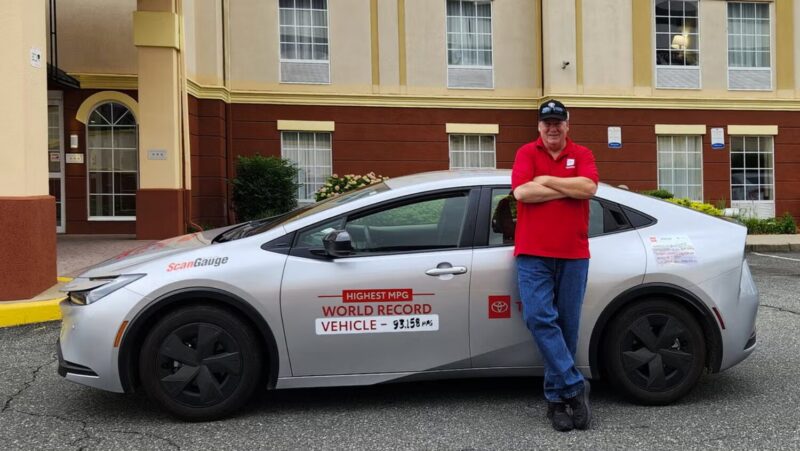
A new world record for the lowest fuel consumption rate has been set in the Guinness World Record for a driving distance exceeding 5,000 km, that is 2.5L/100 km.
This is much more efficient compared to the official figure of 57 MPG (4.12 liters/100 km) released by Toyota!
Wayne Gerdes drove a Toyota Prius LE from Los Angeles City Hall to New York City Hall, covering a distance of 5,168.7 km.
During the journey, he had to navigate routes at an elevation of 2,100 m and traverse the Mojave Desert where temperatures can reach as high as 40 degrees Celsius.
To achieve this figure, Gerdes suggested several tips that can be used to improve fuel efficiency.
These include driving slowly from stops while maintaining steady pressure on the pedal.
“For a record attempt like this, it requires meticulous planning. You need to have a plan and be able to quickly adjust that plan.
“So, if conditions change, you must alter your plan. Change your route. Think about what you can do to reach that goal,” he added.
The Toyota Prius LE has a fuel tank capacity of 43 liters, so based on a quick calculation, Gerdes may be able to achieve a distance of 1,693 km with each full tank refill.
It is indeed an impressive figure, considering Toyota’s official figure is only about 1,036 km.
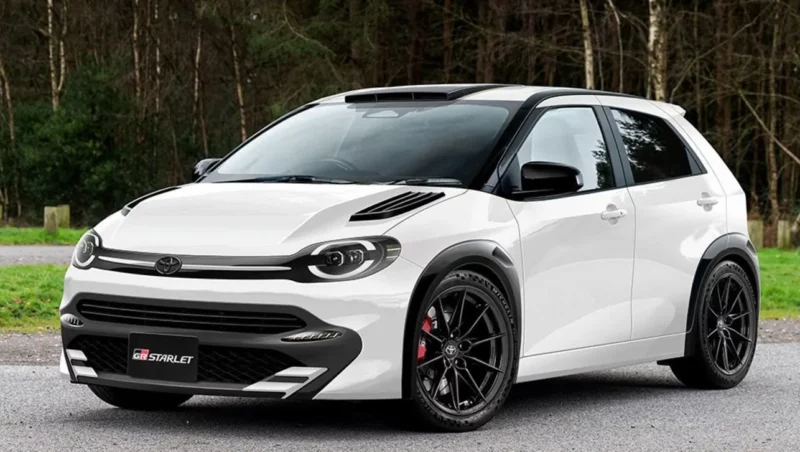
The news about the revival of the Starlet model has long been circulating online.
According to the Japanese publisher Best Car Web, Toyota is planning to reintroduce the Starlet model as a replacement for the discontinued Toyota Passo.
Not only that, the Gazoo Racing racing division also plans to produce a turbocharged hot hatch GR Starlet (unofficial name) that will serve as the basis for the WRC Rally 4 racing vehicle.
The new Starlet model may use the same TNGA-B platform as the Yaris, but with smaller dimensions.
Best Car Web estimates the dimensions of the Starlet to be 3,850 mm in length, 1,725 mm in width, 1,475 mm in height, with a wheelbase of 2,450 mm.
For comparison, the Toyota Yaris (TNGA platform) measures 3,940 mm in length, 1,745 mm in width, 1,500 mm in height, and a wheelbase of 2,560 mm.
Unlike the GR Yaris, which uses the G16E-GTS 1.6-liter turbo engine, the GR Starlet may use a more simplified powertrain.
According to sources, the new hot hatch will be equipped with a 1.3-liter turbocharged inline-three engine based on the earlier 1.6-liter turbo engine, producing about 150 hp, front-wheel drive system, and a six-speed manual transmission.
Due to the absence of the all-wheel-drive GR-Four system, it also contributes to a lighter weight, approximately 980 kg, or 300 kg lighter than the GR Yaris.
Additionally, the actual production model of the Starlet is expected to appear in 2026, while the rally car Starlet will showcase its prowess in the 2027 racing season.
Like other manufacturers, Toyota has also been affected by the decline in demand for electric vehicles.
According to the latest report from the Japanese newspaper The Mainichi, Toyota has reduced its global production target for electric vehicles by 30 percent by the year 2026.
The company is now aiming to produce around 1 million units, compared to the original plan of 1.5 million EV units.
Toyota, previously characterized as a ‘stubborn’ manufacturer, changed their electrification strategy early last year when their president Koji Sato announced a sales target of 1.5 million EV units by 2026.
The global EV market initially experienced rapid growth, thanks to the popular models produced by Tesla and BYD.
However, sales in the zero-emission segment have been slow as they have failed to attract interest from other consumer groups beyond early adopters due to high costs and charging infrastructure issues.
Throughout 2023, Toyota managed to sell 104,000 EV units, a fourfold increase compared to the previous year.
This figure is significantly small when compared to the total vehicle sales exceeding 10 million units.
In comparison to EVs, Toyota’s hybrid vehicles have been well-received as they offer a more practical solution in driving carbon neutrality missions.
Despite the plans to decrease EV production, Toyota will respond to current market demand by increasing production numbers for plug-in hybrid vehicles.
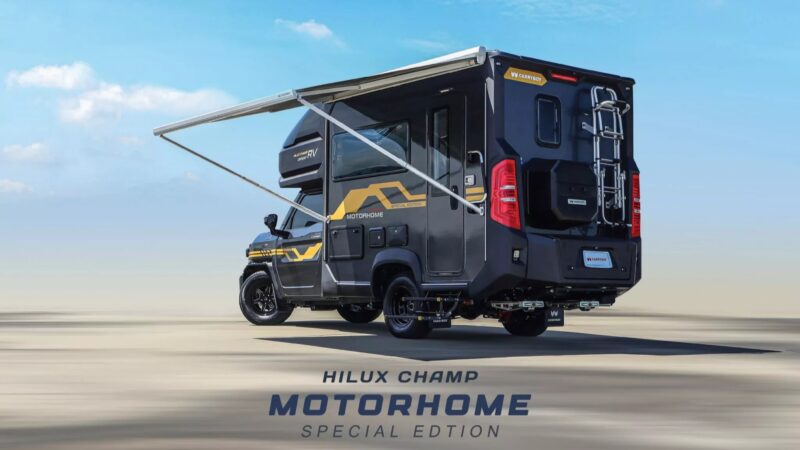
In the Thailand market, Carryboy company has begun offering full-spec motorhome packages for owners of the Hilux Champ pickup truck model who prioritize comfort while traveling.
The same module can actually be fitted onto larger pickup trucks like the Toyota Hilux and Mitsubishi Triton.
Depending on the selected specifications, this motorhome is capable of accommodating up to six people at a time.
It provides a living area that can be transformed into a sleeping area, in addition to other amenities such as LED lighting system, storage space, 80-liter refrigerator, cooking area, 32-inch TV, and air conditioning unit.
On the exterior, Carryboy also installs electric-powered side steps, awning roof, and a pull-out cooking option.
There is a 100-liter fresh water tank for the bathroom and toilet use.
The motorhome also comes with a 9,600 Wh capacity battery that can be upgraded to 19,200 Wh or 28,800 Wh for those who wish to remain off-grid for longer periods.
Owners can also take advantage of hot weather by installing solar panels on the roof to extend the battery life.
The engine power remains standard, with the 2.4-liter diesel heart capable of producing up to 148 hp and 343 Nm of torque to drive the rear wheels through the automatic gearbox.
However, Carryboy also offers an upgraded suspension system option with new shock absorbers that can further increase the ground clearance of the Hilux Champ.
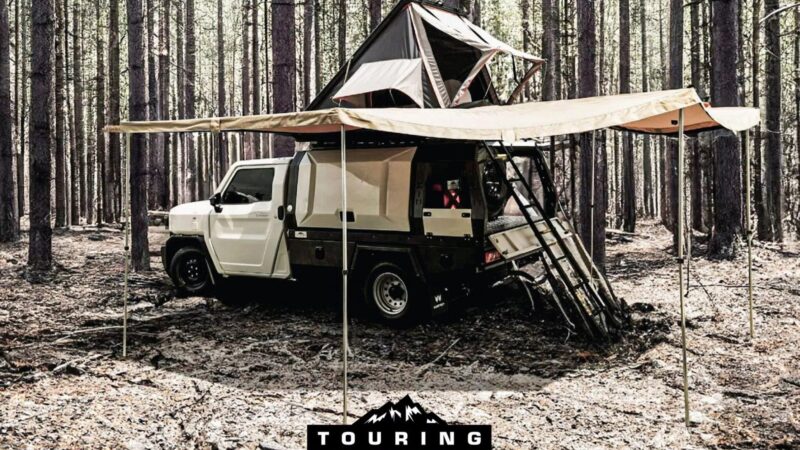
For those who prefer a more compact package, Carryboy offers the Touring Package, including a rear module with organized storage space, and a rooftop tent that can accommodate two adults.
The price for the Touring Package starts from THB 450,000 (RM57,298) for the rear module, and THB 32,500 (RM4,138) for the rooftop tent.
Those interested in the comprehensive motorhome package mentioned earlier can budget from THB 1,997,000 to THB 2,389,000 (RM254k-RM304k).
Despite carrying the Hilux name, the Hilux Champ actually has a smaller size and is positioned below the pickup truck model as a more compact and affordable alternative (priced from THB 459,000 or RM58,444).
For specific markets like North America and Europe, the ninth generation D-segment sedan Toyota Camry is exclusively a hybrid model and no longer available with a conventional petrol engine.
However, this does not signify that Toyota is completely disregarding the traditional powertrain units.
In the Middle East, buyers can still obtain the new generation Camry with a pure petrol engine along with hybrid variants.
It is still powered by a 2.5-liter inline-four cylinder engine producing 201 hp and 240 Nm, similar to that used in the previous generation.
This engine is paired with an eight-speed automatic transmission.
The exterior design of the Camry 2025 is not much different from what is offered in the U.S. market.
Base variants come with 16-inch steel rims, while the highest trim gets 18-inch alloy rims.
The cabin layout remains the same, with the base variant equipped with an 8-inch infotainment screen, while the 12.3-inch screen is reserved for the more expensive trims.
For your information, the new generation 2025 Toyota Camry retains the TNGA-K platform base used in the eighth generation Camry, with some changes made to comfort and handling aspects.
In the UAE, the 2025 Toyota Camry is sold starting from AED 109,900 (RM129,996) and from AED 123,900 (RM146,555) for the hybrid version.
The high-performance SUV genre is no longer an anomaly, considering many manufacturers are racing to produce their own unique products.
Not limited to producers such as Audi RS, Mercedes-AMG, and BMW M, there are also quick SUVs from premium automotive brands like Aston Martin, Bentley, and Lotus.
But what about Toyota?
For your information, Toyota still does not have a lineup of high-performance SUVs, but the manufacturer is said to be planning to produce a Gazoo Racing model in the near future.
During a visit to China to meet with Century SUV owners, Toyota Chairman Akio Toyoda disclosed plans to produce the Century SUV GRMN model so that “more people from around the world can enjoy the model.”
Built on the TNGA-K platform, the Century SUV is equipped with a V6 3.5-liter plug-in hybrid engine producing up to 406 hp.
At the launch of the Century SUV model, Toyota also unveiled a special build Century SUV GRMN model with a more sporty appearance and a sliding rear door design.
For this Gazoo Racing Meister of Nurburgring variant of the Century SUV model, we can expect significantly higher spec upgrades compared to the standard GR Sport and GR models (GR Yaris, GR Corolla, GR Supra).
The Century SUV GRMN model is owned by Akio Toyoda, who also has a Century GRMN sedan with a much more radical appearance than standard Century sedans out there.
UMW Toyota Motor (UMWT) has announced the opening of bookings for the new Hilux, Fortuner, and GR86, featuring several upgrades and enhancements.
Toyota Hilux
Toyota Hilux, the reigning pickup truck king in Malaysia, has been updated with Vehicle Stability Control (VSC) for the 2.4 Single Cab model.
It also comes with Remote Engine Start for selected variants, a first for a Toyota model. Activated through the Toyota My app, this function can also start the air conditioning to cool the cabin before entering the vehicle.
The Hilux 2.8 GR Sport, Rogue, and 2.4V variants are also equipped with the Panoramic View Monitor, while the GR Sport and Rogue editions feature wireless charging capability. The 2.8 GR Sport is powered by a 2,755cc engine with an output of 224PS and 550Nm of torque, while the 2.8 Rogue has an output of 204PS and 500Nm.
Meanwhile, the Hilux 2.4 generates 150PS and 400Nm of torque. The starting price for the Toyota Hilux is RM104,880.
Toyota Fortuner
The Toyota Fortuner now comes with GR body kit as an additional accessory for the 2.7 SRZ and 2.4 models. The kit includes front bumper skirting, fog lamp garnish, and rear bumper skirting.
Remote Engine Start is now available for the Fortuner 2.8 VRZ and 2.7 SRZ. The SUV is still offered with both petrol and diesel engine options.
The 2.7 SRZ petrol unit produces 166PS and 245Nm of torque, while the 2.8 VRZ diesel generates 150PS and 400Nm of torque. The Toyota Fortuner 2024 can be yours starting at RM195,800.
Toyota GR86
In the case of the Toyota GR86 sports coupe, both automatic and manual variants have been updated for better handling and response.
The throttle response has been retuned for more precise control, while the suspension has been refined for handling and road feel.
The steering system has also been recalibrated for a smoother feel. For the automatic transmission, new tuning allows for downshifting at higher RPMs, providing better control for the driver. The price for the 2024 Toyota GR86 starts at RM295,000
The first round of the seventh season of the Toyota Gazoo Racing Vios Challenge, which unfolded last Sunday, had the right mix to produce a more dramatic race weekend.
In addition to the debut of the new generation Vios racing car for the first time, it also became a battleground with changing weather conditions, sibling showdowns, international racer participation for the first time, and a resurgence of young driver dominance.
The first round saw a total of 33 cars battling it out in a challenging one-hour race format, different from previous seasons where drivers only had to compete in shorter sprint races.
In the Super Sporting class, Axle Sports’ driver Naquib Azlan emerged as the overall winner of the first round, taking home a prize of RM16,000.
Mitchell Cheah from Prima Pearl TD Racing came in second place, and Tengku Djan Ley (TD Racing) secured third place.
In the Sporting class, Kenneth Koh from PCM Group Racing Team emerged as the overall winner after improving his position in the second race.
Shafiq Shamsudin (Race Rally KL), who clinched the first race victory, seemed to swap places with Kenneth Koh in the second race, thus securing second place overall.
Meanwhile, Teo Hong Zhou (BAE Racing by ES Yang) finished third overall, after securing fourth place in the first race and second place in the second race.
The Rookie class, showcasing a lineup of young drivers, produced the same results in the second race as the first, with pro karter Adam Mikail clinching first place twice consecutively throughout the weekend.
Adam’s performance has exceeded expectations as a rookie, considering his ability to finish the race early compared to the Sporting class winner, securing a tenth place overall position in a grid of 33 cars.
The seventh season of the Toyota Gazoo Racing Vios Challenge also saw the participation of three young drivers: pro karter Audrey Leong (17 years old), simulation racer Raja Amirul (21 years old), and recreational karter Kingston Tan (19 years old).
The second round of the Vios Challenge will take place from September 27 to 29 at the PETRONAS International Circuit at Sepang.
As someone who isn’t particularly fond of SUV body types (except for a few models), the writer feels grateful that the majority of major automotive manufacturers in Malaysia are still trying to maintain sales of sedan models, despite their decreasing popularity on a global level.
Here, we have several options of sedan models, ranging from affordable prices to high-performance luxury sedan models with considerable prices.
Unfortunately, the competition in the sedan models segment is not as strong as it was decades ago.
For example, in the C segment, consumers are only presented with a few models, such as the Proton S70, Mazda3, Honda Civic, and the very popular name worldwide – the Toyota Corolla Altis.
The Corolla indeed needs no introduction, unless you were born during the Covid era and are only more familiar with those lifeless electric cars.
The Toyota Corolla 1.8G that we test drove is a facelift model launched last year.
Despite being a facelift, if you are expecting something ‘wow’, this 1.8G Corolla may disappoint those expectations.
This is because there are not many changes to the exterior of this sedan model, except for a unique bumper design, followed by new 17-inch rims wrapped in 225/45 profile tires.
The design of the front projector LED headlights and rear lights remain the same. Perhaps it’s already perfect, so there’s no need to change those aspects.
However, you need to enter the cabin to enjoy the changes brought by Toyota in this model.
The front seats have been redesigned for comfort, in addition to providing better support for the driver during spirited driving.
The major change is the presence of a 12.3-inch digital cluster screen, providing a concise interface, and most importantly still offering classic analog meter graphics.
In addition to wireless Apple CarPlay support, the Corolla also provides USB-C charging slots on the center console, as well as clips for holding smartphones in the wireless charging slot.
Apart from that, the basic specifications remain the same, such as a cargo space of 470 liters, MacPherson front strut and double wishbone suspensions, electric power steering system, and front and rear disc brake system.
The writer had the opportunity to test drive this Corolla further while on vacation to the East Coast a few weeks ago.
One main thing that the writer noticed was the quieter NVH levels compared to the pre-facelift Corolla.
The 137 hp and 172 Nm of torque produced by the 1.8-liter engine is sufficient to move this 1.3-ton body.
It is agile, and no lack of power was felt throughout the journey.
Perhaps it’s due to the mindset of drivers who consider the Corolla not a sports car, so the driving is done in a relaxed and straightforward manner.
However, you need to experience the magic of this TNGA platform when exiting the highway and entering winding federal roads.
There, you will find the MacPherson/Double Wishbone suspension setup in this Corolla working brilliantly with stable handling every time it encounters twists and turns.
Body roll is still felt, but at a controllable level even though this sedan is not equipped with a sportier suspension like the GR Sport variant.
Additionally, the electric power steering system also assists the driver in handling this sedan accurately without the need for constant correction.
Whatever the driver directs, the Corolla makes it happen.
Attempts to escape from the highway, sometimes with speed trap cameras, seem to have successfully made the writer fall in love with a rarely used road, through driving this Corolla.
Certainly, the cabin atmosphere is not disturbed by engine noise or the whistling of the wind, and even the noise of the Dunlop SP Sport Maxx tires is well-filtered.
For a standard factory sedan, the writer truly enjoyed a more enjoyable drive than a Corolla compared to the Honda Civic and Proton S70.
The standard seats are also comfortable enough to accompany us throughout the journey.
Although at times, this sedan needs to traverse roads with qualities similar to the surface of Mars, the passenger in the adjacent seat still sleeps soundly.
The 470-liter cargo space is sufficient to accommodate essential items during cross-country trips.
Unlike the Vios, you can fold the second-row seats to provide a larger space.
Fuel consumption is also satisfying, where the writer managed to achieve as low as 8.1 liters per 100 km, or approximately 680 km on a full tank.
Safety aspects need not be worried about, because this Corolla comes standard with Toyota Safety Sense.
Among the features included are the pre-collision system (PCS), lane departure alert (LDA), automatic high beams (AHB), blind-spot monitoring (BSM), rear cross-traffic alert (RCTA), and dynamic radar cruise control (DRCC), which is very useful on the highway.
Furthermore, there are also seven SRS airbags, seatbelt warning, as well as ISOFIX anchors for child seats in the rear.
At the end of the day, what the writer can conclude is that this Toyota Corolla 1.8G could be a worthwhile option for a family sedan to own and consider.
The facelifted Toyota Corolla offers a complete package for those who prioritize practicality and comfort without sacrificing enjoyable driving.
With a starting price of RM147,800 for the 1.8G variant, it’s not wrong for you to break away from the usual preference for the H logo, for this rather perfect companion for the return to the hometown.
Specifications of the Toyota Corolla 1.8G
Engine: 1.8-liter inline-four cylinder (2ZR-FE)
Power: 137 hp @ 6,400 rpm
Torque: 172 Nm @ 4,000 rpm
Transmission: 7-speed CVT
Suspension: MacPherson/Double Wishbone
Rim: 17 inches
Cargo: 470 liters
UMW Toyota Motor has announced the return of the Vios Challenge racing series for its seventh season, starting this weekend, offering a total prize value of RM630,000.
For this year, the Vios Challenge will feature up to three rounds and six individual races taking place at the PETRONAS Sepang International Circuit.
The first round of the Toyota Vios Challenge will take place from August 9-11 simultaneously with the Malaysian Championship Series (MCS), while the second round will be held from September 27-29. Both of these rounds will be broadcast live on Facebook and YouTube.
The final round will take place on January 3-5, 2025, open to the public with various attractions and programs planned to further enliven the atmosphere.
The seventh season of the Vios Challenge will feature three main classes: Sporting Class, Super Sporting Class, and TGR Rookie Class.
Among those expected to draw attention in the Super Sporting Class are three-time champion Tengku Djan Ley, Mitchell Cheah, Eddie Lew, William Ho, Tom Goh, and Freddie Ang.
Additionally, the Super Sporting Class will see the participation of young racers such as Putera Adam, siblings Naquib and Nabil Azlan, Bradley Benedict, Ady Rahimy, and Aman Nagdev from India.
The Sporting Class will list names like Dato’ Dr Ken Foo, Kenneth Koh, Dannies Ng, Shafiq Samsudin, Ricky Tan, Lim Chung Beng, as well as young racers Elson Yew, Amirul Haikal, Timothy Yeo, and Ashen Arumugam.
This class will also feature international racers, namely Panithan Rakpaibulsombut from Thailand and Daniel Inosuke Ooi from Singapore.
Meanwhile, the TGR Rookies will showcase a lineup of 24 young racers who have just completed the GAZOO Racing Young Talent Development Program.
Highlighted names include kart racer Brandon Ho (22 years old), Adam Mikail (18 years old), Amirul Afiq (22 years old), Audrey Leong (17 years old), Kingston Tan (19 years old), and simulation racer Raja Amirul (21 years old).
The seventh season of the Vios Challenge will serve as the main stage for the debut of the latest generation Toyota Vios racing car.
It still retains the 1.5-liter engine paired with a five-speed manual transmission, but with a more stable platform and chassis, and revised aerodynamics to enable it to achieve the fastest lap times.
In the final round of the GR GT Cup Malaysia simulation race held at Sunway University Campus the other day, Taj Izrin Aiman Taj Madira emerged as the champion for the fourth consecutive time.
The 26-year-old teenager has now become the most successful simulation racer in the GR GT Cup Malaysia series, accumulating a total of 59 points, leaving Chong Kai Chang in second place and 2022 champion Muhammad Iqbal Suji in third.
With a total prize pool worth RM120,500, the GR GT Cup Malaysia is the most lucrative simulation racing series ever organized in the country.
According to Taj Izrin Aiman, he made the decision not to change tires when the rain began to fall after two laps, and this bold move allowed him to overtake other racers.
Chong is satisfied with improving his position from third place last year to second place this year.
He, who took home the RM15,000 prize, often practices with his friends using various racing strategies due to the major update received by Gran Turismo 7 involving game physics several days before the final event took place.
The third place was taken by Muhammad Iqbal, bringing home a cash prize of RM12,000.
UMW Toyota’s President Datuk Ravindran K said, “Throughout the seven seasons of organizing the GR GT Cup Malaysia, the competition has become increasingly intense, and each year the driving skills and level of race craft displayed by the finalists are at a higher level.
“This is what we at Toyota aim to achieve, and I am very pleased that we can make an impact on motorsports in Malaysia, whether in the virtual world or through racing circuits such as the GR Vios Challenge and GR Young Driver Development Program.”
The GR GT Cup Malaysia 2024 also featured a race involving 10 finalists selected from the GR GT Cup Malaysia Campus Tour.
Among those who garnered attention was the presence of 14-year-old young racer Ethen Low from St Michael’s Institution, who managed to seize second place.
Meanwhile, Raja Amirul Syauqat has been selected to join the GAZOO Racing Young Driver Development Program and is expected to make an appearance in the Vios Challenge through the Rookie Class.
Additionally, there was a special race organized for Toyota GAZOO Racing rookie racers and media practitioners, aside from the Team Championship, where finalists from the GR GT Cup were combined with Campus Tour participants with the aim of finding new talent to be guided by professional racers.
Good news for those looking for a practical GR vehicle for daily use.
This is because Toyota has just updated the five-door hot hatch GR Corolla for the 2025 model year by offering an automatic gearbox as an option alongside the six-speed manual transmission variant.
The Direct Automatic Transmission (DAT) gearbox has made its official debut through the previous GR Yaris hot hatch model earlier this year.
Unlike the auto transmission found in the GR Supra and GR86, which shift gears based on speed and G-force, the GR Corolla gearbox uses input from the brake pedal and throttle to anticipate the optimal time to shift gears.
In addition, Toyota has also reprogrammed the automatic transmission to offer gear ratios almost equivalent to those of a manual transmission, in addition to coming with a standard transmission cooling system.
The G16E-GTS 1.6-liter turbocharged three-cylinder engine is capable of producing up to 300 hp, with the torque figure increased from 370 Nm to 400 Nm.
All 2025 GR Corolla variants now come standard with front and rear Torsen limited-slip differentials (LSD), along with a retuned suspension system for a more sporty driving experience.
For the 2025 model year, slight changes have been made to the front bumper where the GR Corolla now features improved brake cooling ducts and air curtains capable of reducing aerodynamic drag around the tires.
Toyota also offers an additional sub-radiator for extra cooling as standard for the Premium Plus model or as an option for the Premium model.
There have not been many changes made to the interior cabin, except for the addition of paddle shifters on the steering wheel, along with Launch Control system as standard for the DAT model.
Information regarding additional specifications and pricing will only be announced when the GR Corolla 2025 hits the dealerships in the upcoming winter season.
Toyota Research Institute (TRI) and Stanford Engineering said they have successfully performed tandem drifts with two self-driving Toyota GR Supras.
For nearly seven years, both teams have collaborated on research to make driving safer. But what does autonomous tandem drifting has to do with safety?
According to TRI, by adding a second car drifting in tandem, the teams have now more closely simulated dynamic conditions where cars must respond quickly to other vehicles, pedestrians, and cyclists.
Both cars were programmed to perform tandem drifting using the latest tools in AI. Algorithms on the lead car were developed at TRI, while Stanford engineers developed those on the chase car.
TRI focused on developing robust and stable control mechanisms for the lead car, allowing it to make repeatable, safe lead runs.
Meanwhile, the AI models and algorithms developed by Stanford enabled the chase car to adapt dynamically to the motion of the lead car so that it can drift alongside without colliding.
Both cars were modified by GReddy and Toyota Racing Development (TRD) and built to the same specifications used in Formula Drift competitions to help the teams collect data with expert drivers in a controlled environment.
Both are equipped with computers and sensors that allow them to control their steering, throttle, and brakes while also sensing their motion. The cars share a dedicated WiFi network that allows them to communicate in real time by exchanging information such as their relative positions and planned trajectories.
To achieve autonomous tandem drifting, the vehicles must continually plan their steering, throttle, and brake commands and the trajectory they intend to follow using a technique called Nonlinear Model Predictive Control (NMPC).
Toyota Japan has updated its offering of the rear-wheel-drive sports coupe model Toyota GR86 for the 2025 model year with the anticipated upgrades for its enthusiasts.
Compared to the previous GR86, Toyota claims the 2025 model is able to offer sharper handling and a more connected driving feel with the road.
Based on input obtained from racing circuits, Toyota has retooled the characteristics of the suspension system and the Electric Power Steering (EPS) control of this vehicle for more precise response and control without sacrificing stability.
For the manual transmission model, the traction control has been recalibrated to facilitate throttle blipping, in addition to offering smoother traction control response.
Toyota engineers also adjusted the engine speed tolerance aspect on the automatic transmission-equipped GR86 for a more sporty driving experience based on feedback from customers involved in motorsports.
Furthermore, the Toyota GR86 2025 has been updated with new features such as tire pressure warning system and Daytime Running Lights (DRL).
For those seeking something more exclusive, Toyota Japan has introduced the GR86 “RZ Ridge Green Limited” edition, limited to just 200 units.
It features an exclusive green color on the exterior, 18-inch silver-colored rims, Brembo vented brake rotors, SACHS shock absorbers, two-tone black/tan leather and suede upholstery, as well as special embroidery on the door panel.
The Toyota GR86 Ridge Green Limited edition is priced starting from ¥3,897,000 (RM114,560) and can only be purchased through a lucky draw system, with applications closing on July 28.
Those who miss out can still get the standard Toyota GR86 with a starting sales price of ¥3,195,000 (RM93,923) for the manual version, while the automatic version starts from ¥3,293,000 (RM96,804).
At the end of May, the Japanese automotive giant Toyota announced the development of a new 1.5 and 2.0-liter inline four-cylinder engine as a way to achieve carbon neutrality.
According to Toyota, the new engine is designed to be more compact and lighter, while at the same time capable of delivering higher power and offering better fuel efficiency.
Based on a recent video uploaded on the Toyota Times YouTube channel, the new engine is expected to be installed in a new model possibly being developed by Lexus.
The exterior design of the model is intentionally blurred, but from the cabin space, we can see the design of a four-door sedan that may refer to the new generation of Lexus IS.
The actual sporty sound of this new Toyota engine can be clearly heard as test driver Takashi Uehara shifts gears using paddle shifters. Toyota Times journalist Yuta Tomikawa, sitting in the passenger seat, seemed excited as the new sedan did not produce significant vibrations even when driven at high speeds.
According to Uehara, due to the more compact size of the engine, the new Toyota powerplant can be positioned further back. This lower center of gravity is seen to help control and reduce perceived cabin vibrations, as previously demonstrated in the Toyota Prius engine compartment.
Toyota claims that the 1.5-liter turbo engine is 20 percent smaller in size compared to the existing 2.5-liter NA engine, with a 15 percent weight reduction and a 30 percent efficiency increase.
Meanwhile, the 2.0-liter turbo engine will be 10 percent smaller and lighter than the existing 2.4-liter engine, with increased horsepower and a 30 percent fuel savings.
With the mentioned benefits, the new engine is also seen as having the potential to be installed in high-performance sports cars, such as the new generation Toyota GR86.
It is highly likely that this latest Toyota ICE engine will also be included in the upcoming Toyota Celica and MR2, which are said to be currently in development.
If you have the option to get a powerful and family-friendly hot hatch, the GR Corolla may very well be a suitable candidate.
Easy-to-control power, paired with a delightful clutch match, balanced suspension tuning, and most importantly an already aggressive appearance.
However, for a few owners who desire a more aggressive appearance for their GR Corolla, there is a solution offered by the leading tuner, Varis.
Starting from the front, Varis has developed a carbon fiber splitter priced at $1,695(RM7,984) for a fiercer look, followed by set of front turbulators priced at $645 (RM3,038) aimed at reducing drag and increasing downforce.
The side can be enhanced by the presence of a pair of carbon fiber side skirts priced at $2,295 (RM10,811), followed by the installation of carbon fiber rear diffuser at $845 (RM3,980), exhaust heat shield at $335 (RM1,578), and rear exhaust pipe protector priced at $695 (RM3,274).
Want a more aggressive look? Simply order a adjustable carbon fiber rear wing priced at $1,895 (RM8,926) and carbon fiber engine hood priced at $2,995 (RM14,108), but both components will take about 8 months to reach the customer’s hands.
As of now, Varis does not offer any mechanical modifications, meaning owners can still enjoy the standard 300 hp and 400 Nm torque from the G16E-GTS engine that powers all wheels through a six-speed manual transmission.
Unable to enjoy its second anniversary, the sales of the Toyota GR Supra sports car with a four-cylinder inline 2.0-liter engine for the United States market have been terminated this month.
In a press release, Toyota USA confirmed that the 2025 GR Supra model will only be available with a 3.0-liter turbo inline-six cylinder engine producing 382 hp and 499 Nm of torque.
Fortunately, buyers can still acquire the GR Supra 2025 with a choice of a six-speed manual transmission or an eight-speed automatic.
Toyota introduced the GR Supra with a 2.0-liter turbocharged heart (255 hp/400 Nm) in 2022 as a more affordable option, but this move was seen as not aiding in improving the already sluggish sales performance.
Throughout 2023, Toyota only managed to sell a total of 2,652 units of the GR Supra (manual and automatic models combined).
Returning to the GR Supra 2025, Toyota offers nearly identical features to the 2024 model, such as leather/Alcantara-trimmed sports seats or the option of grey leather, an 8.8-inch touch screen, wireless device charging, and a 500-watt JBL audio system with 12 speakers.
All models come equipped with Michelin Pilot Super Sport tires, TRAC grip control, Pre-Collision System, Lane Departure Warning, Vehicle Stability Control, Automatic High Beams, Tire Pressure Monitoring System (TPMS), and traditional Cruise Control.
The automatic transmission model also includes Dynamic Radar Cruise Control (DRCC) function.
The selling price has increased from US$56,495 (RM266,487) last year to US$57,345 (RM270,496), while the 3.0 Premium model now priced at $60,495 (RM285,355).
Based on a brief internet search, the Toyota GR Supra 2.0-liter is still available in the Japanese market, but only with an automatic transmission.
Those desiring a manual gearbox must opt for the inline-six cylinder version of the GR Supra.
The joy of a Toyota GR Corolla Circuit Edition owner was short-lived when the car’s battery died less than a month after purchase.
According to Anthony Do, the incident was caused by a GPS tracker installed on his car without his knowledge.
In a video lasting over five minutes, Do mentioned that before discovering the hidden GPS tracker, he saw a Facebook post by a GR Corolla tuner who claimed that he couldn’t work on the car due to a similar device.
Subsequently, Do decided to pry open the lower part of his car’s dashboard panel to see for himself. Lo and behold, Do actually found a GPS tracker plugged into the OBD2 port of his car.
This was strange to Do as he stated that he turned down the dealer’s offer to install a GPS tracker when buying the GR Corolla. He further claimed that he purchased the car outright, so the dealer or financial institution had no reason to track his vehicle.
Why is this concerning?
Firstly, the data obtained (such as the vehicle’s location) can be used by irresponsible parties to commit crimes such as car theft. Secondly, the data can also be sold to third parties such as insurance companies.
In Malaysia, Toyota vehicles sold by UMW Toyota Motor can be optionally fitted with Vehicle Telematics System (VTS), which utilises GPS data to track the location of vehicles in real time in case of theft and to keep track the distance and trip history.
The VTS will also dispatch an SOS call to the Toyota call center in case of an accident.
For Toyota enthusiasts, they may be eagerly anticipating the emergence of new sports car models such as the successors to the MR2 or Celica.
However, Toyota cannot haphazardly spend money on research and development (R&D) for a product targeted towards a niche group.
Previously, Toyota has collaborated with Subaru to develop the GR86/BRZ, followed by BMW for the GR Supra/Z4. The Japanese brand is determined to release more sports cars, but they acknowledge the challenges of going solo in this endeavor.
Speaking to the Australian media, Toyota Gazoo Racing President Tomoya Takahashi stated, “the sports car market is shrinking in the future. We cannot sustain sports cars as a single brand, Toyota. Collaboration between brands will increase in the future.”
He further expressed, “this mission is not about helping manufacturers survive but to protect car enthusiasts. This is why we need to collaborate to share costs and subsequently implement sports car projects.”
Similar to a rapidly expanding restaurant, Toyota has a few new ‘menus’ that will be served to its customers. Among those on the list are the affordable FR coupe S-FR, the FWD hot hatch Starlet, the Celica coupe, MR2, and a Toyota GR GT3 race car prototype already spotted at the Spa-Francorchamps circuit.
However, before launching impractical sporty models, Gazoo Racing will likely introduce a lineup of high-performance SUVs tailored for families seeking more space.
Malaysia’s Leading Automotive News | ENGEAR ENGLISH