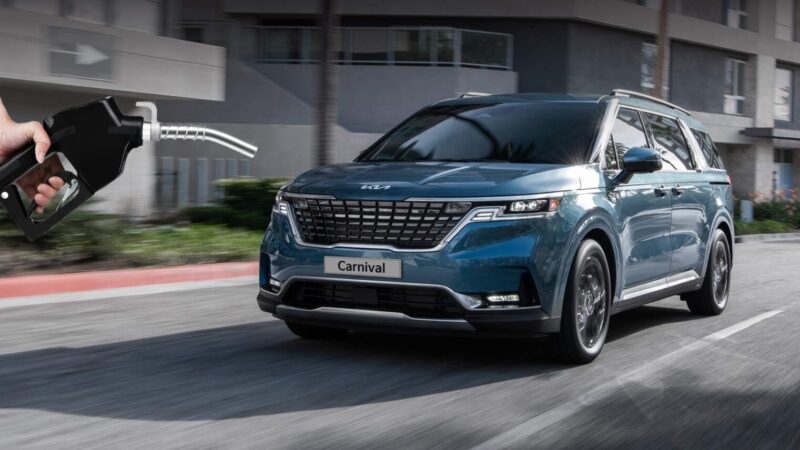
Kia Sales Malaysia (KSM) has announced the introduction of the 8-seater Kia Carnival for the local market, with a selling price of RM238,888.
The addition of this new variant complements the existing offerings, which include the eleven-seater variant priced at RM188,888 and the seven-seater variant at RM248,888.
Unique Second Row Features
The 8-seater variant offers a 2-3-3 seating configuration with soft leatherette upholstery.
The second row includes a 40:20:40 split, a remote sliding function, and can be adjusted to face either forward or backward.
The third row can be folded with a 60:40 split to allow for more flexible cargo and passenger arrangements.
Features Similar to the Seven-Seater Variant
This new variant also comes equipped with a curved panel that integrates a 12.3-inch digital cluster screen and a 12.3-inch infotainment screen.
Additionally, it features a Bose audio system with 12 speakers.
The Kia Carnival eight-seater is powered by a 2.2-liter Turbo Diesel Smartstream engine, producing 202 PS @ 3,800 rpm and 440 Nm @ 1,750-2,750 rpm.
Fuel consumption is approximately 6.5 liters/100 km (WLTP data), allowing for a range of over 900 km on a full tank.
Safety Features
Safety features include eight airbags, as well as Advanced Driver Assistance Systems (ADAS) similar to those in the seven-seater variant, which comprise:
Every purchase comes with a 5-year warranty or a mileage limit of 150,000 km (whichever comes first).
KSM is also offering interest rates as low as 1.98 percent per annum for financing periods of up to 9 years, or a fuel credit of RM6,000 through the ‘We Fuel You’ initiative.
Through Kia Cares, KSM provides a comprehensive insurance package with benefits such as:
Agreed value coverage for up to 15 years
Claim approval for amounts under RM30,000 within 24 hours
Free betterment for up to 10 years, and no excess for selected incidents
Kia Sales Malaysia (KSM) today officially launched the facelifted 2026 Kia Carnival, marking the first model since its inception.
The 2026 Kia Carnival is a locally assembled unit (CKD) and is offered in two variants:
2.2D 11-seater
2.2D 7-seater
Both variants are powered by a 2.2-liter Smartstream turbo diesel engine producing 202 PS at 3,800 rpm and a torque of 440 Nm at 1,750-2,750 rpm.
The engine is paired with an eight-speed automatic transmission driving the front wheels, delivering a fuel consumption rate of 6.5 liters per 100 km.
Exterior
The Carnival facelift showcases a new image based on the Opposites United design philosophy, featuring all-new headlights, a wide grille, and redesigned taillights.
The 11-seater variant is equipped with 18-inch wheels, while the 7-seater variant boasts 19-inch wheels.
Interior
Inside, the vehicle includes features such as a 12.3-inch digital cluster display and a 12.3-inch infotainment screen integrated into a single panel, a leather-wrapped steering wheel, and a dual-zone climate control system.
The new Carnival also supports Apple CarPlay and Android Auto.
The 11-seater variant features foldable middle seats in the second and third rows for easier passenger access.
Meanwhile, the 7-seater variant has a seating arrangement of 2-2-3, followed by Premium Relaxation seats in the second row with side slide functions, and third-row seats that can be folded flat.
Special features for the 7-seater variant include a head-up display, heated and ventilated seating functions, and a Bose audio system with 12 speakers.
Cargo Space
The 11-seater variant offers a cargo space of 56 liters, which expands to 2,689 liters.
The 7-seater variant provides even more cargo space, around 627 liters, and up to 2,827 liters when the seats are folded down.
Safety Features
As standard, the Kia Carnival facelift is equipped with eight airbags, ABS, EBD, Brake Assist, Traction Control System (TCS), Hill Assist Control (HAC), ISOFIX anchors, and Auto Hold functionality.
Advanced safety features, known as ADAS, are available for the 7-seater variant, including functions such as:
High Beam Assist (HBA)
Blind Spot Collision Avoidance Assist (BCA)
Blind Spot Monitoring System (BSM)
Lane Keeping Assist (LKA)
Driver Attention Warning (DAW)
Forward Collision Avoidance Assist (FCA)
Lane Follow Assist (LFA)
Pricing
The 2026 Kia Carnival facelift is priced starting from RM188,888 for the 11-seater variant and RM248,888 for the 7-seater variant.
Kia Sales Malaysia Sdn Bhd (KSM) has officially launched its operations in Malaysia, announcing a restructuring of the pricing for its existing product portfolio.
Effective January 1, 2026, Malaysians can acquire Kia models at new prices as follows:
Kia Sportage
2.0G 2WD – RM128,800
2.0G 2WD Hi – RM138,800
1.6T 2WD Hi – RM158,800
1.6T 4WD Hi – RM178,800
Kia Carnival
2.2D 8-Seater – RM193,000
2.2D 7-Seater – RM218,000
Kia EV9
GT-Line AWD 7-Seater – RM368,888
GT-Line AWD 6-Seater – RM373,888
All new Kia vehicles in Malaysia come with a valid warranty of five years or a mileage limit of 150,000 km, whichever comes first.
To enhance owner confidence, KSM has also implemented the following measures:
A 15 percent reduction in the average price of genuine Kia spare parts.
The establishment of a dedicated spare parts warehouse in Shah Alam.
Additionally, KSM has established the Kia Circle customer loyalty program, which offers a cash rebate of RM6,000 to existing Kia owners for upgrading to a new Kia vehicle.
This program also extends to immediate family members, including parents, spouses, and children.
Additionally, KSM will be introducing Kia Professional, a corporate fleet and professional programme which offers exclusive concessions of up to 3 percent to members of professional bodies and major companies for individual vehicle purchases, along with tailored incentives for larger fleet purchases.
As a complement, KSM offers comprehensive protection through Kia Cares, an insurance program backed by Berjaya Sompo, Zurich, and Zurich Takaful.
Kia has officially revealed the second generation of the B-segment Kia Seltos SUV for the global market.
Unlike its predecessor, the new Seltos is built on the K3 platform, contributing to its larger dimensions and aggressive image that aligns with Kia’s latest design language.
Here are some key facts you need to know:
1. Dimensions
The 2026 Kia Seltos measures 4,430 mm in length, 1,830 mm in width, and 1,600 mm in height, with a wheelbase of 2,690 mm.
These larger dimensions also provide a more spacious cabin, with cargo space now increased to 536 liters.
Depending on the variant, the Kia Seltos can be equipped with wheel sizes ranging from 16 inches to 19 inches.
2. Engine, Transmission, Drivetrain & Suspension
To start, the 2026 Kia Seltos will be offered with two engine options: a 1.6-liter T-GDI engine producing either 180 PS/265 Nm or 193 PS/265 Nm, and a 2.0-liter NA engine generating 149 PS and 179 Nm.
Kia has also listed various transmission options including a six-speed manual, six or seven-speed DCT, eight-speed automatic, and CVT.
The Kia Seltos will be available in front-wheel drive with a MacPherson/torsion beam suspension setup, while the AWD version will come with a multi-link setup at the rear.
A hybrid variant is expected to follow next year, featuring vehicle-to-load (V2L) functionality and Kia’s 3.0 smart regenerative braking system.
Driving modes include Eco, Normal, and Sport, along with a Terrain Mode (Snow, Mud & Sand) specifically for the AWD variant.
3. Aggressive Design
The Kia Seltos adopts the Opposites United design philosophy, presenting an image consistent with modern Kia vehicles.
Unique features include:
Vertical LED daytime running lights (DRL)
Headlights hidden within a wide grille structure
A floating roof design
Door handles integrated into the body
Vertical taillights connected by a horizontal LED bar
There is an X-Line variant that features dark gunmetal accents for a more rugged appearance, while the GT-Line variant has a sportier look with body color accents.
Three new colors have been introduced: Iceberg Green, Gravity Gray, and Magma Red.
4. Cabin
The layout of the cabin in the 2026 Kia Seltos more closely resembles offerings in Kia’s electric vehicles, featuring a dual 12.3-inch display and dedicated climate control panels.
The Seltos also incorporates Shift-by-Wire (SBW) technology, placing the gear shift lever on the steering column to enhance the practicality of the center console.
Other features included in the Seltos cabin are:
A panoramic sunroof
64-color ambient lighting
24-degree adjustable second-row seating
Harman Kardon/Bose audio system
5. Safety
Finally, the 2026 Kia Seltos is equipped with a range of advanced safety features (ADAS) that include functions such as:
The South Korean automotive brand, Kia, is making a comeback in the Malaysian market, now directly managed by Kia Corporation instead of through a distributor.
In a recent event, Kia Sales Malaysia Sdn Bhd announced its leadership team, which will spearhead sales operations in Malaysia, consisting of:
President & Chief Executive Officer: Hyung Ho Kim
Managing Director: Emily Lek
Director of Product & Government Relations: Hafiz Zaim
Executive Sales Manager: Victor Chan
Executive Manager of Ownership: Rafhan Saiah
Executive Marketing Manager: Vince Yeoh
Executive Channel Manager: Phang Chee Wei
Under the direct principal leadership model, which will take effect on January 1, 2026, KSM will fully control the brand’s presence, marketing, sales, ownership experience, and training throughout Malaysia.
Kia will also focus on three key areas to strengthen its position in Malaysia.
The primary objective is to implement global operating standards to solidify the foundation for growth while concentrating on branding and marketing strategies that address the question, “Why Choose Kia?”
Secondly, KSM plans to rebuild its dealer network to ensure peace of mind for customers.
Lastly, KSM aims to enhance its product lineup to ensure each product meets the needs of the Malaysian market.
According to Hyung Ho Kim, “Globally, Kia is the 9th largest automotive manufacturer in the world. Our focus is to move forward at a sustainable pace for the long term.
“Our goal is not just to become a rapidly growing brand but to be a brand that pays attention to customers, dealers, and the Malaysian automotive industry,” he explained.
Emily Lek stated, “This is a significant time for us to begin our re-entry into the Malaysian market as an independent entity.
“The brand is no longer represented by a distributor but is led by the parent company that fully controls our voice, values, and vision. With a robust system and a clear plan, we are ready to restore the true Kia brand experience.
For information, Malaysia houses the Kia Asia Pacific headquarters, serving as a strategic think tank for the Asia region.
Kia APAC oversees six subsidiaries, including Kia Sales Malaysia (KSM) and its manufacturing unit, Kia Malaysia.
Additionally, Kia APAC manages operations in 33 markets, including ASEAN countries, Australia, and New Zealand.
Kia holds a 3.4 percent market share in the APAC region, with sales exceeding 165,000 units recorded in 2024.
After four years, Kia Corporation and Bermaz Auto Berhad have officially ended their strategic partnership, marking a new era for Kia’s operations in Malaysia.
Effective January 1, 2026, Kia Sales Malaysia will take over all aspects of sales, after-sales, marketing, customer service, and training across Malaysia from Bermaz.
The new entity will be led by Hyung Ho Kim as President and CEO, with Emily Lek serving as Managing Director, who previously worked at Omoda | Jaecoo Malaysia.
In an official statement, Ki Seok Ahn, President and CEO of Kia Asia Pacific, stated, “Kia is very excited to reinforce its brand presence in Malaysia.
“We believe that our customer-centric strategies and innovations will continue to enrich the customer experience as we support the growth of Malaysia’s economy and automotive industry.”
Kia Sales Malaysia will also focus on enhancing the Kia dealership network, investing in after-sales services, and introducing new models in the near future.
During this transition period, any orders placed before November 30 will be fulfilled as scheduled.
Customers can begin placing orders for new vehicles starting in January 2026 to facilitate a smoother operational transition.
In late 2020, Kia introduced the Carnival Hi Limousine variant, featuring a taller roof design compared to the standard Carnival.
This is not merely a roof storage box added to the Carnival; rather, it is a raised roof section that provides a larger cabin space.
For the updated 2026 model year, the Kia Carnival Hi Limousine has received several new features and, for the first time, a hybrid engine option.
There is a choice of seven or nine-seat configurations for the Noblesse version, whereas the more luxurious Signature version can only accommodate four people at a time.
The Signature trim not only features captain’s seats complete with footrests, but also offers a massage function and special storage for shoes.
Passengers in the second row must share a control screen to adjust settings, along with a 21.5-inch screen mounted on the ceiling.
Additionally, there are wireless smartphone charging slots, coat hooks, a refrigerator, and a Bose audio system with 12 speakers.
To ensure the comfort of VIP passengers in the rear, Kia has added soft padding, sound dampening, and lowered the height of the rear seats.
In terms of power, the Carnival Hi Limousine is available with a 3.5-liter V6 engine producing 290 hp, and a 1.6-liter turbo hybrid engine capable of generating 242 hp.
Unfortunately, there is no 2.2-liter diesel engine option offered for the Carnival Hi Limousine.
In the South Korean market, the 2026 Kia Carnival Hi Limousine is priced from 63.27 million won (RM192,000) to 97.8 million won (RM297,000) for the Signature Hybrid variant.
The SUV segment in Malaysia is truly vibrant, featuring a variety of models and brands, both local and foreign.
It can be overwhelming if you are unsure of the criteria to consider.
If you are looking for something that stands out from the typical SUVs on the roads, we recommend the Kia Sportage 1.6T AWD as a solid choice.
It has everything you need for a daily-use vehicle, and most importantly, the driving satisfaction you crave.
What’s the point of buying an expensive car if you’re not satisfied with the driving experience, right?
Below is our opinion after borrowing this Kia Sportage from Kia Malaysia for a week.
Exterior Design: too striking?
For your information, the Kia Sportage marketed here is the pre-facelift version that has been around since 2021.
The more aggressive facelift version was launched in South Korea at the end of 2024; however, to say that the design of the Sportage is outdated would be inaccurate.
Even in its pre-facelift version, the Kia Sportage remains eye-catching when cruising on the road.
With boomerang LED graphics both at the front and rear, as well as a low roofline at the back, the Sportage exudes the sporty image it aims for.
At the very least, it is an original design that can make owners satisfied when they look at it, rather than resembling any other model.
If you don’t turn back to admire your car after parking, you might have bought the wrong vehicle.
Dimensions
The AWD version of the Kia Sportage measures 4,660 mm in length, 1,865 mm in width, and 1,665 mm in height, offering a wheelbase of 2,755 mm.
As a C-segment SUV, the Kia Sportage provides a comfortable cabin space for the whole family.
The absence of a panoramic sunroof is not a major issue, as headroom in this cabin is sufficiently spacious.
Rear passengers can also adjust the angle of their seatbacks for a more comfortable sitting posture, so they don’t have to remain upright all the time.
The Kia Sportage offers a standard cargo space of 543 liters, which can expand to a remarkable 1,829 liters with the second-row seats folded down.
Pleasant Features
One of the aspects I appreciated about the Kia Sportage is its driver-friendly dashboard layout.
In addition to the dual 12.3-inch curved screens, the Sportage dashboard features a touch-based control panel complete with physical knobs.
You can adjust the cabin temperature or change the media content playing through the eight speakers of the Harman Kardon audio system from this panel.
For me, this is a user-friendly feature that is highly welcome.
This is because most manufacturers tend to crowd the central screen with various functional buttons, requiring a search and potentially distracting the driver.
The center console also houses several important function buttons that are clear and easy to reach.
The PRND shift-by-wire dial certainly gives the cockpit a more spacious feel; however, there are times when I found the unconventional gear shifting somewhat awkward.
The digital cluster display in the Sportage continues to offer analog meter graphics with several themes that can be selected according to the driving mode (Eco, Normal, Sport, Smart).
Don’t worry— the infotainment screen also provides standard support for Apple CarPlay and Android Auto. You won’t have to wait for over-the-air (OTA) updates.
If you notice, the back of the front passenger headrest features a large hook that is perfect for hanging bags or shawls.
Additionally, there are a few “teh tarik” hooks provided, making the Kia Sportage more user-friendly for Malaysians than some Malaysian-branded SUVs available on the market.
What About the Driving Experience?
The unit we tested is equipped with a 1.6-liter turbocharged inline-four Gamma II T-GDI engine that produces 177 hp at 5,500 rpm and 265 Nm of torque at 4,500 rpm.
This power is transmitted to an all-wheel drive (AWD) system via a seven-speed dual-clutch transmission (DCT).
As experienced during the media test drive, the Kia Sportage 1.6T AWD offers somewhat sluggish response at low rpm ranges.
This presents some challenges when maneuvering in low-speed situations, such as in parking areas, where the Sportage hesitates to deliver power.
However, once this SUV reaches normal cruising speeds, the cabin feels quieter, with minimal vibration and roughness.
This is attributed to the MacPherson strut front suspension and multi-link rear suspension, which work effectively to absorb road imperfections.
It also allows the SUV to feel stable in corners with body roll that isn’t overly pronounced, making the driving experience more enjoyable.
However, if driven aggressively, these advantages can disappear. Therefore, it’s crucial to understand the limits and constraints of the Kia Sportage.
I have no comments regarding the handling of this SUV, as it meets what one would expect from a Kia vehicle.
The precise and responsive steering assist keeps me focused on the winding roads ahead, allowing the vehicle to comply with every direction given by the driver’s hands.
There are times when the steering correction system engages to ensure the SUV stays on course, but its operation never feels tiring or annoying.
Safety Features
The Kia Sportage offers a comprehensive range of safety features, including six airbags, ABS, ESC, and an extensive list of advanced safety technologies.
What I want to emphasize here is the Blind-Spot Monitoring (BVM) system, which displays what is in the blind spots to the left and right of the vehicle when the turn signal is activated.
This system, found in any Kia model (including Hyundai), significantly aids in detecting objects (cars, motorcyclists) that are typically obscured in the blind spot.
Other manufacturers offer more advanced 360-degree cameras that provide a bird’s-eye view.
However, most of the time, these are more for show, as they display images of the car being driven rather than what is concealed in the blind spot.
Sportage for Weekend Getaways
Another feature I appreciate about the Kia Sportage is the rear seats that can fold flat.
There’s no need to spend money on a tent; you can transform the back of the Kia Sportage into a ‘temporary tent’ for relaxing weekend activities.
In the cargo area, there is a 12V power outlet that can be used for charging smart devices or powering light equipment.
Additionally, there is a ‘Sound of Nature’ feature available in the Sportage’s infotainment screen to accompany your activities.
While enjoying leisure time, don’t forget your obligations as a Muslim.
If you wish to fulfill your prayer duties while camping, the Kia Sportage also features a qibla direction compass to serve as a guide.
Conclusion
Is the Kia Sportage 1.6T AWD the best SUV in its class?
Undeniably, the Kia Sportage has its unique advantages compared to competing models in the market.
It has a striking design, a practical package, spacious and comfortable cabin space, and nearly comprehensive safety features.
However, if you’re willing to compromise on the weaknesses mentioned, we believe that the Kia Sportage can be a worthwhile purchase.
Specifications of the Kia Sportage 1.6T AWD (RM186,899)
Engine: Gamma II 1.6-liter turbo, four-cylinder inline
For those who missed the news, Kia has produced a genuine ladder-frame pickup truck to compete against rivals like the Toyota Hilux and Ford Ranger.
It has become a hot topic due to Kia’s somewhat unusual design approach.
However, if you are still interested in Kia products and want to hide that peculiar appearance, ARB, an off-road accessory company, has some offerings.
Among them is a front bull bar complete with a skid plate and recovery points.
There is also a larger bull bar with fender bars connected to a side step structure for a more aggressive look.
In addition, ARB offers several bed structure options, including an enclosed cargo space for storing camping or woodworking equipment.
Customization according to individual needs is also possible.
Other accessories that can be installed include roof racks, additional LED lights, and foldable ladders.
Given the higher ground clearance depicted in these generated images, it is not impossible that ARB will offer a suspension upgrade kit for the Kia Tasman model.
Besides ARB, Kia itself offers various accessory packages that can be directly fitted from the factory, including sport bars, off-road bumpers, snorkels, and accessories for canopies and truck beds.
Following the reveal of the Kia EV4, Kia has unveiled another purpose-built electric vehicle, the Kia PV5.
In terms of design, the Kia PV5 does not present significant differences compared to the PV5 Concept that was showcased over a year ago.
The Kia PV5 is available in both passenger van and cargo van versions.
The main difference between the two models is the presence of side windows in the passenger van, while the cargo van features sliding doors on both the left and right sides of the vehicle, along with twin tailgate openings at the back.
In addition, both models share similar design elements, such as LED daytime running lights (DRL) located at the end of the windshield, followed by the charging port and headlight unit in the center of the front fascia.
It also features relatively large door handles and vertical rear light units.
According to Kia, in addition to the passenger van and cargo van configurations, buyers will also have the option to choose from several other configurations for the PV5 or customize specifications according to their needs.
The full specifications of the Kia PV5 will be officially revealed on February 27.
The new generation of the Kia Sportage was officially launched at the end of last year as a locally assembled unit (CKD), although it actually arrived somewhat late compared to other markets.
With a competitively priced package accompanied by appealing specifications, the Kia Sportage has the potential to be an alternative in a market dominated by Japanese SUVs such as the Honda CR-V and Toyota Corolla Cross.
Based on a short test drive recently, the writer was generally satisfied with what the Kia Sportage offers.
Not all vehicles are perfect in their offerings; there are a few minor weaknesses present in this C-segment SUV.
However, for us, these are minor issues if you can tolerate the shortcomings and prioritize driving satisfaction.
Not Everyone is Fond of the Rotary PRND Dial
The variant we tested is equipped with a 1.6-liter turbo engine paired with a dual-clutch transmission (DCT) and e-shift functionality.
This means it does not come with the conventional gear lever commonly found in other SUV models.
The benefit of using a rotary dial is that it creates a more spacious cockpit appearance, but not everyone appreciates this feature.
Personally, I prefer a physical PRND gear lever, which is easier to control and aligns better with the muscle movements we are accustomed to.
Empty Function Buttons on the Center Console
Kia Sportage Euro spec
Located next to the rotary PRND dial, you will notice a cluster of empty function buttons on the center console.
It is unfortunate that these function buttons are not assigned any features, unlike international specifications that offer features like heated steering wheels and heated or ventilated seats.
It appears empty and gives the impression that the Sportage 1.6T is a lower variant.
Climate Control Panel May Be Difficult to Use
Another interesting feature of the Kia Sportage 1.6T is the touch-based climate control panel and infotainment system located below the central air vents.
Essentially, the driver no longer needs to dig through control menus typically embedded in the infotainment screen.
However, it operates using a touch system, and at times it can be a bit difficult to control, especially for drivers with larger fingers.
This is Kia’s latest electric model, the Kia EV4, the fifth model in the Kia “EV” series, following the EV3, EV5, EV9, and EV6 models.
Built on the E-GMP platform and featuring a design approach similar to its siblings, the Kia EV4 will be available in both hatchback and sedan (fastback) versions.
Both hatchback and sedan models share the same front design, including the EV Tiger Face, headlight units, and LED daytime running lights at the end of the bumper, along with protective plastic cladding on the wheel arches.
The key distinguishing factor between the two models is undoubtedly the design at the rear.
For the sedan version, the Kia EV4 showcases a ‘long tail’ design concept inspired by iconic supercars, followed by a more streamlined roofline towards the back and vertical taillight units.
In contrast, the hatchback version features a more conventional and dramatic light structure, a smaller rear window, and is topped off with a roof spoiler.
Buyers will also have the opportunity to purchase the Kia EV4 in the GT-Line variant, which offers 19-inch wheels, along with sportier front and rear bumpers.
More details, including the cabin design, will be revealed ahead of the official global launch at the end of this month.
A few days before the Chinese New Year celebrations, Dinamijaya Motors, the sole distributor of Kia vehicles, invited automotive media practitioners to test the newly launched C-segment SUV – the 2025 Kia Sportage.
For your information, our market has been somewhat slow to embrace this Sportage model, as the fifth generation was introduced as early as 2021.
However, there is no need for concern, as the launched Sportage units are CKD (Completely Knocked Down) vehicles produced at the Inokom plant in Kulim, Kedah, meaning they come with a very competitive price.
We had the opportunity to test drive the two highest variants, the Sportage 1.6T 2WD High and 1.6T AWD High.
Here are our first insights based on the short test drive we conducted recently:
1. A More Striking Exterior Design
The exterior design of the Kia Sportage represents a significant shift from the previous generation.
Employing an approach known as “Opposites United,” the Kia Sportage features an aggressive front design, beginning with its signature tiger nose grille and boomerang-shaped LED daytime running lights (DRL) that separate the grille from the main headlights.
This boomerang element is also mirrored in the rear lights, though with a smaller opening.
The SUV’s side profile is enhanced by an elongated chrome strip that adorns the lower edge of the glass housing, as well as black finishes at each wheel arch.
This aggressive design could be a ‘plus point’ for owners seeking something different on the road, and may particularly appeal to those weary of the ubiquitous Chinese SUVs.
Nonetheless, it’s wise to introspect and consider personal tastes before making a decision.
2. Driver-Oriented Cockpit Design
I am quite fond of the layout of the all-new Kia Sportage dashboard.
It is neat and, most importantly, designed with the driver in mind, as the central screen and control panel at the base of the air conditioning vents are angled towards the driver.
With an optimal driving posture, there’s no difficulty in reaching the aforementioned components to adjust settings while driving.
Although there are no physical buttons for the air conditioning system, the touch-based panel is user-friendly, allowing drivers to avoid digging through settings embedded in the main display.
What makes the front row seem more spacious is the presence of a rotary PRND knob in the central console.
Additionally, physical buttons remain in that area for essential functions like drive mode selection, Auto Hold, and the surround camera.
For fans of Apple CarPlay and Android Auto, rest assured that these features are indeed available in the Kia Sportage.
3. Comfortable and Practical Cabin
Positioned as a C-segment SUV, the Kia Sportage serves as an alternative for those who aren’t fond of larger SUVs like the Kia Sorento.
With dimensions close to those of a Honda CR-V, space is certainly not an issue for the Kia Sportage.
Importantly, rear passengers can enjoy a more generous recline angle, whether they prefer a more upright position or a comfier angle during their journey.
One feature that I appreciate about the Kia Sportage is the presence of a large hook on the headrest structure that can be used to hang jackets, shopping bags, or scarves.
The cargo space measures a generous 543 liters as standard, and can expand to 1,829 liters when the second-row seats are folded.
4. Driving Performance
To be honest, the driving experience offered by the Kia Sportage meets expectations.
With precise and responsive steering, I encountered no issues while handling this C-segment SUV, whether on the highway, at the Karak Circuit, or on winding rural roads.
Moreover, the steering correction system operates in a driver-friendly manner, not too aggressively to the point of annoyance, unlike some competitors’ models.
The Kia Sportage 1.6T can generate a power output of up to 177 hp and 265 Nm, paired with a seven-speed dual-clutch transmission (DCT).
Starting with the 1.6T AWD unit, the acceleration response felt somewhat less spirited compared to the 2WD variant we tested after lunch.
However, this isn’t a significant downside if you’re not a heavy-footed driver.
You should also know the next advantage of the Kia Sportage: a quiet cabin at normal speeds.
With a suspension setup effective for varying road conditions in Malaysia, it is also challenging to perceive significant vibrations and harshness in the cabin, unless driven more aggressively.
5. Price
The Kia Sportage 2025 for the Malaysian market is sold starting at RM149,781.78 for the 2.0G variant, while the unit we test drove starts at RM179,599 for the 1.6T 2WD variant, and from RM189,599 for the AWD variant.
What are the differences between the 1.6T 2WD and 1.6T AWD variants?
Only three aspects differentiate these two variants: the all-wheel drive system with a differential lock, roof rails, and an eight-speaker Harman Kardon audio system.
Therefore, choosing the 1.6T 2WD model is perfectly valid as it is also equipped with comprehensive safety features, including six airbags, a blind-spot collision warning (BCW), high beam assist (HBA), blind-spot monitoring (BVM), and intelligent cruise control (SCC).
We will share more information in a more comprehensive test drive article coming soon.
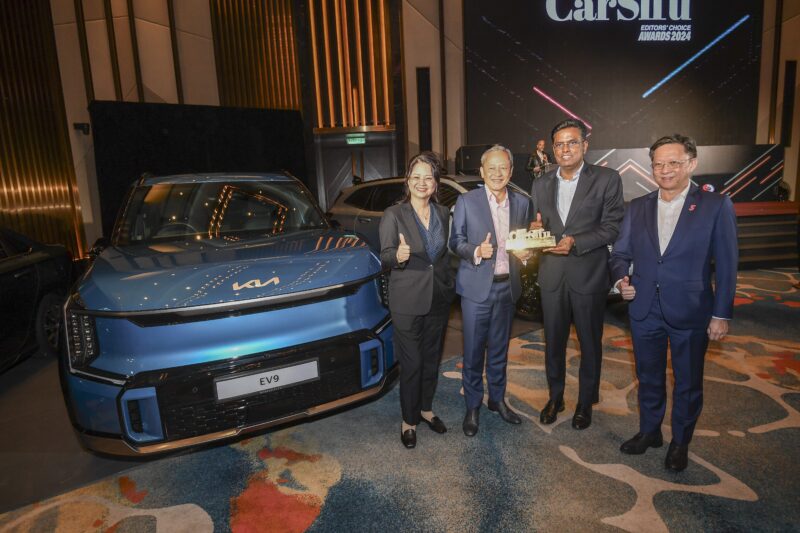
The Kia EV9 has successfully clinched two awards at the recently held Star Carsifu Editors’ Choice Awards 2024.
The electric SUV, featuring three rows of seating, won the award for Electric Car of the Year and Best Electric Luxury 3-Row Seating Vehicle.
According to Dato Wong Kin Foo, Managing Director of Dinamikjaya Motors Sdn Bhd, “We remain committed to closely collaborating with Kia to select the models that best suit the Malaysian market.”
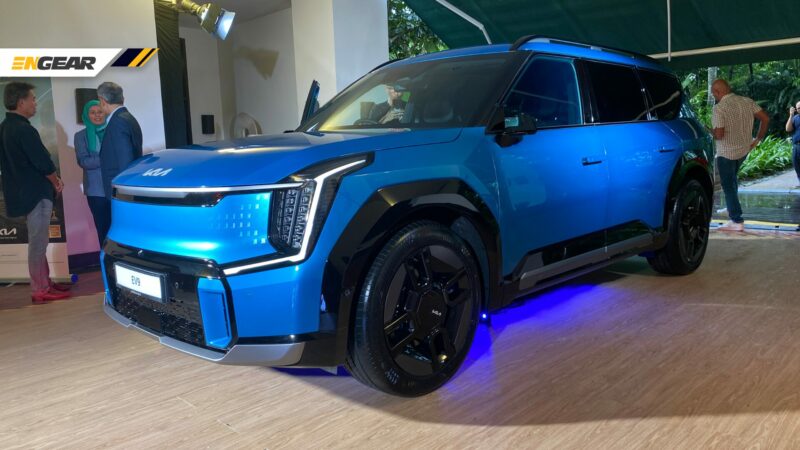
The Kia EV9 officially debuted in the Malaysian market in May 2024, showcasing features such as a dual electric motor setup with 380 hp and 700 Nm of torque, as well as a 99.8 kWh battery pack that offers a driving range of up to 505 km.
This electric SUV is built on the Electric Global Modular Platform (E-GMP) and follows the Opposites United design philosophy, which integrates elements such as the Digital Tiger Face, Digital Pattern Lighting Grille, vertical lighting units, and the LED Star Map lighting system.
The cabin of the Kia EV9 offers a spacious and comfortable configuration for either six or seven passengers, complemented by a minimalist dashboard layout featuring dual 12.3-inch touchscreen displays and sustainable materials.
The starting price for the Kia EV9 is RM368,888 for the 7-seater version and RM373,888 for the 6-seater variant.
Kia has introduced its latest compact crossover, the Syros, which will compete in the Indian market. Although it may resemble the EV9, the automaker’s latest offering is powered by an internal combustion engine paired with a manual transmission.
It is also significantly smaller compared to the colossal electric SUV, measuring 3,995 mm in length, 1,800 mm in width, and 1,665 mm in height, with a wheelbase of 2,550 mm. The Syros is built on the K1 platform, which is also used by the Hyundai Casper.
Despite the size difference, the Syros incorporates several design elements found in the EV9, such as ice cube-shaped LED headlights, Starmap LED taillights, and Kia’s Digital Tiger Face.
Its futuristic appearance is further enhanced by 17-inch Crystal Cut alloy wheels, flush door handles, and puddle lights with Kia logo projection.
The interior layout is also reminiscent of the EV9, albeit on a smaller scale. According to Kia, the Syros is equipped with various segment-first features, including a 30-inch Trinity Panoramic Display comprised of two 12.3-inch screens and a five-inch climate control display.
Additionally, it offers wireless Apple CarPlay and Android Auto, a wireless phone charger, a Harman Kardon premium sound system with eight speakers, and a 64-colour ambient lighting system.
Kia stated that the Syros also comes with a call center-assisted navigation system that allows drivers to receive real-time guidance. Software and connectivity features will be updated over the air (OTA).
Another segment-first feature introduced by the Syros is the sliding and reclining, 60:40 split rear seats, which also come with ventilation. Behind the rear seats is a fairly large boot space with a capacity of 465 litres.
In terms of safety, the Syros comes with six airbags and a Level 2 ADAS system that includes 16 features such as Front Collision Warning, Forward Collision Avoidance Assist, Lane Keep Assist, Lane Departure Warning, Lane Follow Assist, and Smart Cruise Control with Stop & Go, among others.
Customers can choose between two available engines: a Smartstream 1.0-litre turbo petrol engine producing 120 PS and 172 Nm, or a CRDi 1.5-litre diesel engine with 116 PS and 250 Nm. In addition to a manual transmission, an automatic transmission option is also available – both tasked to drive the front wheels.
Dinamikjaya Motors Sdn Bhd (DJM), the official distributor of the Kia brand in Malaysia, has launched the fifth generation Kia Sportage in the local market.
This locally assembled C-segment SUV, produced in Kulim, Kedah, is now open for bookings. It is available in four variants with two engine options as follows:
2.0G 2WD – RM149,781.78
2.0G 2WD High – RM159,781.78
1.6T 2WD High – RM179,599
1.6T AWD High – RM189,599
As you can see, the launched Sportage is the pre-facelift version, not the recently introduced facelift variant.
DJM stated that, for now, the facelifted Sportage is only available in South Korea; however, the SUV is expected to arrive in the local market within the next two years.
The 2.0G variants are powered by a Smartstream 2.0-litre engine that produces 156 hp and 192 Nm, paired with a six-speed automatic transmission.
Meanwhile, the 1.6T variants feature a Gamma II 1.6-litre turbo engine with a power output of 177 hp and 265 Nm. Power is transmitted to the wheels via a seven-speed DCT gearbox.
In terms of equipment, the SUV is fitted with a 12.3-inch digital instrument cluster, Apple CarPlay and Android Auto, as well as ambient lighting. Higher variants will also feature a dual-zone climate control system and Harman Kardon audio system.
Safety features include Forward-Collision Avoidance Assist (FCA), Lane Keeping Assist (LKA), Blind-Spot Collision-Avoidance (BCA), Rear Cross-Traffic Collision Avoidance (RCCA), among others.
For the Malaysian market, the Sportage is offered in four colours: Astra Blue, Meteor Grey, Jet Black and Snowflake White Pearl.
Finally, DJM will provide a five-year warranty and a complimentary five-year service package.
In Malaysia, when discussing luxury MPVs, whether one likes them or not, the vehicles that invariably come to mind are the Toyota Alphard and Vellfire.
From time to time, names like the Mercedes-Benz Vito and Lexus LM may cross the lips of those with a penchant for the luxurious, but ultimately, the Alphard and Vellfire are consistently top of the list.
This is hardly surprising, as this writer is certain that both models are indeed impressive and worthwhile purchases. However, if you are seeking something different, their closest competitor, the Kia Carnival, proves to be a worthy alternative.
Why, you may ask?
First and foremost, it’s about size. In this writer’s opinion, those who purchase MPVs often rank size as one of the highest criteria before making a decision.
Therefore, if you desire a vehicle that is spacious and roomy, look no further than the Carnival, which is appreciably larger than the Alphard/Vellfire.
For comparison, the Carnival measures 5,155 mm in length, 1,995 mm in width, and 1,740 mm in height, with a wheelbase of 3,090 mm.
In contrast, the Alphard/Vellfire duo is somewhat smaller, with a length of 5,010 mm (5,005 mm for the Vellfire), a width of 1,850 mm, a height of 1,950 mm, and a wheelbase of 3,000 mm.
In terms of design, the Carnival boasts a sportier appearance that resembles a sleek long wagon due to its lower and wider body shape. This is further accentuated by 19-inch black alloy wheels replacing the previous 18-inch versions.
While the Toyota MPVs are not unattractive, their boxy design does come across as somewhat conventional when positioned alongside their Korean counterpart.
As for the interior, this writer can confidently assert that the quality and features offered by the Carnival are on par with those of the Japanese models, even though the price difference among these vehicles can be as much as RM300,000.
It’s true that the Alphard/Vellfire feel a touch more luxurious due to their Lexus-like touches and higher-grade materials such as genuine Nappa leather upholstery. However, the Carnival still impresses.
The materials covering the seats, dashboard, and door panels feel sufficiently high-quality, as do all the physical buttons present throughout.
The Carnival is replete with features, including a 12.3-inch digital instrument cluster, a 12.3-inch touchscreen, Apple CarPlay, Android Auto, a three-zone climate control system, heating and ventilation functions for the front seats, and a Bose audio system with 12 speakers.
Moreover, the High variant of the Carnival is now equipped with Blind Spot View Monitor (BVM) that displays video feed from the side mirror cameras on the digital instrument cluster, a feature that can be activated when you use the turn signals.
In summary, this writer can confidently say that the quality and features provided by the Carnival justify its price tag of almost RM250,000.
The unit that this writer recently test drove was the eight-seat variant featuring a 2-3-3 configuration. The centre seat in the second row is larger enough for adult passengers, and when not in use, it can fold down to create a small table complete with two cup holders.
What’s even more interesting is that this seat can be rotated backwards to face the third-row seats or can be completely removed if desired.
For any MPV, the best seat in the house is usually in the back, and the Carnival does not disappoint in this regard, ensuring passenger comfort with its individual climate control for the rear, as well as retractable sunshades and a sunroof.
Additionally, children need not dispute over charging points for their gadgets, as every seat in the Carnival comes with its own USB port.
It is common for three-row vehicles to have limited cargo space when all seats are in use, but with the Carnival, this is not a concern, as there is a generous, deep storage area located beneath the third-row seats.
Now, how does it perform on the road?
The Carnival is powered by a Smartstream 2.2-litre turbodiesel engine, paired with an eight-speed automatic transmission that drives the front wheels.
This engine generates 202 PS at 3,800 rpm and an impressive 440 Nm of torque, available from as low as 1,750 rpm. While the 2.4-litre turbo engine in the Alphard offers slightly more horsepower, the Carnival’s torque advantage (10 Nm more) does not go unnoticed.
As expected from a diesel engine, the torque is readily available in the lower rpm range, making the Carnival feel smooth from a standstill. In fact, its acceleration is fairly smooth and quick, which is not something you can always say about a vehicle weighing close to two tonnes.
On the highway, the engine remains exceptionally quiet. Should you find yourself needing to overtake, there’s no need for concern over power since it consistently feels adequate, even in Normal mode.
The gearbox is responsive, allowing you to quickly accelerate everytime the accelerator pedal is depressed. It also promptly downshifts to deliver the necessary power for easy overtaking.
With the recent diesel subsidy rationalisation, some may harbour concerns regarding the Carnival’s fuel consumption.
For your information, this writer recorded a fuel efficiency of around 15 km/l or 6.7 l/100 km during a mixed driving cycle that included both urban and highway conditions.
The Carnival boasts a 72-litre fuel tank, meaning that theoretically, the vehicle could be driven nearly 1,080 km before needing to refuel.
If you’re paying full price for diesel at RM3.35 per litre, a complete fill-up would cost approximately RM241.20. Is it worthwhile to spend RM241.20 for a driving range exceeding 1,000 km? That’s for you to decide.
Lastly, the Carnival’s suspension tuning and NVH (noise, vibration, and harshness) are noteworthy. The suspension is relatively soft, allowing for a confident ride over uneven surfaces without the constant need to apply the brakes.
Nevertheless, there is something about this suspension setup that instils a sense of confidence and stability, especially at higher speeds. This is what makes the MPV enjoyable to drive fast.
The NVH aspect has been carefully addressed, ensuring that as a passenger, you experience a comfortable journey, with wind and tyre noise significantly minimised. The sound of the diesel engine is only noticeable if you stand outside the vehicle.
In conclusion, there is little more that this writer can say about the Carnival except that it is exceptionally good, enjoyable to drive, and packed to the brim with features and tech to meet the needs of buyers in this segment. What’s even better is that its competitive pricing makes it accessible to a broader range of potential MPV buyers.
However, it cannot be denied that the rationalisation of diesel subsidy may lead some to reconsider their decision to purchase the Carnival.
But, for this writer, if you are in a position to spend over RM200,000 on a large MPV, you are likely capable of managing the fuel costs without subsidy.
Dynamikjaya Motors (DJM), the official distributor of Kia vehicles in Malaysia, has confirmed that the fifth generation Kia Sportage will make its debut at the Kuala Lumpur International Motor Show (KLIMS) 2024 this December.
According to the company, the C-segment SUV is locally assembled (CKD) in Kulim, Kedah. Bookings have already opened at all authorised Kia dealerships nationwide, although the pricing has yet to be announced.
As can be seen, the soon-to-be-launched Sportage is the pre-facelift model and not the recently introduced facelift version.
In a FAQ, DJM stated that currently, the facelifted Sportage is only available in South Korea but the SUV is expected to arrive in the local market within the next two years.
The Sportage will be offered with two engine options: the Smartstream 2.0-litre petrol engine (156 hp/192 Nm) paired with a six-speed automatic transmission, and the Gamma II 1.5-litre turbocharged engine (177 hp/265 Nm) with a seven-speed DCT.
Features-wise, it will come equipped with a 12.3-inch digital instrument cluster, Apple CarPlay and Android Auto, as well as ambient lighting, dual-zone climate control, and a Harman Kardon audio system for the higher variants.
Safety systems will include Forward-Collision Avoidance Assist (FCA), Lane Keeping Assist (LKA), Blind-Spot Collision-Avoidance (BCA), Rear Cross-Traffic Collision Avoidance (RCCA), and more.
Finally, DJM will offer a five-year warranty and a complimentary five-year service package.
Hybrid cars still not sufficient to eliminate range anxiety?
Do not worry, as Kia now offers a hybrid crossover product that can travel up to 1,600 km, namely the Kia Niro Tri-Fuel.
It features a combination of a 1.6-liter Smartstream engine with 89 hp power along with a 43 hp electric motor, making the total power output approximately 126 hp and 264 Nm.
Unlike the regular Kia Niro Hybrid, the Kia Niro Tri-Fuel has two fuel tanks, consisting of a 41.6-liter petrol tank and a 40-liter propane (LPG) tank positioned under the cargo floor.
The third ‘tank’ present in the Kia Niro is actually a 1.3 kWh battery pack.
With two full tanks (along with the battery pack), the Kia Niro Tri-Fuel can be driven up to 1,600 km, while reducing CO2 emissions by 6 percent compared to the standard hybrid model.
To switch from petrol to LPG, the driver can press a special button provided alongside the ignition button, as well as check the remaining LPG fuel capacity.
The LPG system installation process is carried out by the gas equipment company BRC, but owners can still enjoy a full warranty for up to seven years or a mileage limit of 150,000 km.
According to Kia, Niro Tri-Fuel owners can save on fueling costs up to €5,000 (RM23,453).
The selling price of the Kia Niro Tri-Fuel starts from €34,450 (RM161,591) and can reach up to €39,200 (RM183,872) for the premium variant.
Currently, the sale of Kia Niro Tri-Fuel is limited to the Italian market only.
Dinamikjaya Motors Sdn Bhd, the sole distributor of the Kia brand vehicles in Malaysia, has launched a special campaign for the Kia Carnival model.
The “Fuel-on-Us” campaign, which runs from October 1 to December 31, 2024, allows new Kia Carnival owners to enjoy subsidized diesel prices at RM1.05/liter for a period of five years without worrying about changes in fuel prices every week.
To participate in this campaign, customers must register their purchase of the Kia Carnival through any authorized Kia dealer during the campaign period.
Each purchase is eligible for only one application.
The Kia Carnival comes with a 2.2-liter turbo diesel engine producing 202 PS and 440 Nm of torque.
With a fuel tank capacity of 72 liters, the Kia Carnival offers a fuel consumption rate of 6.5 liters/100 km, providing a range of up to 850 km on a full tank of fuel.
In Malaysia, the Kia Carnival is offered in three main variants, with prices starting from RM198,500.
Malaysia’s Leading Automotive News | ENGEAR ENGLISH