
Tag Archives: V6 engine

Mazda once made an MX-5 with a V6 engine some time ago

Since its first launch in 1989, the Mazda MX-5 (Miata) has maintained the same recipe.

A small and lightweight body, and a minimalistic design.

The difference in horsepower between the first-generation and fourth-generation models is not too vast.

But did you know that Mazda once tried to produce the MX-5 with a V6 engine?


A 20-Year-Old Experiment

Christian Schultze, Director of Research and Operations at Mazda Motor Europe, confirmed that this occurred around 20 years ago.

This may have happened during the transition from the second-generation MX-5 (NB) to the third-generation MX-5 (NC).

Speaking to AutoRAI, he revealed that the V6 2.5-liter MX-5 project was driven voluntarily by a group of engineers.

Although it was not explicitly stated, it is likely that it used the K-Series engine that Mazda employed in production cars like the 626 and MX-6.

With significantly more power output compared to the NB engine (140 hp/161 Nm), the V6 MX-5 offered a more exhilarating driving experience.


Two Main Issues

Schultze admitted that there were two main issues that prevented the project from progressing beyond the prototype stage.

First, the V6 engine was too tall, making the overall aesthetics of the car less appealing.

Second, using the V6 engine would affect the overall weight balance, as the 2.5-liter engine is heavier than the existing engine.


What about the new-generation MX-5?

The fourth-generation MX-5 has been on the market for 11 years now, and it is time for Mazda to replace this roadster with a completely new model.

If the MX-5 were offered in a hybrid version (complete with an electric motor and battery), how would Mazda ensure the existing lightweight car recipe is maintained?

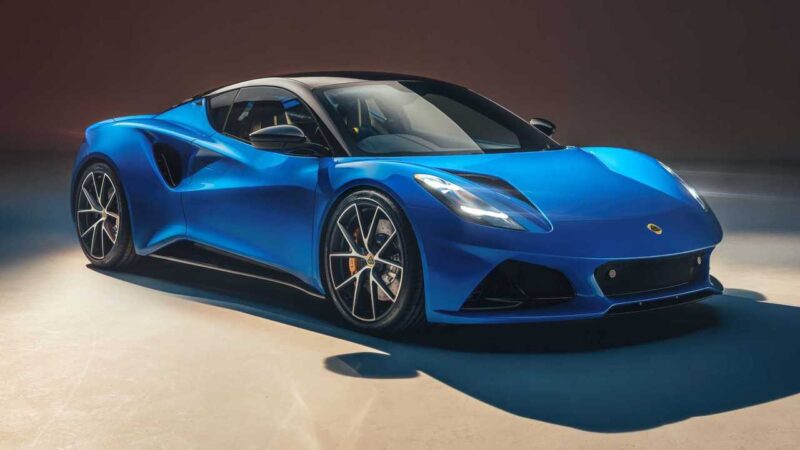
Lotus Emira to receive V8 engine replacement for V6

The Lotus Emira is currently the only pure internal combustion sports car still offered by Lotus to its enthusiasts.

Before production of this model ends in 2027, Lotus is reportedly planning improvements to the model, particularly for the United States market.

According to recent reports from Autocar, Lotus is considering a V8 engine for the Emira.

Its CEO, Feng Qingfeng, stated that the brand is exploring the feasibility of a V8 engine to replace the currently used V6 engine.

The Lotus Emira is available with a 3.5-liter supercharged V6 sourced from Toyota, or a 2.0-liter engine from Mercedes-AMG.

Feng dismissed the idea of increasing the power of the existing V6 engine, citing that the Toyota engine is unable to meet the stricter Euro 7 standards.

Lotus previously planned to gradually phase out the V6 offering to make way for the AMG-powered model.

However, with strong demand for the six-cylinder model in the United States, Lotus is prompted to consider the proposal of installing a larger engine.

Lotus Europe CEO, Matt Windle, told Autocar, ““The US is an incredibly important market for us for the car. It always has been. So we’re looking at the market demand for the product going forward.”

He further explained that the company is exploring several options that could be implemented to ensure the full potential of the Emira can be realized, including possibly matching engines from existing suppliers—most likely Mercedes-AMG.

Ferrari F80, LaFerrari successor with 1,184 hp twin-turbo hybrid V6 engine!

Ferrari has finally unveiled the hypercar F80, the successor to iconic models like the GTO, F40, F50, and Enzo, following over a decade since the launch of the LaFerrari.

Despite not featuring the iconic V12 engine, the Ferrari F80 remains the most powerful model ever built by the Prancing Horse marque, boasting a total power output of 1,184 hp.

More than half of this horsepower is contributed by the 120-degree V6 engine, where the internal combustion engine alone can unleash a high 888 hp and 740 Nm, far surpassing the 296 GTB model.

The engine is aided by three electric motors, two at the front producing 282 hp each and a third at the rear generating 80 hp.

This makes the F80 the first Ferrari hypercar to feature all-wheel drive (AWD) system. Unfortunately, no EV mode is provided despite having three electric motors.

Instead, drivers can choose from three driving modes – Hybrid, prioritizing energy recovery and battery charging, Performance, and Qualify for full power.

There is a technology called Boost Optimization, where the system identifies sections on the track that need additional power thrust and is ready to unleash that power when necessary.

For this flagship model, the Ferrari F80 showcases a carbon fiber monocoque chassis, with the front and rear sub-frames made of aluminum.

This asymmetrical design provides a 1+1 seating configuration, allowing the driver’s seat to be adjusted while the passenger’s seat cannot.

The exterior of the F80 also features design cues from previous Ferrari models. For example, the front visor is inspired by the Daytona model, followed by angular front fenders and rear fenders reminiscent of the iconic F40.

The aerodynamic aspects of the F80 draw heavily from Ferrari’s expertise in Formula 1, capable of generating up to 1,000 kg of downforce at a speed of 249 km/h.

The CCM-R Plus brake system developed with Brembo offers 100% better mechanical strength than conventional carbon brakes, along with 300% better heat conduction rate.

There are two tire options – Michelin Pilot Sport Cup 2s or Pilot Sport Cup 2Rs, sized at 285/30 at the front and 345/30 at the rear.

In addition to sharing the same engine as the 296 GTB, the F80 also shares the same suspension system settings as the Purosangue.

The spool-valve Multimatic damping system can offer a balance between performance handling and quality driving, while sidelining the use of traditional anti-roll bars.

Not forgetting, the active safety system includes automatic emergency braking, lane departure warning, lane-keeping assistance, automatic high-beam assistance, and traffic sign recognition.

Only 799 units of the Ferrari F80 will be produced starting from the end of 2025, each commanding a starting price of €3.6 million (RM16.87 million).