In the past, the name “Cross Country” was used by Volvo to bridge the gap between wagon models and SUVs.
However, it is now being applied to the brand’s most compact SUV, the Volvo EX30 Cross Country.
This rugged version of the Volvo EX30 features unique characteristics, such as matching protective plastic paneling, a skid plate, and exclusive 18-inch rims fitted with all-terrain tires.
Additionally, Volvo has modified the rear suspension settings of the EX30 Cross Country to better handle more challenging terrains.
At the front, a black panel displays a relief map of the Kebnekaise mountain range in Sweden.
As standard, the Volvo EX30 Cross Country is equipped with a dual electric motor producing 422 hp and 542 Nm of torque, paired with a 69 kWh battery pack.
While the originally stated range of 427 km may be difficult to achieve with the aforementioned all-terrain tire setup, there’s no need to worry.
The Volvo EX30 supports DC fast charging at 153 kW, allowing the battery to charge from 10 to 80 percent in just 28 minutes.
Launched in Malaysia last September, the Volvo EX30 is, without a doubt, an exciting electric vehicle. Firstly, it is a small car (it’s the smallest Volvo to date) and this makes it perfectly suited for urban driving.
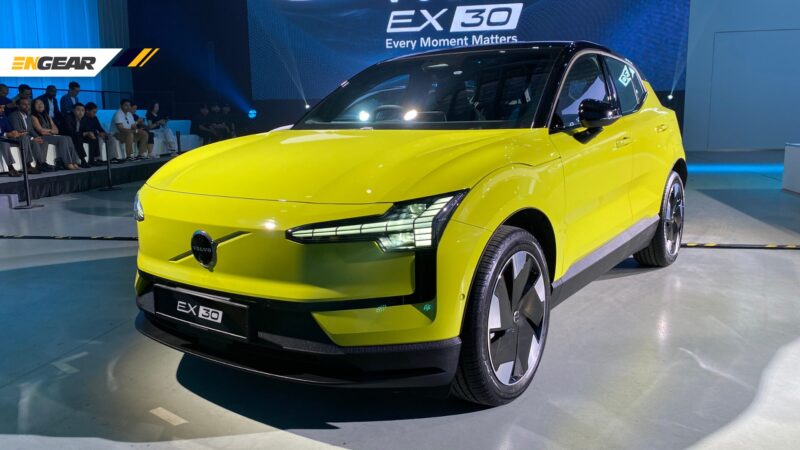
Secondly, with its pixelated Thor hammer lights, short front and rear overhangs, and wide stance complemented by large wheels, the EX30 presents a modern and sporty appeal that is sure to attract younger buyers.
Thirdly, if you opt for the top variant, the Ultra Twin Performance, you can outperform most modern sports cars and supercars in 0-100 km/h acceleration without breaking a sweat. The EX30 achieves this impressive feat in just 3.6 seconds but first, you’ll need to activate the Performance AWD mode buried somewhere in the infotainment system.
However, there are still three aspects of the EX30 that the writer finds less than ideal. Let’s take a look at them:
Overreliance on the screen
Similar to other Volvo models, the EX30’s cabin design emphasises a minimalist concept. However, unlike the C40, XC90, and several other Volvo models that still feature physical buttons for audio controls and gear levers, the EX30 has no physical buttons apart from two power window switches on the center console.
This means that control for the infotainment system and climate control must be done through the touchscreen. While this isn’t unusual for an EV, as many other manufacturers follow suit, with the EX30, users may find it awkward since they also have to use the touchscreen to adjust the side mirrors and open the glove box.
Lack of head-up display
Perhaps in an effort to maintain a clean and tidy dashboard consistent with its minimalist design, the EX30 lacks a digital instrument panel. One might expect Volvo to offer a head-up display (HUD) as an alternative, but strangely that’s not the case.
Instead, all driving-related information (speed, gear position, and ADAS functions) is displayed on the touchscreen. This arrangement has two drawbacks: first, you have to divert your attention from the road to check this information; and second, all of it is displayed at the top of the screen in relatively small font.
Soundbar not as good as we expected
The EX30 does not come with conventional speakers on the front and rear door panels to create additional storage space. Instead, Volvo has placed a Harman Kardon soundbar that covers the entire width of the dashboard.
While it certainly looks appealing— and as we know, Harman Kardon audio quality is among the best in the industry— the absence of speakers in the rear diminishes the overall music listening experience, as the sound is concentrated only at the front of the cabin.
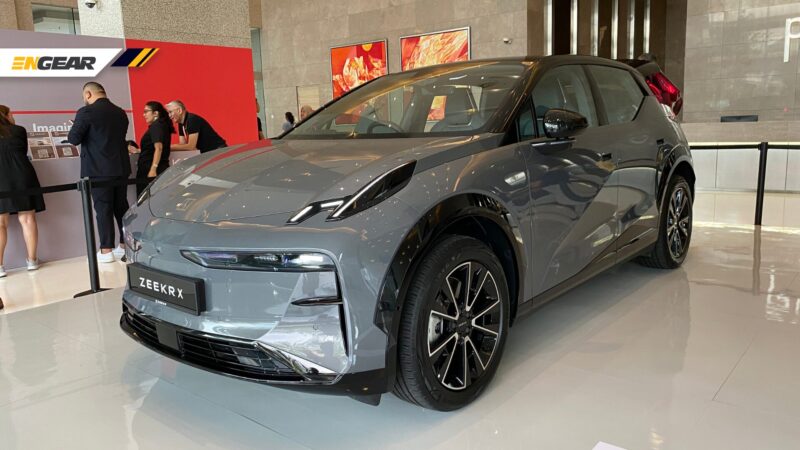
In addition to the luxurious MPV 009, Zeekr Malaysia is also set to launch an electric crossover known as the X to heat up the competition in the local EV market.
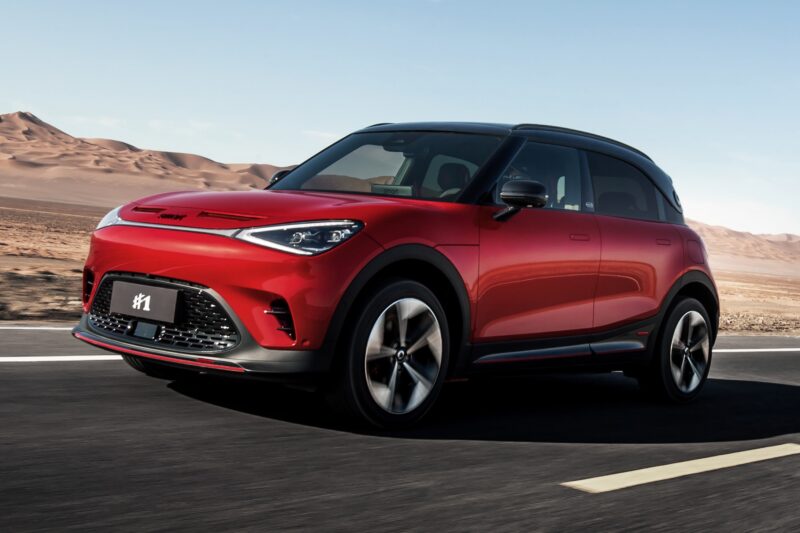
For your information, the X actually has ‘siblings’ that have already been launched in Malaysia, specifically the smart #1 and #3, along with the Volvo EX30.
What is the connection between the X and these three models? Interestingly, despite their very different designs, all of them share the same ‘skeleton’ that is the Sustainable Experience Architecture (SEA) platform developed by Geely.
This is not surprising, as smart, Volvo, and Zeekr all operate under the Geely umbrella and platform sharing is arguably the easiest way to reduce costs.
In this article, we will compare the four models to help you choose the one that best fits your budget and needs:
Dimensions
Although they utilise the same platform, all four EVs have slightly different dimensions. The smart #1 is the smallest, measuring 4,270 mm in length, 1,820 mm in width, and 1,636 mm in height, with a wheelbase of 2,750 mm.
The #3 is slightly larger, with a length of 4,400 mm, width of 1,844 mm, height of 1,556 mm, and a wheelbase of 2,785 mm.
The EX30, Volvo’s smallest car to date, measures 4,223 mm in length, 1,837 mm in width, 1,555 mm in height, and has a wheelbase of 2,650 mm.
Meanwhile, the X stands out as the longest model, measuring 4,450 mm in length, 1,836 mm in width, and 1,572 mm in height. However, its wheelbase is identical to that of the #1, also at 2,750 mm.
Powertrain
For this category, we will compare the twin electric motor variants. Interestingly, all four have the same power output of 422 hp (315 kW) and 543 Nm of torque.
However, looking at the acceleration time from 0 to 100 km/h, the EX30 Ultra Twin Performance is the fastest at 3.6 seconds. The #3 Brabus follows closely at 3.7 seconds, with the X at 3.8 seconds, and finally, the #1 at 3.9 seconds.
The maximum speed for all four models is capped at 180 km/h.
Battery and Range
In terms of battery, the #1 Pro and #3 Pro come equipped with LFP 49 kWh batteries, offering ranges between 315 km and 325 km. The Premium variants of both models use nickel manganese cobalt (NMC) 66 kWh batteries, with ranges from 440 km to 455 km.
The highest variant, Brabus, uses the same battery but with a shorter range of 400 km for the #1 and 415 km for the #3.
The EX30 features a 69 kWh NMC battery, providing a range of 476 km for the single motor variants (Plus and Ultra) and 450 km for the Ultra Twin Performance variant with twin motors.
Meanwhile, the X is equipped with a 66 kWh NMC battery, promising a range of 440 km based on the WLTP cycle.
Price
This may be the most crucial aspect when comparing these four electric crossovers.
Starting with the #1, the Pro variant is priced at RM169,000, the Premium at RM209,000, and the Brabus at RM249,000.
The #3 Pro retails for RM175,000, the Premium for RM215,000, and the Brabus at RM255,000.
For the EX30, the base variant (Plus) is priced at RM188,888, the Ultra at RM208,888, and the Ultra Twin Performance at RM228,888.
As of the time of writing, the official price for the Zeekr X has yet to be announced. However, according to the company, it is expected to be priced below RM180,000.
Developed on Geely’s SEA platform, which also underpins the smart #1 and Zeekr X, the EX30 is the smallest vehicle from Volvo to date.
That being said, don’t let its compact size fool you. The EX30 encompasses everything buyers in this segment desire—style, technology, practicality, and of course, performance.
Thanks to the well-thought-out though (though slightly unusual) activities organised during a recent media test drive by Volvo Car Malaysia, we gained a clear insight into the true capabilities of the EX30 and why it stands out in the market.
But before delving into the whole experience, let’s first explore the exterior and interior of this rather interesting EV. With dimensions of 4,223 mm in length, 1,837 mm in width, and 1,555 mm in height, it is indeed smaller than both the #1 and X.
Nevertheless, the EX30 boasts well-balanced and sporty proportions, featuring equally long front and rear overhangs, a lengthy wheelbase of 2,650 mm, and large wheels to complete the look.
Even though the test units were wrapped in camouflage, it’s easy to pinpoint it as a Volvo at first glance, thanks to the prominent Thor’s Hammer LED daytime running lights. Of course, the brand logo is also clearly displayed on the front of the car.
As one would expect from the Swedish marque, the interior of the EX30 is stylish and well-organised. In line with its sustainability efforts, Volvo has chosen to apply generous amounts of renewable and recyclable materials throughout nearly every nook and cranny of the cabin.
Aside from the window controls on the center console, you won’t find any physical buttons in the EX30. In fact, there’s no traditional gauge cluster in this vehicle. All functions and information—like vehicle speed and gear position—must be accessed through a 12.3-inch portrait-oriented touchscreen.
The minimalist approach effectively creates a spacious cockpit; however, those accustomed to conventional controls will take some getting used to. Even adjusting the side mirrors and opening the glovebox must now be done via the touchscreen.
While the interior of the EX30 is undeniably compact, I don’t believe most users will struggle to store their belongings. This is because Volvo has creatively maximised storage space. Firstly, instead of conventional door-mounted speakers, you’ll find a Harman Kardon soundbar covering the entire width of the dashboard to make room in the door panels.
Furthermore, the cupholders in the center console can be slid out fully. Located below this is another substantial storage area where you can place items like a wallet. Interestingly, the floor of this compartment can be opened to create a deeper space, right behind which is a removable tray.
Now, returning to the previously mentioned media test drive. From Volvo Malaysia’s headquarters in Petaling Jaya, we departed for the old airport in Sungai Besi where we did two driving activities: a drag race and a slalom run.
While slalom isn’t new to me, this time it was a bit different as we had to perform it in reverse. The bright and clear video feeds from the exterior cameras helped me avoid the cones.
Next, racing against a Volvo V60 T8 demonstrated the true potential of the EX30 on a straight line. The Twin Motor Performance variant we drove has a ‘secret’ Performance All-Wheel Drive mode that, when activated, generates a maximum power output of 428 PS and 543 Nm.
Just like that, the EX30 blasts from 0 to 100 km/h in a scant 3.6 seconds, surpassing the plug-in hybrid wagon that is actually significantly more powerful.
After the activities in Sungai Besi, we moved to Bamboo Hills for a demonstration of the Park Pilot Assist feature. The feature is incredibly user-friendly and can instantly detect available parking spaces. You simply need to select your desired spot, and the car will handle the rest for you.
Next, we headed to Ikea Damansara for a unique shopping experience. Each team, composed of six media members, was given a budget of RM2,000 to buy as many items as possible to cram into the tiny EV.
Thanks to the boot space, which can accommodate up to 904 litres (when the back seats are folded), a 61-liter compartment beneath the boot floor, and a 7-litre frunk, our team successfully packed several chairs, a futon mattress, pillows, and many other items without a snag.
It is uncustomary for car manufacturers to let motoring media run wild in a mall as part of a media drive but this activity showcased that even though the EX30 is compact, its interior is versatile enough for weekend getaways in the Klang Valley and surrounding areas.
From Kuala Lumpur, we then headed to Janda Baik as the final stop of the media drive. The journey from the capital to this popular resort was enjoyable, especially when cruising along the Karak Highway, given the EX30’s stable and solid handling.
Even after an aggressively spirited day of driving, including the drag race earlier, we arrived in Janda Baik with about 45% battery power remaining. Just imagine the range if driven more conservatively.
For your information, the Twin Motor Performance variant features a 69 kWh Nickel Manganese Cobalt (NMC) battery, promising a driving range of approximately 450 km based on the WLTP cycle.
The battery can be charged from 10% to 80% in just 30 minutes using a 153 kW DC fast charger, while AC charging at 11 kW takes about 7.5 hours for a full charge.
Conclusion
For an electric vehicle, the Volvo EX30 offers numerous advantages. Its modern and attractive design—both exterior and interior—is eye-catching, yet never overwhelming.
While the lack of physical buttons might lead to potential buyers feeling a little hesitant, based on my experience, all functions and features can be easily accessed. It just takes a bit of time to learn how to use them.
For me, the key strengths of the EX30 lie in its performance and practicality, making it an ideal choice for young individuals with an active lifestyle.
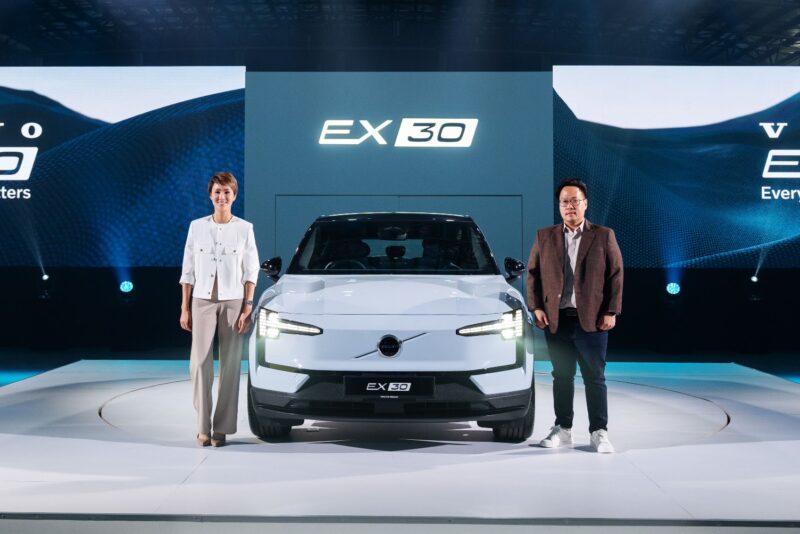
Volvo Car Malaysia has launched its latest electric vehicle, the Volvo EX30. This marks the smallest and fastest vehicle ever produced by the brand to date.
For the local market, the EX30 is offered in three variants: Plus, Ultra, and Ultra Twin Performance.
The Plus and Ultra variants utilise a Single Motor Extended Range powertrain that generates 272 PS and 343 Nm of torque, allowing acceleration from 0 to 100 km/h in just 5.3 seconds.
The Ultra Twin Performance variant is equipped with dual motors, producing a total system output 428 PS and 543 Nm of torque, achieving the same acceleration in a scant 3.6 seconds.
All variants are equipped with a 69 kWh NMC battery, providing a range of up to 476 km for the single motor variants and 450 km for the Ultra Twin Performance.
The battery supports fast charging via a 175 kW DC charger, which is capable of juicing up the battery from 10% to 80% in only 28 minutes.
Standard features include LED headlights, 19-inch Diamond Cut alloy wheels, a premium Harman Kardon sound bar audio system, power tailgate, frameless auto-dimming side and rear-view mirrors, and themed ambient interior lighting.
The Ultra variant adds Park Pilot Assist, a 360° camera, powered front seats, and a panoramic sunroof.
Safety-wise, it includes advanced driver assistance systems featuring enhanced Pilot Assist, Park Pilot Assist, door opening alert, automatic braking and automatic steering avoidance.
Customers have the option of exterior colours such as Cloud Blue, Vapour Grey, Crystal White, and Onyx Black, with the unique Moss Yellow color available exclusively for the Ultra variant for a limited time in Malaysia.
Pricing starts at RM188,888 for the EX30 Plus, RM208,888 for the EX30 Ultra, and RM228,888 for the EX30 Ultra Twin Performance.
Like every fully electric Volvo model, the EX30 comes with a five-year Volvo Service Plan (VSP), digital services, 24-hour roadside assistance, and an unlimited mileage vehicle warranty.
For further peace of mind, the high-voltage battery pack is warrantied for eight years.
Volvo Car Malaysia will be giving customers the opportunity to get in the driver’s seat of the Volvo EX30 at a massive, first-of-its-kind launch showcase and driving experience happening from 26 to 29 September at KL Base, Sungai Besi.
The Volvo EX30 Experience will come hot on the heels of the official unveiling – slated for September 25 – and will offer customers the opportunity to be amongst the first to experience Volvo’s new, fully electric SUV.
The EX30 is packed with technology, featuring a new automatic parking feature, Google Built-in, upgraded Pilot Assist, and 360° environmental awareness from multiple cameras, sensors, and radars that look out for you and others on the road.
Big on tech and safety, it is also Volvo’s fastest-accelerating car and is designed to have the smallest carbon footprint ever of any Volvo car to date.
Attendees at the Volvo EX30 Experience will be able to:
Understand the many little ideas, inspirations, calculations and tests that built up to make a big impact in the design of the EX30.
See, touch, hear, and feel the EX30 in person.
Learn about the EX30’s cutting-edge technology and safety features in an interactive, guided car ride.
Experience the EX30’s blisteringly fast acceleration and dynamic handling on the runway of the iconic Sungai Besi airstrip.
Drive the EX30 on real-world city roads to appreciate its urban-friendly design.
Enjoy warm Scandinavian hospitality accompanied by knowledgeable consultants from Volvo’s authorised dealers.
The Volvo EX30 Experience will run from 10:00AM to 6:00PM each day and slots are available on a first-come, first-served basis. Register for the event at https://forms.volvocarmalaysia.com/ex30.
Customers can place their bookings online for the EX30 from 25 September.
VOLVO Car Malaysia (VCM) seems to be launching the EX30 in the near future. Bookings are now open, and those interested can start registering on the newly opened dedicated webpage.
The Volvo EX30 is a new-generation compact electric vehicle (EV) from the Swedish manufacturer. It measures 4,223mm in length, 1,837mm in width, 1,555mm in height, with a wheelbase of 2,650mm.
Depending on the variant, this SUV is equipped with a 69kWh nickel manganese cobalt (NMC) battery. It can be charged using AC 11kWh (7.5 hours) or DC 153kW (26.5 minutes from 10 to 80 percent).
The specific variant available in the Malaysian market is yet to be confirmed, but the EX30 comes with three motor configuration options.
The Core Single Motor Extended Range and Ultra Single Motor Extended Range models each have a single electric motor at the rear, with outputs of 268hp and 343Nm, and a driving range of 480km.
The higher variant is the Ultra Twin Motor Performance with two electric motors, and outputs of 422hp and 543Nm torque. It has a slightly lower driving range of 460km according to WLTP cycle.
Like previous Volvo models, the EX30 cabin is quite minimalistic but features a completely new design. The dashboard features a 12.3-inch vertical infotainment screen with software such as Google, Apple, and Qualcomm. It also has ECARX, and all of this can be updated over-the-air.
The EX30 also comes with a digital key that can be integrated with various smartphones, with applications for functions such as charging, location, locking, and heating. The Park Pilot Assist on the EX30 is the latest version.
Interested in the latest Volvo electric SUV? You can register your interest at this link.
Malaysia’s Leading Automotive News | ENGEAR ENGLISH