In recent days, social media has been buzzing about the pricing of RON95 fuel under the subsidy program announced by the Madani government.
In these uncertain times, it’s understandable that some more affluent individuals are seeking to avoid the impact of rising fuel prices.
Electric vehicles (EVs) may not be the ideal choice for everyone. So what options are available in the market?
The Lexus NX350h was recently introduced by Lexus Malaysia just a few months ago.
Engear TV was recently invited to experience a brief drive of this luxury hybrid SUV as we headed toward a popular tourist destination in the southern region of the country.
We then stopped at a new lodging location called The Lisbon Melaka to enjoy the fusion cuisine offered there.
Here’s our brief review:
Exterior Design
Physically, there is little change in the hybrid variant compared to the NX250 variant it replaces.
Standard features include LED projector headlights, L-shaped LED taillights, and 20-inch rims wrapped in 235/50 tires.
Hybrid Powertrain
A significant change this time is the presence of the hybrid power unit.
The hybrid system consists of a 2.5-liter naturally aspirated engine (A25A-FXS) paired with two electric motors, an E-Four all-wheel-drive system, and an eight-speed virtual CVT.
Overall, the NX350h generates up to 243 hp and 239 Nm of torque, with fuel consumption rated around 5.0 liters/100 km.
There are three driving modes: Eco, Normal, and Sport.
What About the Cabin Space?
The NX350h’s cabin retains the standard NX layout, reflecting the Tazuna philosophy.
A 14-inch central screen is positioned facing the driver to facilitate menu changes and temperature adjustments throughout the journey.
In fact, Lexus generously retains physical dials for switching driving modes.
The 360-degree surround display system, complete with a ‘transparent’ floor view, makes maneuvering in tight spaces easier.
Drivers are also accompanied by a wireless Apple CarPlay map display, as well as captivating audio from a 10-speaker sound system with a powerful subwoofer.
In addition to a standard black color, buyers can also choose the Dark Rose color trim seen in the unit we drove.
Notably, one unique finish on the door panels is the 3D Cutting Black texture, which stands out under sunlight.
Hybrid Driving Experience
In our opinion, the Lexus NX350h is ideally positioned for those who are still hesitant to switch to EVs.
With an efficient hybrid system, long-distance travel can occur without the need for frequent stops at gas stations.
Based on our brief drive, we found that the Lexus NX350h confidently dominated the right lane of the highway at stable speeds, while also maintaining responsive acceleration.
Furthermore, when switching to Sport mode, the power delivery felt more vigorous, easily outpacing segment B sedans that boast speed.
During this spirited driving experience, the Lexus NX350h recorded fuel consumption of around 6.6 liters per 100 km, with a remaining driving range of approximately 480 km.
Interestingly, this hybrid SUV also recorded zero-emission driving over 50%, while the fuel gauge only dropped two bars.
With a more moderate and relaxed driving style, you might even achieve a greater range.
One advantage offered by the Lexus NX350h is its premium, quiet cabin atmosphere throughout the journey.
Engine noise is still present, but more akin to a purr than a roar.
Pricing
In the Malaysian market, the Lexus NX350h starts at a price of RM395,888.
Affected by the implementation of fuel subsidies? This hybrid SUV may be the right fit for you!
The Lexus LBX is one of the most unique luxury products available; it is not designed to meet the practical needs of a housewife.
Instead, it is crafted as a “favorite sneakers” that is perfect for those who want to enjoy the thrill of driving on weekends.
If the standard hybrid version is already exciting enough, those who can afford it will surely want more—the Lexus LBX Morizo RR, powered by a 300 hp engine from the GR Yaris.
The result is a crossover that is agile, fast, and powerful, especially when equipped with a manual transmission.
Adding to this, Lexus is now introducing the LBX Morizo RR Original Edition, which closely resembles the specifications of the concept model LBX Morizo that debuted in January 2024.
The exterior of this vehicle is adorned with a Sonic Chrome paint finish, complemented by Morizo yellow on the brake calipers and accents on the top of the grille.
Inside the cabin, you’ll find yellow seatbelts, along with Ochre trim similar to that used in the Lexus LC 500.
The Lexus LBX Morizo RR is available with a six-speed manual transmission or an eight-speed automatic gearbox, just like the GR Yaris and GR Corolla.
In Japan, Lexus is limiting the sale of the LBX Morizo RR Original Edition to just 100 buyers.
ASEAN NCAP has announced that Toyota Yaris Cross has successfully achieved a five-star rating in the new vehicle assessment tests conducted.
In the evaluation, the Toyota Yaris Cross received an overall score of 83.02 points, assessed based on four categories:
Adult Occupant Protection (AOP) – 36.36/40.00
Child Occupant Protection (COP) – 17.32/20.00
Safety Assistance (SA) – 16.89/20.00
Motorcycle Safety (MS) – 12.21/20.00
Depending on the market, the Toyota Yaris Cross, specially designed for the ASEAN market (excluding Singapore, which receives the TNGA Yaris Cross model), is equipped with standard safety features such as six airbags, Electronic Stability Control (ESC), ABS, seatbelt reminder (SBR) for front and rear passengers, and pedestrian protection technology.
Several advanced functions are also included, such as Autonomous Emergency Braking (AEB), Blind Spot Detection (BSD) for both left and right sides, Lane Departure Warning (LDW), Forward Collision Warning (FCW), Lane Keeping Assistance (LKA), and Automatic High Beams (AHB).
Take a look at the image above. Malaysia is listed in the production schedule dedicated to the ASEAN market.
Does this mean the Yaris Cross will be arriving in Malaysia soon?
Who would have thought that this agile little crossover from Lexus was a direct response to a request from Akio Toyoda, the driving force behind Toyota?
During the early stages of development, Akio, also known as Morizo, asked the R&D team to create a casual car that could be driven on weekends, much like a beloved pair of sneakers.
The result is a luxurious compact crossover with an attractive design and a fun driving experience – the Lexus Breakthrough Crossover, or LBX.
The Lexus LBX is the smallest production car ever produced by Lexus and is positioned below the Lexus UX.
Although it is built on the GA-B platform, which serves as the foundation for the European market Yaris Cross, the LBX is more than just a badge-engineered product.
Design
Compared to the European specification Yaris Cross, the LBX has a more robust appearance.
This is achieved through more rounded wheel arches, wider and more pronounced fenders, and larger tire sizes.
Moreover, the shoulder line of the LBX is lower compared to the Yaris Cross, creating an almost snowman-like appearance from the front, side, and rear views.
Masahiro Sasaki, a racer and Toyota test driver, explains that this design gives the LBX a more balanced look and a lower center of gravity.
As a result, the LBX appears sturdy even when stationary in a parking spot, and even more so when driven on the road.
Interior Space
For me, the Lexus LBX is best described as a casual car to drive on weekends without compromising practicality.
Yes, the rear passenger space may seem small, and it is better suited for children or petite adults.
As for cargo space? It offers about 315 liters, which is ample for grocery shopping. Alternatively, if you fold down the second-row seats, you will have a cargo area of up to 992 liters.
Lexus seems to have focused heavily on the Tazuna concept, especially in the driver’s cockpit.
There are not many physical function buttons; only essential functions are retained.
The intention? To ensure that the driver’s attention remains on the road.
The control buttons on the steering wheel may appear vacant without any functions, but in reality, you can easily set shortcut buttons for various operations.
You’ll just need to keep an eye on the head-up display to see what operations are being activated or deactivated, such as adjusting the fan speed or changing the music playing.
Initially, it may take some time to get used to this setup, but over time, I have come to prefer this method as it minimizes eye movement while driving.
Additionally, the Lexus LBX offers plush seating that is comfortable and firmly supports the driver – a feature that’s hard to find in any car in a similar segment.
The 9.8-inch central screen displays easily accessible menus and supports connections to Apple CarPlay and Android Auto.
The 12.3-inch digital cluster screen is also easy on the driver’s eyes, and most importantly, the analog meter theme is still present!
The start drive button is positioned fairly high next to the instrument cluster, making it easy for the driver to see and reach.
Honestly, this is exactly what I expect from a Lexus: a luxury car that still prioritizes the needs of the driver.
Modern Features for Convenience
Inside the LBX cabin, you will find up to four USB Type-C charging ports, along with a wireless Qi charging slot for smart devices.
A Mark Levinson audio system with 13 speakers is ready to accompany you during spirited weekend drives.
Door operations are made easy with the e-Latch system; simply press the lever on the door panel (as well as the door handle outside) with just one finger, and the door will open.
Although the center console appears somewhat narrow for fitting two arms at once, it is still equipped with the necessary operational buttons for the driver.
Hybrid Engine with EV-like Behavior
One of the most exciting aspects of driving the Lexus LBX is its powerful hybrid engine performance.
Unlike typical Chinese hybrid cars that use turbo engines, the LBX offers a naturally aspirated (NA) 1.5-liter hybrid engine with the code M15A-FXE.
This engine, with an output of 90 hp and 120 Nm of torque, is paired with an electric motor producing 93 hp and 185 Nm, resulting in a combined output of around 136 hp.
The efficient eCVT transmission ensures that every brisk acceleration in the LBX can be fully enjoyed by the driver, especially when taking off from traffic lights or toll plazas.
After enjoying the curves, I returned to a more relaxed pace, navigating the central roads. Most of the time, the vehicle prioritized EV driving mode, creating a quieter and more comfortable atmosphere.
At times, I recorded a zero-emission driving ratio of 50 percent over a distance of 78 km.
Handling and Comfort, Perfectly Balanced!
As standard, the Lexus LBX features a MacPherson strut setup in the front, complemented by a simpler torsion beam system in the rear.
On paper, it may seem commonplace, similar to B-segment SUVs currently available in the market.
However, what sets the LBX apart is Lexus’s tuning of its handling, which distinguishes its performance from other SUVs.
During my test drive, I found it difficult to pinpoint negatives; the LBX felt stable and glued to every corner while effectively absorbing road imperfections.
In short, it strikes a balance between handling stability and driving comfort, further enhanced by the Vehicle Braking Posture Control function to reduce pitch and roll effects.
Additionally, the steering responsiveness is sufficiently tactile, adhering to every command from the driver without feeling overly light.
The harmonious integration of its chassis with a short wheelbase, powerful engine, efficient transmission, and suspension makes the Lexus LBX a remarkable product in its segment.
It’s hard to describe this feeling in words; you need to experience the LBX first-hand if given the chance.
The sound of the three-cylinder engine is also minimal, merely a whisper in your ears, especially when the accelerator is pressed hard. However, most of the time, the cabin remains quiet and comfortable.
Safety Features
As standard, the LBX comes equipped with safety features, including eight airbags, as well as the Lexus Safety System+, which encompasses functions such as:
Autonomous emergency braking
Adaptive cruise control with stop-and-go functionality
Lane-keeping assistance
Active steering assistance
Traffic sign recognition system
Blind spot monitoring system
Door opening warning
Automatic high beam assist
Conclusion
With a price tag of RM268,888, I must admit that the LBX is not a luxury car designed for everyone, nor is it suitable as a first car.
It has drawbacks that may be difficult to compromise on; however, it offers a package that can bring a smile to the driver after a long week of driving an SUV or MPV.
Much like a favorite pair of shoes, it is perfectly suited for when you need it.
Specifications for the Lexus LBX (RM268,888)
Engine: 1.5-liter inline three-cylinder NA (code M15A-FXE)
The writer had the opportunity to test drive several small Volvo models before, including the Volvo V40 and the Volvo XC40 and C40 crossovers.
This time, it’s the turn of the smallest production model ever created by the Scandinavian manufacturer, the Volvo EX30.
It comes exclusively as an electric crossover, with no internal combustion engine options available.
Despite being available only in an EV version, the EX30 is not a model to underestimate.
It has a package that can meet the needs of every user—offering style, practical space, and performance capable of outperforming larger SUVs, especially when you choose the Ultra Twin Performance variant, which we drove for this test.
Here’s a summary of our experience after enjoying the EX30, priced at RM228,888, for several days.
Exterior Appearance
Yes, in terms of design, it’s hard to deny that this is a Volvo SUV.
Just look at the headlights with Thor hammer-shaped LED graphics, the front end without a grille displaying the minimalist Volvo logo, and the rear lights—all reminiscent of the Volvo EX90.
Its size is indeed quite compact, measuring 4,223 mm in length, 1,837 mm in width, 1,555 mm in height, and a wheelbase of 2,650 mm, making it smaller than its siblings, the XC40 and C40.
However, small does not mean the EX30 is less practical; the details can be found in the next section.
Practicality
Volvo seems clever in providing a comfortable and practical cabin space in the EX30.
Due to the absence of a speaker system (it has only a Harman Kardon soundbar on the dashboard), there is ample space on the door panels.
The center console appears simple, but when the weather is warm, you can place a cool drink in a pull-out cup holder that can be hidden away when not in use.
Is that not enough? The floor console is also provided, along with additional hidden compartments for smaller items and space in the console tunnel.
The glove box is positioned in the center for easy access by both the driver and front passenger.
Although it looks small from the outside, the Volvo EX30 offers a cargo space of 318 liters, which can expand up to 718 liters when the second-row seats are folded flat in a 60:40 ratio.
This is large enough to accommodate items up to 1.64 meters long and 0.86 meters high.
If you need to head to Ikea for furniture shopping, you can refer to the storage guide graphic provided on the rear tailgate.
Still not enough? There’s a frunk that offers a capacity of seven liters.
Extremely Minimalist to the Point of Confusion
Want to know why Volvo can provide such extensive space?
It’s because Volvo has taken minimalist design to an extreme level, requiring me to ‘reset’ my mindset each time before starting my journey.
The window buttons have been relocated to the center—like cars from the old days—and there are only two buttons available.
You need to press an extra button to open the rear passenger window.
To control the temperature of the air conditioning system? Use the central display screen.
To adjust the steering settings and side screens? Again, it’s done through the central display.
Want to open the glove box? Yes, you also need to press the menu on the central screen.
Fortunately, to start my journey, I didn’t have to scroll through the central screen to switch to Drive mode. The gear shift lever is provided in the steering column, complete with cruise control mode (you only need to pull the lever down once after entering Drive mode).
Finishing Touches
One commendable aspect of the Volvo EX30 is its extensive use of sustainable materials within the cabin.
For example, the upholstery for the seats, dashboard, and doors is made from recycled materials such as denim, hemp, and a wool blend.
The use of these materials does not compromise the comfort factor throughout the driving experience.
What I particularly like is the seating that fully supports the lower legs, along with the comfortable armrest panel on the door.
However, if you look closely, the plastic finishes in certain areas seem inconsistent with the luxurious image Volvo is trying to portray in the EX30. After all, it is made from recycled plastic.
Agile Driving on the Road
The Ultra Twin Performance variant of the EX30 comes equipped with two electric motors that produce 422 hp and 543 Nm of torque, allowing it to accelerate from 0 to 100 km/h in just 3.6 seconds.
With its small, agile body package, the EX30 has no trouble outperforming any sports car out there.
Its suspension tuning is excellent, effectively absorbing all the imperfections found on the road and providing a delightful driving experience, especially when encountering curves.
To be frank, I believe the suspension tuning in the EX30 is significantly better compared to its bigger siblings, the XC40 and C40.
Most of the time, the power delivered by the rear motor is sufficient, and I hardly relied on the Performance mode for the AWD system (which has to be accessed through the central screen).
The NMC 69 kWh battery pack allows you to achieve an impressive driving range of 450 km, making it well-suited for urban driving.
The steering response is also quite good, ensuring that the EX30 stays precisely on its intended path.
Unexpected Off-Road Capability
Clearly, the Volvo EX30 has its unique strengths, making it suitable as an everyday vehicle.
However, one unexpected advantage I discovered is the comfort it offers when the Volvo EX30 is taken off-road (more appropriately, soft-road).
I admit that this EV is already quite comfortable on paved roads, but when the tires hit gravel paths, the EX30’s suspension system effectively filters out all the roughness of unpaved roads.
It’s perfect for driving across rough terrain, allowing you to enjoy outdoor weekend activities like picnicking by the river or camping on the beach.
Given this impressive potential, it’s no surprise that Volvo showcased the EX30 Cross Country version earlier this year for those who seek a more rugged driving experience in this compact EV.
Will the EX30 Cross Country be realized in the future? We can only wait and see what plans Volvo has for this electric SUV.
Charging
The 69 kWh NMC battery supplied in the Volvo EX30 supports AC charging at 11 kW, taking eight hours for a full charge.
If you’re short on time, simply charge the EX30 at any fast-charging station, as this EV supports DC charging up to 153 kW.
In just half an hour, the 69 kWh battery can be charged from 10% to 80% state of charge.
Alternatively, you can visit any shopping center with fast-charging facilities, allowing you to shop for your desired items while the vehicle charges.
One feature I particularly like about this EV is the Google-based mapping system that displays the estimated battery state of charge upon arrival at your destination or after a round trip.
Safety
As a Volvo, the EX30 is equipped with nearly comprehensive safety features in this compact package.
These include adaptive cruise control, traffic jam assistance, collision avoidance assistance, autonomous emergency braking, lane keeping assistance, lane departure warning, blind spot monitoring, and rear cross-traffic alert.
Ironically, it also features a driver attention monitoring system that alerts the driver if it detects a lack of attention on the road.
What can you expect from a car that crams all sorts of settings and functions into a single 12.3-inch screen?
Essential information such as speed, battery state of charge, traffic light notifications, and gear position (RND) is displayed at the top of the screen.
During driving, I find myself looking to the left to ensure that this EV is being driven at the speed allowed by law.
Or every time my left finger pushes the lever to activate the turn signal.
Or each time I feel the cabin temperature is too cold and want to adjust the air conditioning.
It would be more pleasant if the EX30 had a separate screen behind the steering wheel, so that eye movement would be minimized compared to having to rely entirely on the central screen.
Directly installing a head-up display screen would probably be more practical.
Conclusion
For an urban-use EV, I find the Volvo EX30 has a solid foundation and an attractive design, making it suitable for young people with active lifestyles.
That is, if you don’t mind the overly minimalist dashboard layout presented in this Volvo.
Try taking the time to get used to it, and it won’t be a major issue.
However, it can be somewhat problematic for old-school drivers like me, who are still adjusting because we’re used to physical buttons and controls.
In terms of driving, the EX30 is certainly suitable as an everyday car, enjoyable to drive, and, most importantly, it does not compromise practicality and safety elements, which are the primary foundations of the Volvo brand.
However, if you aren’t concerned about all-wheel-drive performance or the panoramic glass roof, you can opt for a lower variant (priced from RM189k) to enjoy a longer driving range.
Specifications of the Volvo EX30 Ultra Twin Performance (RM228,888)
In addition to the bZ model, Toyota America has launched another electric SUV designed for outdoor enthusiasts, the bZ Woodland.
The Toyota bZ Woodland fundamentally shares the same platform as the previously introduced Subaru Trailseeker.
Compared to the standard bZ model, the bZ Woodland features larger dimensions, measuring 4,830 mm in length (+140 mm), 1,860 mm in width, 1,670 mm in height (+20 mm), and a wheelbase of 2,850 mm.
These dimensional changes contribute to a larger cargo space, around 850 liters.
Additionally, the ground clearance has increased by 2.54 mm to 210 mm, thanks to the use of higher suspension.
This mid-size SUV can tow a weight of 1,588 kg and can be equipped with All-Terrain tires.
Toyota has also streamlined the offerings for the bZ Woodland, which is only available in a dual electric motor configuration producing 375 hp.
Acceleration performance has not been disclosed; however, it is noted that the Subaru Trailseeker can accelerate from 0 to 96 km/h in just 4.4 seconds.
The all-wheel-drive (AWD) system is complemented by a driving mode selection known as X-Mode and a Grip-Control feature for enhanced off-road performance.
The 74.7 kWh battery pack allows this SUV to be driven up to 418 km and supports NACS plug charging for compatibility with the Tesla Supercharger network.
Fast DC charging takes only 30 minutes to go from 10 to 80 percent state of charge (SoC).
The exterior appearance of the bZ Woodland resembles that of the standard bZ model, except for the addition of black body cladding, 18-inch aluminum wheels with removable covers, and roof rails.
The rear features a more minimalist light housing, followed by a Woodland badge on the tailgate.
Inside, the bZ Woodland cabin includes a 14-inch central screen, a wireless smartphone charging slot, USB Type-C charging ports, and SofTex-wrapped seating with heating functions for the front row.
There is also a Premium package that adds a JBL audio system, a panoramic glass roof, a digital rearview mirror, and front seat ventilation.
Lastly, the Toyota Safety Sense features a suite of safety functions, including a Pre-Collision System (PCS), Dynamic Radar Cruise Control (DRCC), Lane Departure Alert (LDA), Road Sign Assist (RSA), Automatic High Beams (AHB), Blind Spot Monitoring (BSM), Safe Exit Alert (SEA), Rear Cross-Traffic Alert (RCTA), and a Surround View Camera system.
Toyota’s electric SUV is now presented with a new, simpler name that rolls off the tongue more easily: the Toyota bZ.
For the 2026 model year, several enhancements have been made, particularly in terms of driving range to alleviate range anxiety among owners.
There are two battery pack options available: 57.7 kWh and 74.7 kWh.
The base front-wheel drive (FWD) version with 168 hp and a 57.7 kWh battery can now travel up to 380 km (EPA data).
There is also a more powerful FWD variant (221 hp) which has an impressive range of up to 505 km when paired with the 74.7 kWh battery pack.
Toyota also offers an all-wheel drive (AWD) version with 338 hp, capable of covering up to 463 km on a full charge.
Notably, the 2026 Toyota bZ is now equipped with a North American Charging Standard (NACS) plug, allowing owners to charge their vehicles at Tesla Supercharger stations at a capacity of up to 150 kW.
Unlike the bZ4X model, the bZ now features a more streamlined front fascia similar to that of the Camry and Prius.
The previously black-painted wheel arch protective plastics have now been color-matched to the body of the vehicle.
Upon entering the cabin, one will find a redesigned center console that includes a slot for wireless smartphone charging and a 14.0-inch infotainment screen.
Additional features include SofTex upholstery, a six-speaker audio system with an option for a JBL Premium nine-speaker audio system, and Toyota Safety Sense 3.0 safety features.
To strengthen its presence in the European market, Mitsubishi will rely on models produced by Renault for badge engineering.
Most recently, Mitsubishi is set to launch an all-electric SUV, the Eclipse Cross EV, based on the Renault Scenic E-Tech platform.
Previously, Mitsubishi has introduced several models based on Renault, including the Colt (Clio), ASX (Captur), and Grandis (Symbioz).
Based on a teaser video that was uploaded, several features can be identified, such as aerodynamic wheel design, front grille pattern, hidden door handles, and the Eclipse Cross and EV badges.
To differentiate it from the donor model from Renault, Mitsubishi will also apply its Dynamic Shield design language to the new model.
This C-segment SUV is expected to retain the specifications found in the Scenic E-Tech, with either a single electric motor delivering 168 hp or a dual-motor version producing 215 hp, along with battery pack options of 60 kWh and 87 kWh.
Additionally, the Eclipse Cross EV will feature a five-seat configuration, with a cargo space of 545 liters, a Google-based infotainment system, and various ADAS safety features.
Toyota has introduced a facelifted version of the Corolla Cross in several Southeast Asian markets since last year.
However, for the European market, the SUV now comes with a much bolder appearance, especially for the GR Sport variant, which is being launched in the continent for the first time.
Starting with the standard version, this facelifted Corolla Cross features a redesigned bumper accompanied by a honeycomb grille structure.
Unlike models for other markets, the 2026 Corolla Cross is equipped with sharper graphic LED headlights, followed by the introduction of a horizontal LED light bar.
The taillights also feature new graphic designs, while all four wheel arches are adorned with new 18-inch rims.
Inside the cabin, there is a 10.5-inch central screen, a 12.3-inch digital cluster screen, a larger center console featuring a new gear knob, and a faster wireless smartphone charger.
Additionally, Apple CarPlay support is also available.
Toyota promises a quieter ride, thanks to improvements made in sound insulation to reduce noise and vibrations.
The highest variant will come with ambient lighting, as well as heated seats and a heated steering wheel.
As mentioned, this is the first time Toyota has introduced the GR Sport variant for the Corolla Cross in Europe.
This bolder appearance is largely inspired by the bumpers of the GR Yaris and the facelifted GR Corolla.
In addition, the Corolla Cross GR Sport is also equipped with sportier 19-inch rims, a suspension that is 10 mm lower, as well as recalibrated power steering and the addition of paddle shifters as standard features.
Toyota adds a Sport Mode feature for quicker acceleration, along with a Snow Extra mode for improved control and stability during winter.
In Europe, the Corolla Cross will be available in Hybrid 140 or Hybrid 200 specifications.
The base Hybrid 140 features a 1.8-liter hybrid engine capable of producing 138 hp, while the Hybrid 200 variant comes with a 2.0-liter hybrid engine with a power output of up to 194 hp.
Launched at Auto Shanghai 2023, the young brands Omoda and Jaecoo have successfully gained the trust of over 500,000 users worldwide with their lineup of crossover designs that have captivated the lifestyle segment.
This is an impressive achievement for a brand that has only been established for two years.
In addition, the brand has successfully entered 42 countries with more than 1,300 showrooms established globally, as well as garnering over seven million followers across various digital platforms.
Moving forward, Omoda and Jaecoo will focus on the Super Hybrid System (SHS) technology spearheaded by the Jaecoo J7 PHEV.
With a combination of a fifth-generation 1.5TGDI DHE (Dedicated Hybrid Engine) and a hybrid DHT transmission, SHS can offer a total range of up to 1,200 kilometers.
The efficiency of SHS has been proven through several long-distance driving tests previously conducted across three countries (Singapore, Malaysia, Thailand), achieving a record of 1,427.5 kilometers; in the Philippines with 1,488.8 kilometers; and in Mexico with 1,613.1 kilometers.
In conjunction with their second anniversary, Omoda and Jaecoo also unveiled several new models, including the Omoda C7 and Omoda C3, at Auto Shanghai 2025.
Here are some quick info of both models:
Omoda C7
– C-segment SUV
– Larger dimensions than the Omoda 5, yet smaller than the Omoda C9
– Shares the same Super Hybrid System (SHS) powertrain used in the Jaecoo J7 PHEV
– 1.5-liter turbo engine (156 PS/220 Nm) paired with an electric motor (204 PS/310 Nm)
– Total power output of 360 PS/530 Nm
– Overall range of up to 1,475 kilometers
– 15.6-inch infotainment screen that can be repositioned
Omoda C3
– B-segment SUV
– Futuristic spaceship-inspired design and body geometry
– ‘Starship Cockpit’ cabin design
– Set to be launched globally in October 2025
At the Shanghai Hongqiao Hotel, another electric SUV known as the X20e made an appearance next to a segment B electric SUV.
The design of the X20e certainly reminds us of the smart brand’s EV, the #1, particularly in the front and rear light designs; most notably, the finishing on both C-pillars stands out.
Interestingly, the showcased X20e is a right-hand drive (RHD) version.
Does this mean that Jetour is ready to market this model for right-hand drive countries?
Since the X20e is a very new model, there are no specifications available to report at this time, and it is not listed on any official Jetour websites.
However, based on the exhibited model, the X20e is equipped with 15-inch alloy wheels, a pastel green color, hidden door handles, and a floating roof design inspired by the smart #1.
Inside, the cabin features two separate display screens for the driver and the center console, physical control buttons for the air conditioning system, a three-tone dashboard finish, and relatively comfortable fabric-wrapped seats.
With very few small EVs currently available in the Malaysian market, could the X20e be a suitable candidate for urban driving?
For several generations, the Subaru Outback has been recognized as a station wagon ready to tackle off-road adventures.
The recently launched seventh-generation model, coinciding with its 30th anniversary celebration, returns with a bolder appearance.
There are no details yet regarding the dimensions of this new off-road wagon.
However, the Subaru Outback is expected to offer a ground clearance of 220 mm, along with a more boxy design aimed at maximizing cabin space.
With a roofline that is 50.8 mm higher and a wider opening, the Outback’s cargo area now reaches up to 991 liters.
The front of the Outback features overlapping headlight designs and a larger grille structure, while the sides showcase more pronounced wheel arches.
The Outback’s roof rails can support a static load of up to 363 kg.
Inside the cabin, there’s a central 12.1-inch screen and a 12.3-inch digital cluster that supports wireless Apple CarPlay and Android Auto.
The HVAC (heating, ventilation, and air conditioning) control buttons remain in a physical format located beneath the central screen.
In terms of power, the 2026 Subaru Outback maintains a 2.4-liter turbo engine that now produces 260 hp, along with an optional 2.5-liter naturally aspirated engine generating 180 hp.
Both engines are paired with a CVT transmission and come standard with Subaru’s Symmetrical All-Wheel Drive system.
Looking for something more rugged?
The Subaru Outback is available in a Wilderness variant, which comes with several unique features.
For example, it includes a more aggressive front bumper complete with the word “SUBARU,” dull black body cladding, specific Wilderness accents, additional underbody protection, 17-inch wheels, all-terrain tires, and an electronically controlled suspension damping system.
Key off-road driving angles for the Wilderness model have also been improved compared to the standard Outback, with an approach angle of 20 degrees, a departure angle of 22.5 degrees, and a breakover angle of 21.2 degrees.
It can also tow loads of up to 1,500 kg, aided by a revised rear bumper and upgraded trailer hitch hardware.
Inside the cabin, the Outback Wilderness comes standard with water-resistant upholstery materials, with an option for ventilated Nappa leather.
To meet the practical needs of SUV drivers in urban areas, Continental Tyres has introduced a tire specifically designed for SUVs, the UltraContact UX7, which will be available starting in the second quarter of this year.
The new UltraContact UX7 is powered by SUV Confidence+ technology, focusing on three key aspects: safety, durability, and quieter driving.
The X-Force Macroblocks feature on the UX7 maximizes the contact area with the road, creating a wider footprint for improved handling and stability on all road surfaces.
It is also enhanced by the Adaptive Diamond Compound formulation for shorter braking distances on both wet and dry roads, along with unique Aqua Channels to improve water evacuation.
The construction of the UltraContact UX7 is reinforced with Robust360 Construction design, which includes reinforced steel belts to absorb shocks and a sturdier carcass structure to reduce the risk of tire damage.
The polymer chain in the Diamond Compound can enhance durability and prevent damage from cuts and debris—a crucial feature for ensuring higher durability and longer lifespan.
Finally, the UltraContact UX7 features a tread pattern that minimizes vibrations and reduces noise generation, along with Noisebreaker 3.0 technology to ensure a quieter and more serene cabin environment.
The UltraContact UX7 is available in sizes ranging from 15 to 22 inches, suitable for most crossover vehicles, mid-sized SUVs, and premium SUVs.
Honda Malaysia has officially opened booking for their first electric SUV model, the Honda e:N1, which is set to launch in the second quarter (Q2) of 2025.
Built on the e:N Architecture F platform, the Honda e:N1 is powered by a front-wheel-drive electric motor producing 201 hp and 310 Nm of torque.
Its 68.8 kWh lithium-ion battery pack allows for a driving range of up to 500 km on a full charge (NEDC data).
With dimensions measuring 4,380 mm in length and 1,592 mm in height, and a wheelbase of 2,610 mm, it matches the size of the petrol version of the HR-V.
Features included in the e:N1 comprise two-tone 18-inch alloy wheels, LED headlights and taillights, a charging slot in the front grille, a white Honda badge, and the word ‘Honda’ emblem on the rear.
Safety features also include blind spot information (BSI), a cross-traffic monitoring system (CTM), in addition to nine advanced Honda SENSING safety functions.
Honda customers can place orders for the e:N1 on the website https://prebook.honda.com.my/ or via the HondaTouch app.
Honda Malaysia has also appointed eight authorized dealerships to handle any matters related to the e:N1 as follows:
MG Motor Malaysia has recently unveiled an upcoming electric SUV model, the 2025 MGS5 EV.
In terms of dimensions, the MGS5 EV measures 4,476 mm in length, 1,849 mm in width, and has a wheelbase of 2,730 mm.
The cargo space is 452 liters, which expands to 1,441 liters when the second-row seats are folded down.
The MGS5 EV is powered by a rear-wheel drive electric motor that produces 170 PS and 250 Nm of torque.
There are two battery options available: a 49 kWh battery that offers a driving range of 340 km, and a 62 kWh battery that provides a driving range of 430 km.
The MGS5 EV supports 11 kW AC charging as well as fast DC charging up to 88 kW, and it includes a Vehicle-to-Load (V2L) function of up to 6.6 kW.
In the cabin, the MGS5 EV features a 10.25-inch display cluster, a 12.8-inch infotainment screen, and connectivity for wireless Apple CarPlay and Android Auto.
The premium variant comes with additional features such as 18-inch alloy wheels, a panoramic glass roof, powered tailgate, leather and perforated fabric seats, a heated steering wheel, power-adjustable driver’s seat, a premium audio system with six speakers, and a 360-degree surround camera.
Safety features include seven airbags and Advanced Driver Assistance Systems (ADAS).
There are five attractive color options available: Arctic White, Monument Silver, Camden Grey, Dynamic Red, and Elegant Latte.
Slated for launch soon, the MGS5 EV is expected to be priced around RM115,000.
The Nissan LEAF battery electric vehicle has been on the global market since 2010 and has endured through two generations in a hatchback body style.
However, for the third generation, the Nissan LEAF has been redesigned as a crossover to align with the market demand, which leans more towards larger-bodied models.
Built on the CMF-EV platform owned by the Renault-Nissan-Mitsubishi alliance, the new LEAF features increased overall dimensions, though it is slightly shorter compared to the existing LEAF.
From the showcased design, it is evident that the LEAF borrows many styling elements from the Ariya EV and boasts a drag coefficient of 0.25.
Nissan has not disclosed further specifications for the LEAF.
However, according to Nissan Europe’s product chief, Francois Bailly, the new LEAF is capable of offering a real-world driving range exceeding 598 km.
He added that the LEAF will also receive the latest Google-based infotainment system, complemented by advanced driver assistance systems.
In less than a month after the launch of the latest Jaecoo J7 PHEV model, another model is set to be launched soon – the Jaecoo J8.
Previewed earlier in 2024, the Jaecoo J8 is now on public display at One Utama Shopping Centre in Petaling Jaya from March 27-30.
The Jaecoo J8 has the following dimensions: 4,820 mm long, 1,930 mm wide, and 1,699 mm tall, with a wheelbase of 2,820 mm.
Thanks to its relatively long dimensions, the Jaecoo J8 is available in two configurations: two rows (five seats) or three rows (six seats).
The SUV is powered by a 2.0-liter turbo engine producing 249 PS and 385 Nm, paired with a eight-speed automatic transmission. It will be available in front-wheel drive or all-wheel drive (AWD).
The driving experience is further enhanced by a Continuous Damping Control (CDC) system, exclusive to the AWD variant, and a water wading depth of 450 mm.
Exterior features include full LED lighting, 20-inch alloy rims, embedded door handles, a Mercedes-style Panamericana grille structure, and a floating roof design.
The cabin layout is reminiscent of the Mercedes-Benz E-Class, featuring twin 12.3-inch screens and a panoramic sunroof.
The Jaecoo J8 2WD includes a 540-degree camera system, a Sony audio system with 12 speakers, and a cargo space of 738 liters.
The AWD version upgrades to a Sony audio system with 14 speakers, 10 airbags, an automatic fragrance system, NFC-based key system, power-adjustable first and second-row seats, ventilation for the driver, and leather and suede trim in the cabin.
The J8 AWD offers a significantly smaller cargo space of 200 liters, in contrast to the 2WD version.
The estimated selling price starts from RM195,000 for the 2WD version and goes up to RM220,000 for the AWD version.
Those interested in seeing the Jaecoo J8 SUV up close can visit One Utama Shopping Centre (GF Luxe) from March 27-31, Queensbay Mall (April 9-13), and the Malaysia Autoshow 2025 (May 8-15).
Note: The displayed Jaecoo J8 outside is a pre-production unit; final specs may vary.
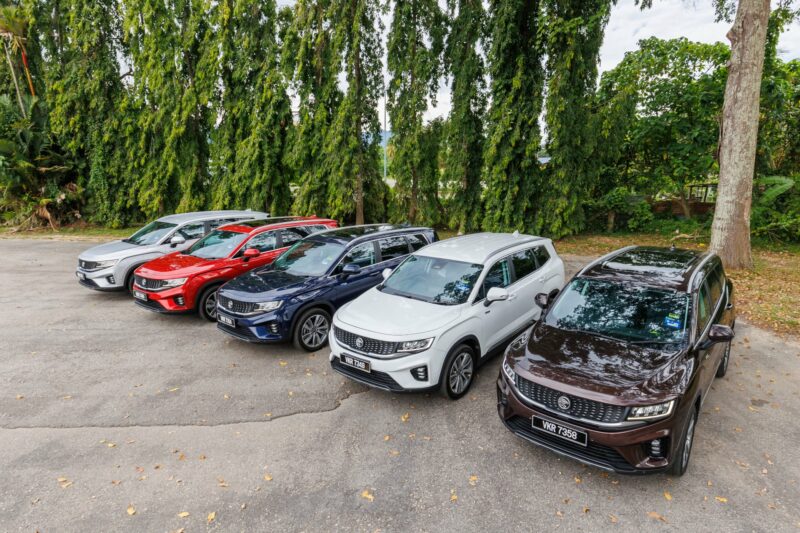
National automaker Proton in a statement said that its X-Series SUV lineup remains resilient in the market despite facing stiff competition from other brands vying for the same customer base.
X50
According to the automaker, the X50 has emerged as its best-selling SUV, with total sales of 23,647 units last year. The 2024 version, launched on 4 June, received an overwhelming response with a total of 8,000 bookings in the first month. A total of 13,780 units of the 2024 X50 were sold last year, accounting for 58.3% of the model’s total sales.
Meanwhile, the X50 Sport Edition (SE) received 941 orders, with 299 units registered in less than a month after its debut.
A recent survey of over 1,300 customers revealed that X50 owners were drawn to the vehicle primarily due to its combination of features, engine performance and spacious cabin.
X70
Proton’s first SUV, the X70, recorded sales of 5,628 units for the 2025 version. This makes up 62.6% of the total 8,992 units sold in 2024.
From the same recent survey, key reasons for purchase included fuel efficiency, features and engine performance.
Launched in August last year, the 2025 X70 is a comprehensive update to its predecessor, featuring revised exterior styling, new interior equipment and upgraded ADAS level 2 safety technology.
X90
The X90, Proton’s entrant in the D-segment SUV space, ended 2024 with 3,553 units delivered, maintaining its position as a market leader since its launch two years ago.
Proton reported that buyers were drawn to the X90’s driving performance, storage capacity and value for money. About 30% of buyers preferred the car for its strong driving performance, while 27% liked it because of its large storage compartments, good value for money and number of features compared to competitors.
The automaker added that X90 owners have families with children with a similar buying profile as X50.
“Thanks to our intelligent models, we have managed to raise the overall level of sophistication in cars offered to Malaysian buyers and while the strong market response to our current model lineup is testament to the trust and loyalty we have earned from our customers. Looking ahead, we remain dedicated to delivering vehicles that offer outstanding performance, features, and value,” said Roslan Abdullah, Chief Executive Officer of Proton Edar.
Edaran Tan Chong Motor (ETCM) has announced that the new Nissan Kicks e-Power crossover will be delivered to its customers in the upcoming weeks.
According to Khoo Cheng Pah, CEO of Edaran Tan Chong Motor Sdn Bhd, “We are excited to share that the Nissan Kicks e-Power is on track for delivery in the coming weeks.
“Our team is committed to accelerating this process to ensure our customers can experience the e-Power technology as soon as possible.”
Officially launched at the Kuala Lumpur International Motor Show (KLIMS) 2024, the Nissan Kicks e-Power features a second-generation e-Power system that offers improved fuel efficiency (21.7 km/l) and a driving range of up to 900 km on a full tank.
The e-Power system consists of a 129 PS/280 Nm electric motor, a 1.2-liter HR12DE engine (82 PS/103 Nm) that serves as a power generator, and a 2.06 kWh battery pack.
The all-new Nissan Kicks e-Power is now available for booking in two variants, VL and VLT, with a starting price of just RM113,800.
The 2026 Subaru Crosstrek, now in its third generation, is available with a variant equipped with a new generation hybrid powertrain.
As previously reported, the 2026 Crosstrek Hybrid features a hybrid system consisting of a 2.5-liter boxer engine (158 hp, 209 Nm), two electric motors, and a 1.1 kWh lithium-ion battery pack, producing a total output of 194 hp.
Interestingly, the Crosstrek Hybrid retains Subaru’s pure Symmetrical AWD system, meaning the addition of the hybrid system does not compromise its responsive on-road or off-road driving capabilities.
In terms of exterior design, there are not many differences in this hybrid model compared to the standard model, except for the Hybrid emblem featuring the horizontal engine logo and the dark gray 18-inch alloy wheels.
The ground clearance of the Subaru Crosstrek Hybrid remains at 220 mm.
Inside the cabin, this crossover is equipped with a 12.3-inch digital cluster screen, alongside an 11.6-inch central infotainment screen, with wireless support for Apple CarPlay and Android Auto.
All variants of the 2026 Subaru Crosstrek Hybrid will come with advanced safety features, including the EyeSight system that offers functions such as pedestrian and cyclist detection, advanced adaptive cruise control, and other active safety features like automatic reverse braking, blind-spot detection, and rear cross-traffic alert.
There are two new colors available for the Subaru Crosstrek Hybrid: Sand Dune Pearl and Citron Yellow Pearl.
More details will be announced in the lead-up to the official launch, which is scheduled to take place this fall.
Malaysia’s Leading Automotive News | ENGEAR ENGLISH