Tag Archives: aviation

5 car technologies adapted from aviation world

We should be grateful because the cars we can buy today come with various advanced technologies. Most of these technologies are designed to facilitate driving and improve safety.

However, did you know that many of the technologies present in today’s cars actually come from the aviation and aerospace world? We will share the top five main technologies.

1. Anti-lock braking system (ABS)

The anti-lock braking system or commonly known as ABS was first used in the aviation industry since the 1950s. Aircraft at that time were equipped with anti-lock brakes called Decelostat to enhance stability during landing on slippery and rough surfaces.

Some of the early aircraft equipped with anti-lock brakes were the Avro Vulcan, de Havilland Comet 2c, Hawker Siddeley Trident, and Dutch Fokker F27.

ABS began to appear in luxury cars in the 1980s. Now, ABS brakes have become a mandatory and essential feature for modern cars.

2. Head-Up Display (HUD)

The Head-Up Display (HUD) is a clear display in the aircraft cockpit positioned at the pilot’s line of sight in the front mirror. It displays important flight information such as airspeed, altitude, horizon line, and other indicators. Pilots can access this information without diverting their gaze from the front mirror, thereby enhancing flight safety.

Today, HUD has emerged in the automotive world, displaying information such as speed, speed limits, music, and even navigation directions. Its purpose remains the same, to prevent drivers from shifting their attention away from the front. However, HUD is still considered a premium feature for cars.

3. Autopilot

As the name suggests, autopilot is a feature where the aircraft can fly itself steadily. However, it is not engaged throughout the flight. Autopilot is usually activated when the aircraft is at a steady altitude, constant speed, and fixed direction. This can reduce the pilot’s workload for long-haul flights, which would otherwise be exhausting for the pilot to control manually throughout the journey.

The first aircraft equipped with autopilot was the Sperry Corporation in 1912. Autopilot was mechanically linked to the aircraft’s control system. Today, in the aviation world, the autopilot feature is highly advanced with various automatic and electronic controls.

In the automotive world, autopilot uses special radar and cameras to read the road, signs, and lane markings, allowing the car to be driven automatically while maintaining speed and distance from the vehicles ahead.

4. Carbon fiber

Carbon fiber has been developed for 150 years to achieve a high strength-to-weight ratio. It produces a very hard yet lightweight material, making it highly suitable for the aviation industry. A lightweight aircraft not only improves fuel efficiency but also enhances flight performance.

The process of producing carbon fiber today is slightly different from 100 years ago, but its goal and properties remain the same.

For aircraft, carbon fiber is used in the aircraft body and jet engine components. In the automotive world, carbon fiber was first used in racing cars due to its suitability for racing needs – lightweight and strong.

Now, carbon fiber is increasingly found in everyday cars. The most common components made of carbon fiber are spoilers, skirts, and interior car panels.

5. Turbocharger

The turbocharger is powered by a turbine that introduces more air into the combustion engine to enable it to produce more power. It is very suitable for the aviation industry because aircraft engine sizes can be compact or small but still produce sufficient power for flight performance.

As expected, turbochargers later entered the automotive world, initially in racing.

Today, turbocharged engines are very common not only in high-performance cars but also in everyday cars for tasks such as school runs.

Turbocharging in cars is no longer just for performance, but also for fuel savings and improving engine efficiency

Pitch Black 2024 takes off, RMAF deploys a contingent

The Opening Ceremony of Exercise Pitch Black 2024 (PBK24) recently took place officially at the Darwin Convention Centre, Australia.

But what is Exercise Pitch Black 2024? Pitch Black is the largest exercise in the southern hemisphere organized by the Royal Australian Air Force (RAAF) and is held every two years.

This year’s edition is scheduled from July 12 to August 2, and it is said to be the largest ever held. It is joined by 20 countries from around the world with more than 140 fighter aircraft and 4,400 military personnel.

The Royal Malaysian Air Force (RMAF) also deployed a contingent this year consisting of three F/A-18D Hornets and an Airbus A400M. This is not the first time the RMAF has participated in Exercise Pitch Black.

First held in 1981, Pitch Black brings together various air forces from around the world for a series of exercises involving complex scenarios with fighter aircraft and support such as tanker aircraft, as well as control and early warning (AEW&C) aircraft.

Most aircraft will operate from RAAF Base Darwin, but there will also be aircraft operating from Tindal and Amberley bases.

The air forces returning to Darwin for Pitch Black 2024 are from France, Germany, India, Indonesia, Japan, Malaysia, the Republic of Korea, Singapore, Thailand, the United Kingdom, and the United States.

There are also air force units participating for the first time, such as from the Philippines, Spain, Italy, and Papua New Guinea. Some personnel from Fiji and Brunei will also join, as well as from Canada and New Zealand.

This exercise is not only anticipated by participants from the military but also eagerly awaited by aerospace and military enthusiasts in the Darwin area and beyond.

This is because they have the opportunity to see advanced fighter aircraft from various countries, which are not always present at Darwin base, such as the F-22 Raptor, F-35 Lightning, F-15 Eagle, F-16 Falcon, F/A-18 Hornet and Super Hornet, Eurofighter Typhoon, FA-50, Dassault Rafale, Saab Gripen, and Sukhoi Su-30.

The exercise involves various activities and situations that will test the skills of pilots and crews to work together with each other and with colleagues from other countries.

In addition, for the local community, the sidelines of Pitch Black involve an open day at Darwin Air Base and an air show at Mindil Beach.

For additional information, the RMAF contingent began their journey several days ago. They departed from Butterworth last week, made a stop in Kuching and Bali before continuing their journey to Darwin.

Some air forces also made Malaysia a stopover, such as the Italian air and naval forces, which stopped in Subang a few days before continuing their journey.

Among the aircraft taking part in the event are:

Royal Australian Air Force (RAAF) – Boeing EA-18G Growler, F/A-18F Super Hornet, E-7A Wedgetail AEW&C, Lockheed Martin F-35A, C-130J Hercules, Airbus A330/KC-30A MRTT
French Air and Space Force (FASF) – Dassault Rafale, Airbus A330 MRTT, A400M, CN235
German Air Force – Eurofighter Typhoon, Airbus A330 MRTT, A400M
Indian Air Force (IAF) – Sukhoi Su-30MKI Flanker
Indonesian Air Force – Lockheed Martin F-16A/B/C/D
Italian Air Force – Lockheed Martin F-35A, F-35B, C-130J Hercules, Eurofighter Typhoon, G550 AEW&C, Boeing KC-767
Italian Navy – Lockheed Martin F-35B, AV-8B Harrier II
Japan Air Self-Defense Force (JASDF) – Mitsubishi F-2A/B, Boeing E-767 airborne early warning and control (AWACS)
Papua New Guinea Defence Force (PNGDF) – PAC-750
Philippine Air Force (PAF) – Korea Aerospace Industries (KAI) FA-50PH Fighting Eagle
Royal Malaysian Air Force (RMAF) – Boeing F/A-18D Hornet, Airbus A400M
Republic of Korea Air Force (ROKAF) – Boeing F-15K Slam Eagle
Republic of Singapore Air Force (RSAF) – Lockheed Martin F-16C/D, Boeing F-15SG, G550 CAEW&C, Airbus A330 MRTT
Royal Air Force (RAF) – Eurofighter Typhoon, Airbus A330/Voyager MRTT
Spanish Air and Space Force (SASF) – Eurofighter Typhoon, Airbus A400M
Royal Thai Air Force (RTAF) – Saab JAS-39C/D Gripen
United States Air Force (USAF) – Lockheed Martin F-22A Raptor
United States Marine Corps (USMC) – Bell Boeing MV-22 Osprey

Photo sources: TUDM Rasmi, Adj.com.my, Cameron Reynolds, William Nguyen-Phuoc, Muhamad Hanis, Tajul Haizreel

This Malaysian produces his own unique RC planes, receives international bookings

Many Malaysian products have actually penetrated the international market, but who would have thought that one of those products is a radio-controlled aircraft (RC). It is the work of Hazanie Abd Hamid, a 48-year-old from Johor.

He has been involved in this hobby for 10 years, and now his RC aircraft has received international demand, including from the United Arab Emirates (UAE).

Hazanie shared that he nearly gave up when more than 30 remote-controlled aircraft he created failed to function and fly.

However, with the encouragement of friends and family members, his son successfully flew his first RC aircraft named Debab.

He mentioned that his experience as a technician, coupled with a deep interest in innovation, motivated him to strive harder.

“I was almost giving up when more than 30 aircraft I built failed to fly. But I persevered because I believed I could make it fly,” he said.

After 10 years of patience, he finally succeeded in creating and flying his first aircraft.

When asked why he named it Debab, Hazanie explained that the idea came to him after seeing Russia’s largest cargo aircraft, known as the Antonov An-124.

Following this success, he has sought to add value to his creations through online learning.

To date, Hazanie has created over 100 aircraft, well-received by local and international RC aircraft enthusiasts.

Most of these ‘Debab’ aircraft are based on real models but have been modified to look cuter.

Some of his Debab versions include A4 Skyhawk, F-14 Tomcat, Fatty Flying Ship, Sukhoi Su-30, and Macross.

His latest creation, the VTOL FlyingShip, is capable of moving on water surfaces and flying in the air, attracting a buyer from Dubai, UAE, who has placed an order.

Photos credit: Facebook Haznie Abd Hamid

Turkish first fifth-gen fighter successfully completed maiden flight

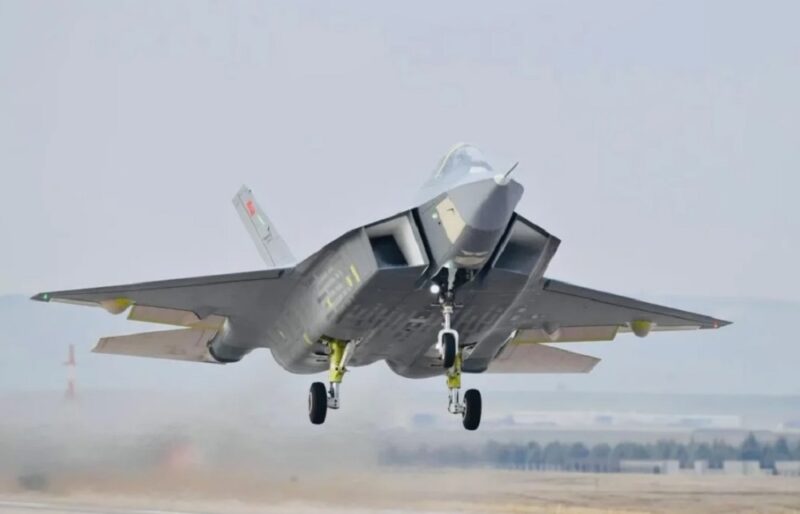
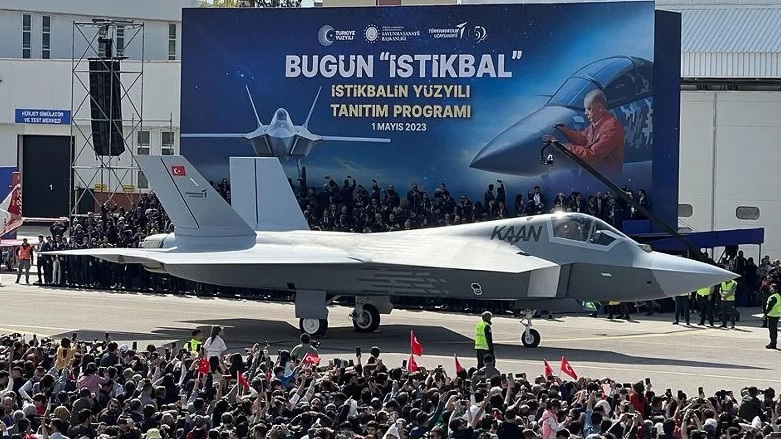
The first indigenous fighter aircraft built by Turkey, named KAAN, successfully completed its maiden flight at the Akinci airbase near Ankara.

Temel Kotil, CEO of Turkish Aerospace Industries (TAI), announced on Twitter that the maiden flight lasted for 13 minutes. The aircraft reached a speed of 230 knots and an altitude of 8,000 feet.

Development of the fighter aircraft began in December 2010, with the concept design contract signed between TAI and the government in August 2011. The development contract followed in August 2016.

The program aims to produce a fifth-generation fighter aircraft that meets the requirements of the Turkish Air Force after 2030, replacing the country’s fleet of F-16s. Turkey aims to be among the countries with a complete fighter aircraft production chain, from technology and infrastructure to human resources and production capabilities.

With a wingspan of 46 feet and a length of 69 feet, KAAN is equipped with two engines. The initial prototype is powered by two General Electric F110-GE-129 turbofan engines. However, the final version will utilize engines developed by Turkey’s own company, TRMotor.

TAI will produce five more prototype units, and the Turkish government has purchased 10 sets of F110 engines.

This fifth-generation Turkish fighter aircraft will combine several features, serving as a multi-role fighter with air superiority capabilities, including ground attack, diverse sensor systems, Active Electronically Scanned Array (AESA) radar, drone network control, and hypersonic guided munitions.