Hyundai Motor Malaysia (HMY) has officially opened a new dealership located in Petaling Jaya.
This marks another significant step in HMY’s efforts to expand its network across the country and reinforce its commitment to enhancing the premium customer experience in Malaysia.
Two Decades of Partnership
The new dealership is operated by Palm Motor Sdn Bhd, which has been part of the Hyundai dealer network since 2002.
Covering an area of 4,200 square feet, the dealership showcases the complete range of current Hyundai models, including the Santa Fe, Tucson, and Staria.
In conjunction with the opening ceremony, Palm Motor also celebrated the first delivery of a Hyundai Tucson 1.6T HEV to a customer.
Grand Launching Bonanza
Hyundai PJ is hosting a Grand Launching Bonanza from April 10 to 12, offering various exciting rewards.
One winner will be chosen to enjoy an all-expenses-paid holiday package to the world’s largest football match for two people.
Additionally, customers will have the chance to enter a lucky draw with prizes worth up to RM10,000, which include:
Grand Prize: iPhone 17
Second Prize: 40-inch Sharp Smart TV
Third Prize: Xiaomi Bluetooth Speaker
Consolation Prizes: Dashcam, free service package, car care products, tinting packages, Hyundai merchandise, petrol vouchers, Touch ‘n Go cards, SmartTag, and much more.
Hyundai PJ is also offering a trade-in promotion worth up to RM5,000, as well as demo unit rebates of up to RM38,888.
Palm Motor Petaling Jaya is located at Lot 23-A & 25, 13/2, Jalan Kemajuan, Section 13, 46200 Petaling Jaya, Selangor, and operates from 9 AM to 6 PM (Monday to Saturday) and from 10 AM to 5 PM (Sunday & Public Holidays).
Hyundai Motor Malaysia is set to launch several new models throughout 2026.
Among the models expected to be introduced are the locally assembled (CKD) versions of the Tucson and Santa Fe.
The brand has also confirmed the arrival of a B-segment MPV in the fourth quarter of this year, namely the Hyundai Stargazer.
In addition, Hyundai plans to introduce two high-performance models, the Ioniq 5 N and Ioniq 6 N, along with a range of products under the N-Line sub-brand.
Target of 25 Sales and Service Centers
Hyundai Malaysia aims to have up to 25 sales and service centers, including in East Malaysia. Currently, Hyundai Malaysia has 12 branches, with five Letters of Intent signed in 2025 and one earlier this year.
Enhancing Ownership Experience
Hyundai aims to further improve the customer ownership experience through the myHyundaiCare program.
Initiatives under this program include:
Reassessing service and maintenance packages to lower ownership costs
Reducing hybrid battery costs by only replacing damaged battery modules instead of the entire unit
Free vehicle inspection and service campaigns during festive seasons
Mobile technical support teams
Service clinics and owner workshops to enhance confidence and product knowledge
Continuation of the 8-year/160,000 km warranty
Vehicle value protection through the Hyundai Protection Plan, supported by insurance partners including Allianz, Berjaya Sompo, Etiga General Takaful, Takaful Ikhlas, and Tokio Marine
Improved spare parts stock through the Glenmarie warehouse
Staria All-Star Referral Program
The Staria All-Star referral program offers the following benefits:
RM500 service credit for referrers
Savings of up to RM1,500 for new customers on existing promotions.
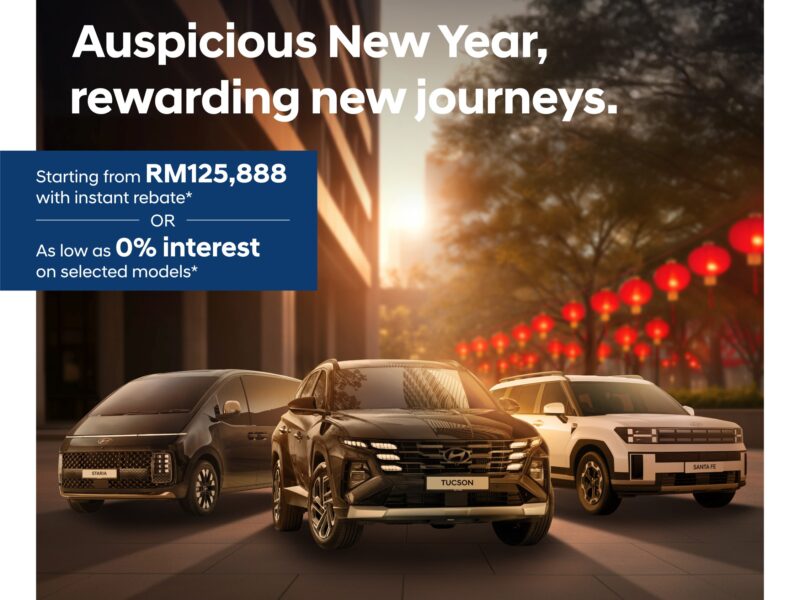
Hyundai Motor Malaysia ushers in the Lunar New Year with an exclusive offer on the new TUCSON, making this festive season an ideal moment for Malaysians to step into a smarter and more refined SUV.
The new TUCSON is available priced from RM125,888, while stocks last. Designed to meet the needs of modern drivers, the new TUCSON blends advanced technology with everyday comfort and versatility.
As part of this promotion, Hyundai Motor Malaysia is also offering rewards across all models, including the all-new SANTA FE and STARIA, allowing customers the flexibility to choose the ownership benefits that best suit their needs.
Chinese New Year Promotion Highlights:
Hyundai Tucson
Customers may choose either of the following options:
Total Drive Rewards – Cash rebates ranging up to RM19,000, with selected variants also receiving complimentary service packages + 8 times free service
Instant Savings – Cash rebate of up to RM24,000 on selected variants.
Low Financing – 0% interest financing available on selected variants.
Trade in support – up to RM2,300 for selected variants.
Hyundai Santa Fe
Customers may choose one of three ownership options, depending on variant availability
Total Drive Rewards – Cash rebates up to RM24,000, with selected variants also receiving complimentary service packages + 8 times free service
Instant Savings – Cash rebates of up to RM29,000 on selected variants
Low Financing – 0% interest financing available on selected variants.
Hyundai Staria
Customers can enjoy Total Drive Rewards across selected variants, with cash rebates up to RM20,000.
Adding to the celebrations, customers who test drive any Hyundai model and complete their booking within seven working days will receive an additional RM888 Early Bird Ang Pao, on top of the selected promotional savings.
Customers may visit the nearest authorised Hyundai showroom for more details and assistance.
Hyundai Motor Malaysia (HMY) and Edaran Otomobil Nasional Berhad (EON) have signed a Letter of Intent (LOI) to expand Hyundai’s retail footprint across Malaysia.
Two new dealership branches are set to be established in the Klang Valley and Penang, with completion expected by the first half of 2026.
These locations were identified based on market potential, increasing customer interest, and the growing trend of hybrid vehicle usage.
The new branches will also support Hyundai’s plans to enhance customer trust by providing sales, service, and after-sales facilities in densely populated areas.
Jahabarnisa Haja Mohideen, Managing Director of Hyundai Motor Malaysia, stated, “This collaboration is not just about growth; it is about building trust and providing long-term value to the people of Malaysia.”
“We are grateful to EON for joining us on this journey. Their strong reputation and nationwide presence make them a highly valued partner,” she added.
Meanwhile, Akkbar Danial, Chief Executive Officer of EON Berhad, remarked, “This collaboration reflects EON’s ongoing efforts to seek new opportunities in shaping the future of mobility in Malaysia.”
“Aligned with our guiding principle, ‘Passion Drives Possibilities’, we look forward to Hyundai as one of our brands that will enable us to deliver greater value to our customers,” he explained.
Hyundai Motor Malaysia has announced the opening of bookings for the locally assembled (CKD) Hyundai Staria model.
The MPV, which will be assembled at the Kulim factory in Kedah, will be sold at a price starting from RM179,888 to RM267,888.
Several new color options are available, including Jet Black, Snow Flake White Pearl, Meteor Grey, and Stormy Sea, across all variants.
In Malaysia, the Staria can be configured with either 10 seats or up to 7 seats for the premium variant.
In terms of power, the Staria is equipped with a 2.2-liter turbo diesel engine that produces 177 PS and 430 Nm of torque, paired with an 8-speed automatic transmission.
Further details about the Hyundai Staria can be read through this link [HERE].
In 2022, Hyundai launched the affordable MPV Stargazer to compete with manufacturers like Toyota, Daihatsu, and Mitsubishi in the Indonesian market.
The futuristic design has now been updated for the 2025 model year, featuring a bolder appearance and modern amenities.
The new facelift version of the Stargazer is known as the Stargazer Cartenz, named after Cartenz Peak, the highest mountain in Indonesia.
Significant changes are evident at the front, with more traditional headlight units, LED daytime running lights shaped like fangs, a grille structure, and a larger opening in the front bumper.
The new longer hood structure eliminates the egg-like appearance of the previous Stargazer.
At the rear, the Stargazer Cartenz features a redesigned bumper and thinner LED lights.
The Cartenz X model includes unique characteristics such as higher roof rails, protective plastic cladding around the body, a more aggressive bumper, and shiny black rims.
The Stargazer’s cabin has also been updated, with a digital cluster screen and central display integrated into a single panel, along with separate climate control panels.
As standard, the Stargazer comes with a seven-seat configuration; however, buyers can opt for the Captain Seat configuration in the middle to convert it into a six-seater vehicle.
Other features include ventilated seats with electric adjustments, wireless charging, a Bose sound system, smart cruise control, and a blind spot monitoring system.
The Cartenz X model is equipped with Shift-by-Wire technology, eliminating the gear lever for a more spacious central console.
In terms of power, the Stargazer retains the 1.5-liter naturally aspirated engine producing 113 hp and 144 Nm of torque, paired with either a six-speed manual transmission or a CVT.
Compared to its predecessor, this facelift version has increased dimensions, with an additional 115 mm in length, while the wheelbase remains at 2,780 mm, and ground clearance is at 205 mm.
In Indonesia, Hyundai sells the Stargazer Cartenz starting at Rp 350,400,000 (RM 90,580), while the Stargazer Cartenz X starts at Rp 361,900,000 (RM 93,553).
In conjunction with the Goodwood Festival of Speed, Hyundai took the opportunity to launch the high-performance electric sedan, the Ioniq 6 N.
The Hyundai Ioniq 6 N is the second high-performance EV produced by the South Korean manufacturer, following the introduction of the Ioniq 5 N in 2023.
Here are the details:
Power
The Ioniq 6 N is powered by two electric motors, delivering a total output of 601 hp and 740 Nm of torque.
With the N Grin Boost function, this power can surge to 641 hp and 770 Nm, but only for a duration of 10 seconds.
Acceleration from 0 to 100 km/h can be achieved in just 3.2 seconds, before reaching a top speed of nearly 260 km/h.
Chassis
According to Hyundai, the chassis of the Ioniq 6 N has been refined with a focus on improving handling, including suspension geometry with this sole purpose.
It is also equipped with electronically controlled dampers, complete with sensors that allow the vehicle to adjust damping based on current driving conditions.
Drivers can also take advantage of the N Drift Optimizer and N Torque Distribution functions for an exhilarating power control experience.
Braking System and Wheels
To bring the powerful N electric machine to a stop, Hyundai has fitted it with four-piston calipers and 15.7-inch rotors at the front, along with single-piston calipers and 14.1-inch rotors at the rear.
All four corners feature 20-inch wheels.
The Hyundai Ioniq 6 N utilizes specially developed 275/35R20 Pirelli P-Zero 5 tires designed specifically for this model.
Aerodynamics
Compared to the standard Ioniq 6 model, the Ioniq 6 N is equipped with a more sporty body kit, featuring a more aggressive bumper and front splitter.
For improved aerodynamic performance, the Ioniq 6 N comes with a ducktail rear wing and wider fenders.
For Drivers
In addition to the mentioned features, the Ioniq 6 N boasts an upgraded N e-shift system designed to minimize performance loss and enhance sound quality.
There is also an N Ambient Shift Light system that synchronizes with the ambient lighting when ‘gear shifts’ occur.
Finally, the N Active Sound+ feature offers three unique sound options: “Ignition,” inspired by motorsports; the nostalgic EV sound “Evolution”; and the futuristic theme “Lightspeed.”
How far can it go?
The Hyundai Ioniq 6 N is equipped with an 84 kWh battery pack, offering a range of up to 468 km on a full charge according to WLTP data.
For comparison, the Ioniq 5 N can travel up to 356 km using a similar battery setup.
Color Options
This high-performance EV is available in Performance Blue Pearl, Abyss Black Pearl, Serenity White Pearl, Nocturne Gray Metallic, Nocturne Gray Matte, and Gravity Gold Matte.
If you have noticed, the Hyundai Staria MPV has been one of Hyundai’s best-selling models in Malaysia since its official introduction three years ago.
Sales of this model will continue under Hyundai Motor Malaysia (HMY), with an updated version set to be officially launched on July 2.
Also showcased is the most premium variant, the Prestige, which offers a seven-seat configuration.
It features unique characteristics such as Brass Chrome trim on the exterior, including the side mirror housing, light housing, door handles, and the emblem.
In addition to the seven-seat Staria Prestige, there will also be a 10-seat Prestige version, as well as two other 10-seat variants: Style and Prime.
Depending on the variant, the Staria is equipped with features such as a dual panoramic glass roof, Premium Relaxation seats, automatic climate control, an 8-inch touchscreen, a Bose audio system with 12 speakers, and a cargo space of 431 liters.
All variants continue to be powered by a 2.2-liter CRDi diesel engine that produces 177 PS and 430 Nm of torque, drive only to the front wheels.
Interestingly, HMY’s press release mentions the upcoming hybrid variant, the Prestige HEV.
According to global market specifications, the Hyundai Staria HEV is powered by a Smartstream G1.6 T-GDi engine that delivers 245 PS and 367 Nm, paired with a 6-speed automatic transmission.
The Hyundai SmartSense safety features include functions such as Forward Collision-Avoidance Assist (FCA), Driver Attention Warning (DAW), Blind Spot Collision Warning (BCW), Safe Exit Assist (SEA), Smart Cruise Control (SCC), Lane Following Assist (LFA), Lane Keeping Assist (LKA), Rear Cross-Traffic Collision Avoidance Assist (RCCA), a surround view monitoring system, blind spot monitoring, and a Tire Pressure Monitoring System (TPMS).
More information, including pricing, will be revealed at the official launch event on July 2.
Hyundai Motor Malaysia (HMY) is set to launch several new models next month.
One of these is the 2025 Hyundai Santa Fe, a new generation mid-size crossover with a boxy design.
The new generation Santa Fe measures 4,830 mm in length, 1,900 mm in width, 1,780 mm in height, and has a wheelbase of 2,815 mm.
For the local market, it will be offered in three variants: Prime, Prestige, and Calligraphy (six seats).
There are two engine options available: a 2.5-liter turbo engine producing 281 PS at 5,800 rpm and 422 Nm of torque at 1,700-4,000 rpm, paired with a 6-speed automatic transmission, or a 1.6-liter turbo hybrid engine with 235 PS at 5,500 rpm and 367 Nm at 1,000-4,000 rpm, coupled with an 8-speed DCT transmission.
Exterior features of the Santa Fe include LED headlights with front and rear H graphics, dark chrome finishes on the radiator grille, and hidden rear windshield wipers.
During the preview session, we were not allowed to view the cabin layout of the Santa Fe.
However, based on the global market model, we can expect this SUV to be equipped with a curved panel consisting of two 12.3-inch screens, as well as a separate panel for cabin climate control.
It is reported that the 2025 Hyundai Santa Fe will be launched on July 2 in fully imported (CBU) units, while the locally assembled (CKD) version will be available starting in the third quarter of this year.
We will publish the full specifications of the 2025 Hyundai Santa Fe ahead of the official launch next week.
Another new model set to be officially launched by Hyundai Motor Malaysia (HMY) next month is the C-segment SUV, the 2025 Tucson.
Unlike what was previously offered by Hyundai Sime Darby, the 2025 Hyundai Tucson is a facelift version that features several cosmetic changes.
Among these changes are the Parametric Jewel front grille, which conceals larger daytime running lights (DRL), newly designed rims, and a more angular front bumper.
More significant changes can be observed in the cabin, where the layout has been completely redesigned.
The 2025 Tucson facelift now features a more streamlined dashboard, complete with a twin 12.3-inch screen integrated into a single curved panel, a three-spoke steering wheel without the italic H logo, and a separate 6.6-inch panel for climate control.
The center console houses a wireless device charging slot and a larger storage compartment, thanks to the shift lever being relocated to the right side of the steering column.
Three variants of the Tucson are set to be launched: the Style, equipped with a 2.0-liter engine (156 PS/192 Nm); and the Prime and Prestige (4WD), powered by a 1.6-liter turbo engine (180 PS/264 Nm).
There is also a 1.6-liter turbo hybrid engine option delivering 235 PS/367 Nm, offered specifically for the Prestige HEV variant.
The Style and Prestige HEV variants come with a 6-speed automatic transmission, while the Prime and Prestige variants are equipped with a 7-speed dual-clutch transmission.
In terms of dimensions, the 2025 Tucson measures 4,640 mm in length, 1,865 mm in width, 1,665 mm in height, and has a wheelbase of 2,755 mm.
Further details, such as safety features and sale prices, will be officially announced at the launch event on July 2.
Hyundai Motor Company (HMC) has officially established a new entity, Hyundai Motor Malaysia (HMY).
This move marks the evolution of the Hyundai brand from a distribution model run by Sime Motors to a principal-based operational approach that eliminates intermediaries.
With this initiative, Hyundai will assume full responsibility for branding, marketing, sales, and direct customer experience.
A dedicated local team will be formed and empowered to make faster and more relevant decisions within the new headquarters located at Menara Affin @ TRX.
Simultaneously, HMY will introduce three new models in the SUV and MPV segments for the local market.
Hyundai will also establish a local assembly operation in Kedah starting in the third quarter of this year (Q3 2025) through a partnership with Inokom Corporation Sdn Bhd.
The facility is expected to produce up to seven vehicle models over a five-year period, integrating Malaysia into the brand’s global production network.
In the short term, Hyundai’s production operations will focus on internal combustion engine (ICE) models and hybrid electric vehicles (HEVs) to meet Malaysian demand, with 30 percent of production expected to be exported to neighboring countries.
According to Jahabarnisa Haja Mohideen, Managing Director of Hyundai Motor Malaysia, “Malaysia is a highly potential market, with the highest demand for passenger vehicles in ASEAN at 35 percent.
“The stable GDP growth rate of 4.3 percent reflects strong consumer confidence and increased purchasing power. This situation will drive innovation and long-term investment.
“Through collaboration with local stakeholders, Malaysia is an ideal location to expand Hyundai’s presence and establish a key hub in Hyundai’s growth strategy in the Asia Pacific region.”
Meanwhile, Sime Motors will continue to be part of the Hyundai dealership network.
In addition, Hyundai plans to enhance its service network by opening up to 25 new branches by 2030 and upgrading its after-sales system.
Existing customers can update their information via THIS LINK to ensure HMY can provide continuous support under the new management.
Hyundai has been a well-known name in the Malaysian market since the early 2000s.
A variety of models have been introduced, covering diverse powertrains (ICE, HEV, BEV) and segments (sedan, SUV, MPV) such as the Elantra, Ioniq 5, Ioniq 6, Ioniq Hybrid, Palisade, Santa Fe, Sonata, Starex, Staria, and Veloster.
Overall, Hyundai has recorded sales exceeding 147,862 units, demonstrating an increasing market acceptance.
Take a look at this concept model alongside the Saloon Concept from Honda’s 0 Series.
Yes, both of these models are car concepts featuring a wedge body shape. The only difference is that one carries an italic “H” logo, while the other has a straight “H” logo.
This dark black vehicle is actually the Hyundai Obsidian Concept, designed by transportation design student Dominik Anders, with full support from Hyundai itself.
This full-scale model was showcased alongside the Kia EV2 Concept during the 2025 Car Design Event held in Munich.
Unfortunately, no details have been released at this time.
However, we can observe several features such as a horizontal LED pixel light bar at the front, pixel taillights, aerodynamic rims, and an aggressive diffuser at the rear.
It also features a flatter, more level roof design aimed at maximizing cabin space.
What are your thoughts on this latest concept from Hyundai? Should it be brought to life?
Introduced for the first time in June last year, the Hyundai Inster is a rather cutesy subcompact electric vehicle.
Soon, it will have a more aggressive and ferocious-looking twin known as the Insteroid.
According to Hyundai, the name Insteroid is derived from a combination of ‘Inster’ and ‘Steroid’. While full reveal will only happen sometime in early April, this official teaser provides a glimpse of the model’s design.
From what we can see, the Insteroid features round headlights and the brand’s signature pixel LED lights similar to the Inster. But beyond that, it is an entirely different machine.
This is due to the Insteroid being fitted with a wide body kit and a massive rear spoiler designed based on racing video games. To these eyes, it looks exactly like a WRC car.
Additionally, the Insteroid boasts a roof scoop, air vents on the wheel arches, a prominent rear diffuser, and 21-inch disc wheels. The interior has yet to be revealed, but it is clear that space has been stripped out to make room for a roll cage.
The technical specifications of the Insteroid are also still unknown but given that it is equipped with a Boost button and Track mode, it is undoubtedly more powerful and exciting to drive compared to the car it’s based on.
As a refresher, the Inster, which Hyundai claims is enjoying strong sales in South Korea and Europe, is powered by a single electric motor delivering 97 PS in the Standard version or 115 PS in the Long Range version.
Automotive company Hyundai has announced a collaboration with TVS Motor Company to develop last-mile mobility solutions for the Indian market.
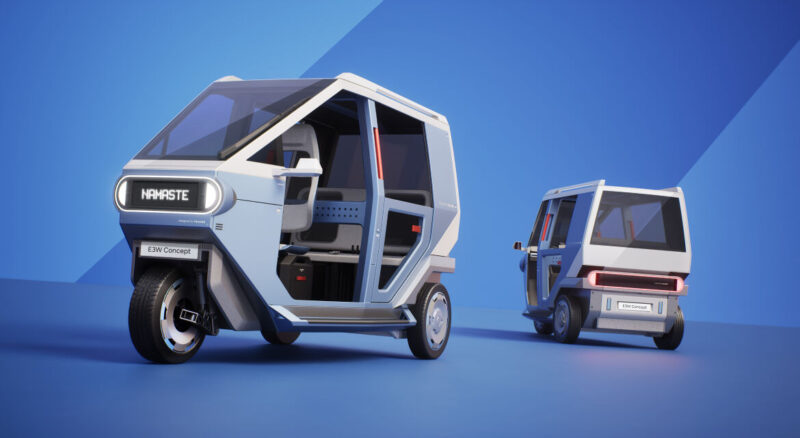
Two concept models have been showcased: a three-wheeled rickshaw concept (E3W) and a more suitable four-wheeled concept (E4W) designed for vehicle-sharing services.
Both vehicles feature a minimalist design reminiscent of the tuk-tuks commonly found on the congested roads of India.
To ensure lower manufacturing costs, Hyundai plans to use recycled plastic and flatter body panels, thereby reducing the burden on owners when replacing damaged parts.
Compared to typical rickshaws, the E3W boasts dimensions that are 200 mm longer and 35 mm taller to facilitate easier entry and exit.
Other features included are bottle holders and smart device storage, a USB charging port, and storage space under the seat.
Another concept model, named E4W, has a four-wheel configuration and a cabin space that appears larger than that of the E3W.
The handling characteristics are more akin to those of a real car, featuring a minimalist digital display and a round steering wheel equipped with a cluster of control buttons.
Under the bench-style second-row seat, there is storage space for goods, as well as a special board that can be used to hang items like fans or umbrellas.
An auto rickshaw speeds through heavy rain in Agartala, India on June 1st (Reuters/Jayanta Dey) pic.twitter.com/IQCW6GAQUZ
According to Hyundai, the ground clearance for both models can be adjusted as needed, particularly when navigating waterlogged routes during the monsoon season.
No specifications regarding the powertrain have been provided at this time.
However, it is worth noting that TVS has launched the three-wheeled King EV Max rickshaw priced at INR 295,000 (RM 14,928), which offers a range of 179 km and a top speed of 60 km/h.
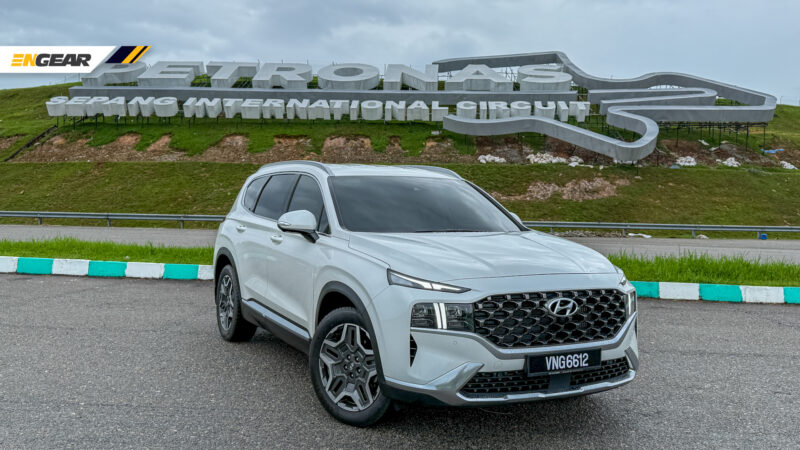
Officially launched a few months ago, it seems that many netizens have overlooked the fact that we actually have an equally impressive family SUV alternative— the Hyundai Santa Fe Hybrid.
We were given the opportunity to test drive this hybrid SUV at the end of last year, and we were quite satisfied with the package offered to consumers in Malaysia.
However, there are a few aspects that we found less favorable about the Santa Fe Hybrid, which could influence potential buyers’ decisions regarding its purchase.
1. Exterior Design That’s Too Bold for Some
Most family SUVs on the market tend to have a more conservative design approach that isn’t overly prominent.
This is not the case for the Santa Fe Hybrid, which, in its facelifted version, features a rather bold front end that some might find too aggressive.
Children with strong imaginations might see the Santa Fe Hybrid as a giant fish waiting to devour its prey.
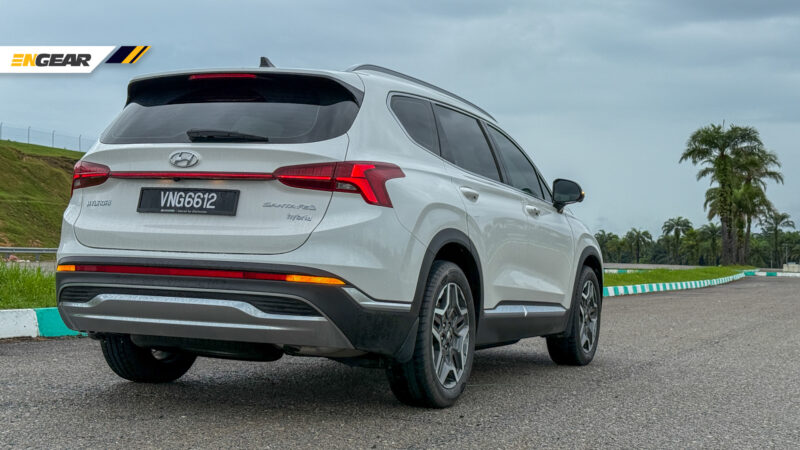
2. Relatively Low Position of the Turn Signal Lights at the Rear
I personally appreciate the modern and simplistic design of the rear light units.
However, it would be preferable if the turn signal function were incorporated into the main light housing.
Their relatively low position may lead some road users to overlook a driver’s intention to change lanes, even when the signal has been activated for a few seconds.
This contrasts sharply with the front view, where the turn signal lights, resembling graphic hammers, are bright and clear.
3. Cabin Design That Looks Outdated
Many manufacturers have started adopting a more simplistic and minimalist design approach for cabin interiors.
Unfortunately, this is not the case with the Hyundai Santa Fe Hybrid, which displays a design that feels several years behind that of its competitors.
This is largely because the Hyundai Santa Fe Hybrid still relies on a generation that is now one step behind; specifically, the fourth generation that was introduced to the global market in 2018.
In contrast, several markets around the world, particularly in ASEAN, such as Indonesia, the Philippines, and Singapore, have already begun offering the fifth generation of the Hyundai Santa Fe, which is far more sophisticated and modern-looking than the Santa Fe Hybrid available in Malaysia.
As a family head looking for a comfortable car/SUV packed with modern conveniences, several models from Japan and China are likely on your consideration list.
In addition to well-known Japanese brand SUVs that have a good reputation for reliability, there are now family SUVs from China that are significantly cheaper and offer more modern safety specifications.
However, many may forget that we actually have another family SUV model from a South Korean brand—the Hyundai Santa Fe Hybrid.
Officially (and quietly) launched in September last year, the facelifted Hyundai Santa Fe Hybrid can be positioned as an alternative for those who want something different from the usual choices available in Malaysia.
With a selling price of RM215,800, is the Hyundai Santa Fe Hybrid significantly better than competing models? Here are our first driving impressions after spending a short period with it:
1. Facelift – More Than Just a Cosmetic Change
For your information, the ‘new’ Santa Fe Hybrid launched a few months ago is not a completely new generation model.
It is classified as a facelift model, featuring an updated front end with a wider grille and LED headlights resembling the hammer graphic associated with Volvo models, which tends to make heads turn when spotted on the road.
At the rear, the LED lights have been revamped with a more elegant geometric pattern, complemented by a horizontal LED bar connecting both light housings.
Yes, while the Santa Fe is a facelift model, the significant changes are actually hidden beneath its elegant exterior. It uses an all-new platform that has improved safety aspects, handling, fuel efficiency, and NVH (noise, vibration, and harshness) levels.
It is quite rare for a facelift model to come with an entirely new platform.
2. Cabin Space Features
One crucial aspect necessary for a comfortable family car is a spacious and comfortable cabin.
The Santa Fe Hybrid meets these needs with comfortable seating in the second and third rows, as well as a cargo space that can be maximized for various uses.
One feature we particularly liked is the third-row seating that can be folded down by simply pressing a button, along with separate air conditioning vents to ensure rear passengers remain comfortable throughout the journey.
Additionally, there are USB charging ports and power sockets available to charge electronic devices and smart gadgets.
For the driver, the Santa Fe Hybrid provides a digital cluster screen with the option for easy-to-read analog meter graphics, as well as an eight-inch infotainment screen complete with wireless Apple CarPlay/Android Auto support.
The center console has been raised to function as a more comfortable armrest, also providing hidden storage space under the dashboard.
Moreover, the use of simpler PRND buttons in place of a traditional gear shift lever gives the cockpit a more spacious look.
The large functional button cluster also facilitates easy adjustments to settings such as the air conditioning system, drive modes, or simply ensuring front passengers are more comfortable with built-in heating and ventilation functions for the seats.
While the cabin layout of the Santa Fe may not be as minimalist as newer modern cars, it doesn’t prompt excessive complaints, particularly when searching for or adjusting desired functions.
3. Highly Fuel-Efficient Hybrid Engine
The Santa Fe Hybrid we tested is powered by a 1.6-liter Smartstream G1.6 T-GDI inline four-cylinder engine that produces 180 PS at 5,500 rpm and 265 Nm of torque at 1,500-4,400 rpm.
This engine is coupled with a 60 PS electric motor that provides 264 Nm of torque, bringing the total power output to 230 PS and 350 Nm.
While it may not be the most powerful SUV like a sports car, it is sufficiently capable of moving its relatively large body.
In terms of driving, the Santa Fe Hybrid offers lively initial acceleration to outpace sporty-looking cars next to it, while also delivering impressively economical fuel consumption.
We were unable to empty a full 67-liter RON95 tank in the Santa Fe Hybrid due to time constraints; however, according to Hyundai, this SUV can go up to 1,000 km before needing a refill.
Our short drive came close to 300 km, yet the fuel gauge barely registered a decrease.
4. Driving and Comfort
One of the advantages of the Santa Fe Hybrid is its ability to operate in electric driving mode at low speeds, and for relatively long distances as well.
This is a significant factor in the SUV’s fuel efficiency, as during most city driving, only the electric motor is in use, with the 1.6-liter turbo engine occasionally kicking in just to ensure that the 1.49 kWh battery maintains sufficient charge.
Moreover, in EV mode, the Santa Fe Hybrid does not operate entirely silently; it emits a futuristic warning sound to alert pedestrians of its presence on the road.
What we can praise about this hybrid SUV is the driving dynamics and handling, which are noticeably better compared to Chinese-made SUVs.
Why do we often emphasize good steering and suspension tuning? All of this contributes to the comfort of both the driver and passengers.
With a steering system that is responsive and not overly artificial, the driver will not feel excessively fatigued after a long journey.
The slightly firmer suspension tuning enhances cornering confidence, while still effectively filtering out the roughness that exists on beloved Malaysian roads. The result is a remarkably comfortable ride, regardless of the road quality encountered.
Most notably, the NVH (noise, vibration, and harshness) performance is exceptional, as we found it difficult to perceive any roughness, vibrations, or exterior noise inside the cabin.
Even though the turbo engine operates from time to time—especially when the right foot is pressed firmly to the floor—the engine sound is not intrusive within the cabin. The transition between engine and electric motor operation is also very smooth, making it sometimes difficult to detect.
5. Safety Features
As standard, the Hyundai Santa Fe Hybrid comes equipped with the Hyundai SmartSense Level 2 Advanced Driver Assistance Systems (ADAS), offering semi-autonomous driving support to ensure a safer and more reassuring driving experience.
A unique feature we appreciate in the Hyundai Santa Fe Hybrid is the Blind-Spot Monitor (BVM), where the display for the left or right blind spot appears on the digital cluster screen to assist with safe lane changes.
What we find particularly valuable about this function is that it provides only the necessary information for the driver to detect the presence of objects from behind, rather than a bird’s-eye view perspective that is often unhelpful.
Another important feature for families is the Rear Occupant Alert, which ensures you do not forget any young children seated in the back when leaving the vehicle in a parking spot, especially in hot weather conditions.
6. Price that Might Be Out of Budget
Despite its various advantages over competing models, a significant drawback of the Santa Fe Hybrid is its selling price, which may be beyond the means of some buyers.
At RM215,800, not many will consider it a budget-friendly purchase.
In fact, for a lower price, one could opt for a non-hybrid three-row SUV such as the Mazda CX-8 or Chery Tiggo 8 Pro, or a mild-hybrid SUV like the Proton X90.
For those with small family members, there are still hybrid SUV options with a five-seat configuration, such as the Toyota Corolla Cross HEV, Haval H6 HEV, or Honda CR-V e:HEV.
However, for those who can afford it and desire something different, the Hyundai Santa Fe Hybrid may still be a purchase that brings a smile and is appreciated by the whole family.
Hyundai India is set to launch an all-electric SUV, the Creta Electric, for the local market.
In terms of appearance, the 2025 Creta Electric showcases a different design compared to its internal combustion engine (ICE) counterpart.
A significant change is evident in the front, featuring a layered grille adorned with pixel patterns, more stylish LED daytime running lights, and headlamps integrated into the ends of the bumper.
At the rear, the previous layered light design has been replaced with a more modern lighting layout.
The side profile of the Creta Electric seems to retain elements from the internal combustion engine version, but it is enhanced with a newly designed 17-inch aerodynamic rim.
Inside the cabin, the Creta Electric is equipped with a new steering wheel, a gear shift lever borrowed from the Ioniq 5 model, a drive mode switch knob (Eco, Normal, Sport), and twin 10.25-inch digital display panels.
The Creta Electric also supports Vehicle-to-Load (V2L) functionality, featuring a power socket beneath the rear seats that can be used for charging electronic devices.
In addition to the existing storage space, owners can store the charging cable in the frunk.
Hyundai has not disclosed detailed specifications for the electric motor of this SUV but has confirmed an acceleration of 0-100 km/h in just 7.9 seconds.
There are two battery pack capacity options: 42 kWh with a range of 390 km, or 51.4 kWh offering a range of 473 km (based on ARAI cycle data).
The Creta Electric also supports 11 kW AC charging, allowing for a full charge in approximately four hours, and DC fast charging, which enables the battery to charge from 10 to 80 percent in 58 minutes.
The Hyundai Creta Electric will be officially launched at the Bharat Mobility Show on January 17.
Whether one realizes it or not, the Hyundai Palisade has now entered a new generation after making its debut in 2018.
Unlike its predecessor, the second generation of the Hyundai Palisade 2026 boasts a sturdier design without overly busy body lines.
In terms of dimensions, the Hyundai Palisade 2026 is now 5,060 mm long (+65 mm), 1,980 mm wide (+5 mm), 1,805 mm tall (+55 mm), and has a wheelbase of 2,970 mm (+70 mm).
From the side profile, the added dimensions result in a shorter front overhang and a longer rear overhang.
It resembles a Range Rover.
This luxurious appearance is further enhanced by a relatively large and wide grille, followed by a cluster of gigantic LED daytime running lights that also serve as turn signal indicators visible from a distance.
The layered lighting theme continues at the rear, though without the transverse LED bar that is currently in trend.
Inside the cabin, the Palisade features a layout that is far more luxurious, akin to a Genesis brand vehicle.
The dashboard houses a twin 12.3-inch screen in a single curved panel, adorned with wooden trim, ambient lighting, a steering wheel similar to the Range Rover model, and a cluster of controls for the infotainment and cabin temperature systems.
In Korea, the Hyundai Palisade is also available in a nine-seat version, where the ninth seat is a small bench between the front seats that can be converted into a center console.
For other markets, the Palisade remains available in seven- or eight-seat versions.
In the seven-passenger version, the second-row seats come with electric adjustability (including reclining and folding), massage functions, and a tilting walk-in feature for easy access to the third row.
Cargo space can also be maximized to 615 liters simply by moving the third-row seats slightly forward.
Drivers are also given the freedom to adjust the position and angle of the second and third-row seats through the infotainment screen menu.
It is worth noting that the Hyundai Palisade 2026 still retains the same unibody platform as its predecessor, although it has been upgraded.
Despite sharing the same platform, the new Hyundai Palisade does not retain the 3.8-liter V6 engine, instead replacing it with a 2.5-liter turbocharged inline-four engine that produces 277 hp and 422 Nm of torque.
The hybrid version, which consists of the 2.5-liter turbo engine, a single electric motor (72 hp/264 Nm), and a 1.65 kWh lithium-ion battery pack, can generate up to 330 hp, with a driving range exceeding 1,000 km!
In addition to the new engines, the Hyundai Palisade is the first Hyundai SUV to feature a technology known as Electronic Controlled Suspension (ECS).
This ECS system uses navigational data and sensors to adjust vehicle movements throughout the journey, prioritizing enhanced passenger comfort.
Furthermore, the new Palisade offers a quieter cabin using thicker glass and additional sound insulation around the windows.
The second-generation Hyundai Palisade 2026 is set to be sold in the Korean market starting at ₩43,830,000 (approximately RM135,724).
Hyundai Motor has reportedly announced plans to open its first factory in Malaysia next year, with an investment valued at RM2.16 billion.
According to the Investment, Trade and Industry Minister Tengku Datuk Seri Zafrul Tengku Aziz, the investment will become the largest by the car manufacturer in the country and create numerous job opportunities.
“The RM2.16 billion investment from Hyundai Motor will enable Malaysians to purchase vehicles manufactured by Hyundai Motor at more competitive prices.”
Tengku Zafrul added that the government has set certain conditions for Hyundai Motor to incorporate domestic components in the vehicles produced.
“In this way, Hyundai Motor can manufacture vehicles at more competitive prices,” he stated.
The Hyundai Motor factory in Kulim, Kedah, is expected to commence production by mid-2025.
It will involve seven models, including hybrid and internal combustion engine (ICE) models.
“To start with, they will produce seven vehicle models with hybrid and ICE capabilities over the next five years.
“However, in the long term, it may also include the production of electric vehicles (EV),” he added.
Thanks to its aggressive styling and an exhaust that pops and bangs everytime you lift your foot from the throttle, the Hyundai Elantra N certainly stands out, even in its standard guise.
However, perhaps sensing that the high-performance sedan still has room for improvement, the Korean automaker has unveiled the Elantra N TCR Edition.
Inspired by the race cars competing in the TCR World Tour, the Elantra N TCR Edition comes with multiple upgraded performance parts.
The most notable addition is of course the carbon swan neck spoiler, which is adjustable to provide optimal downforce settings for various driving conditions and preferences.
On top of that, the Elantra N TCR Edition features lightweight 19-inch forged wheels that are highly rigid. Hidden behind these wheels is the Hyundai’s N Performance four-piston braking system.
For some reason, the TCR Edition’s striking blue, red, and white livery, with an oversized ‘N’, is exclusively available in the South Korean market.
Inside, the cabin boasts an Alcantara-wrapped steering wheel, adorned with a Performance Blue 12 o’clock marker, matching Performance Blue seat belts, and an exclusive TCR Edition badging.
The engine remains untouched. Like the standard version, the Elantra N TCR Edition delivers 280 PS and 392 Nm of torque from its 2.0-litre turbocharged four-cylinder engine.
The Elantra N is offered with two transmission options: an eight-speed dual-clutch transmission (DCT) and a six-speed manual. Official images released by Hyundai show the DCT variant, but it remains uncertain whether the manual option will be available for this special edition.
The Elantra N TCR Edition is set to launch in South Korea this December, with a global rollout anticipated next year.
Malaysia’s Leading Automotive News | ENGEAR ENGLISH