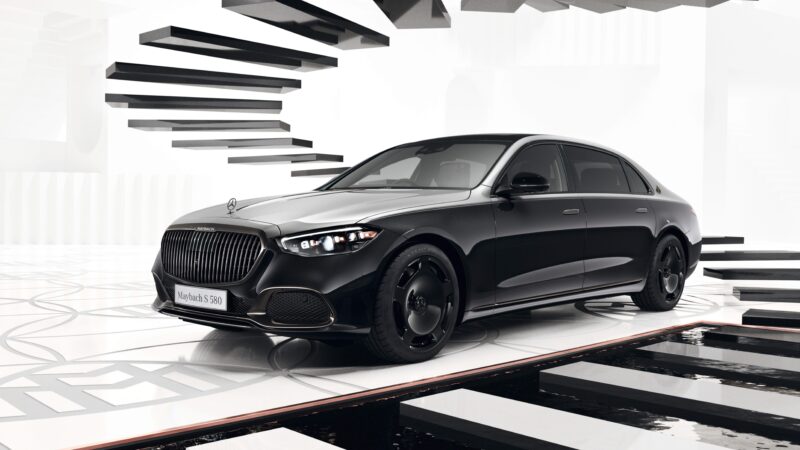
Mercedes-Benz Malaysia has announced the arrival of the ultra-luxurious executive sedan, the Mercedes-Maybach S580 4MATIC Night Series, in the local market, with a starting price of RM2,404,888 (on-the-road without insurance).
Unlike previous S-Class Maybach models, the Night Series edition features an exclusive dark motif that elevates luxury and sportiness to a new level.
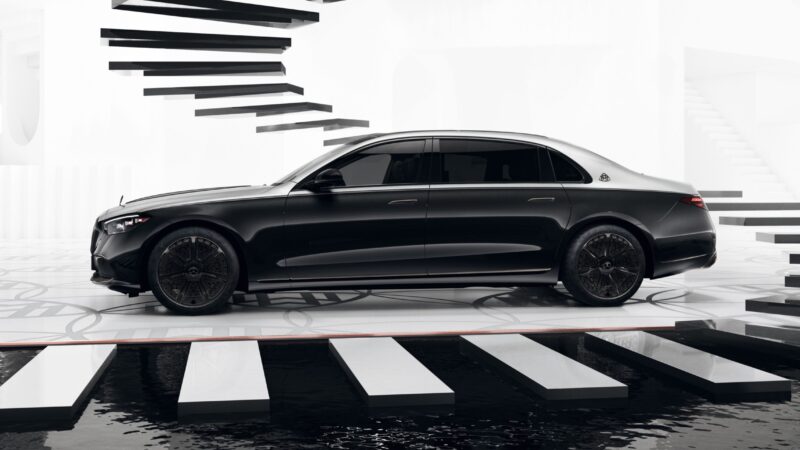
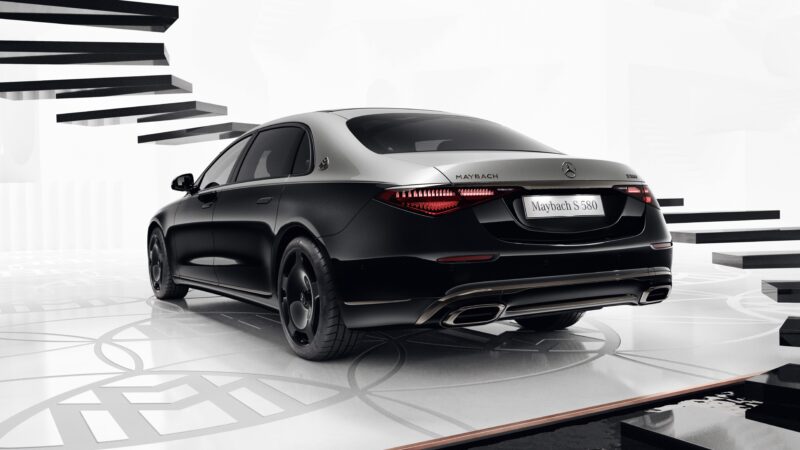
Several exterior colors are available, including gray, black, and white, along with two-tone combinations such as Onyx Black/Mojave Silver and Manufaktur Opalite White Bright/Obsidian Black.
The sedan is further adorned with detailed finishes, such as rose gold and dark metallic chrome accents on the headlights, as well as dark shadow gloss on the front grille and bumper, the Mercedes star, door handles, and the Maybach emblem.
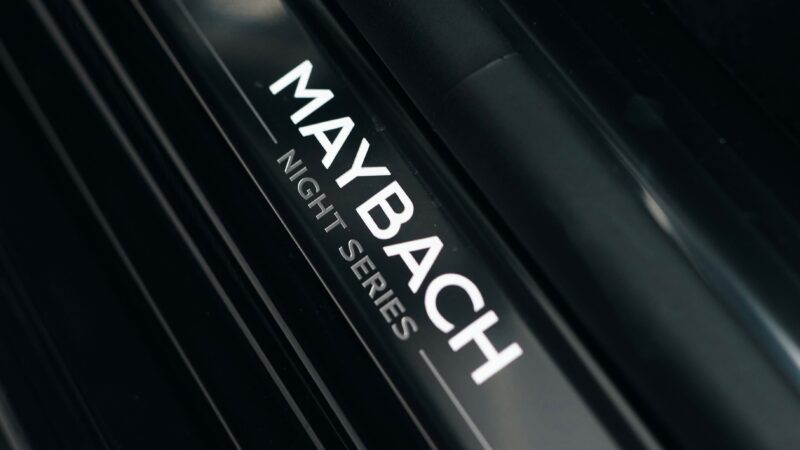
Additionally, there is glossy black trim around the window surrounds, the B-pillar, and the side mirror housings, complemented by illuminated door sills featuring the “MAYBACH Night Series” script.
Finally, the four corners of the wheel arches are decorated with 20-inch seven-spoke lightweight Maybach alloy rims.
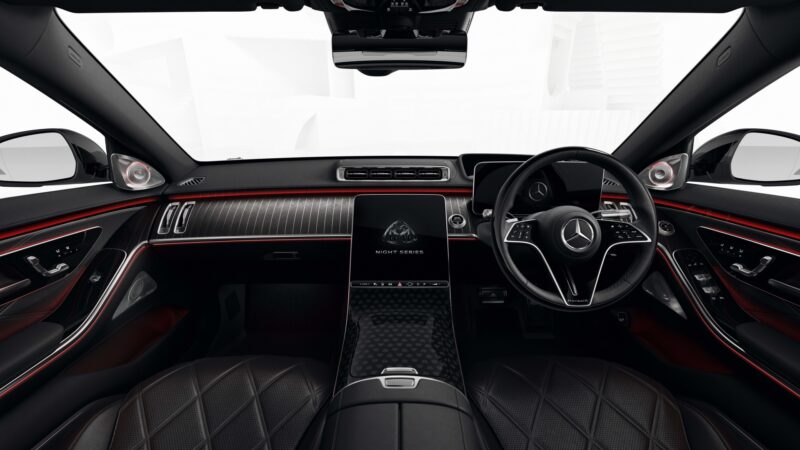
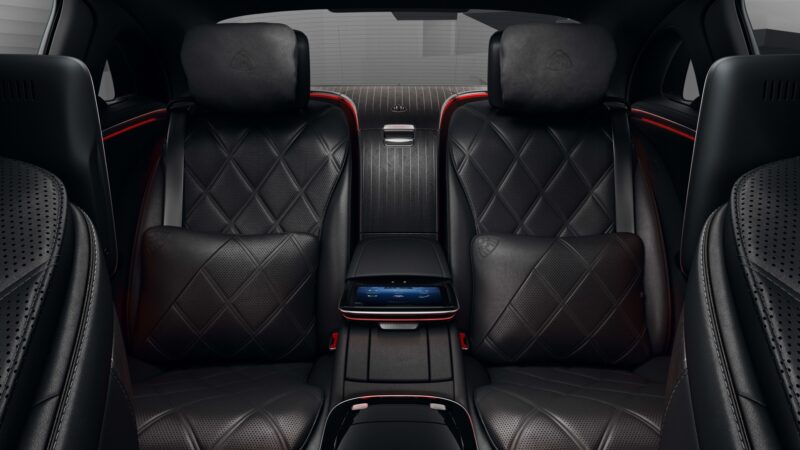
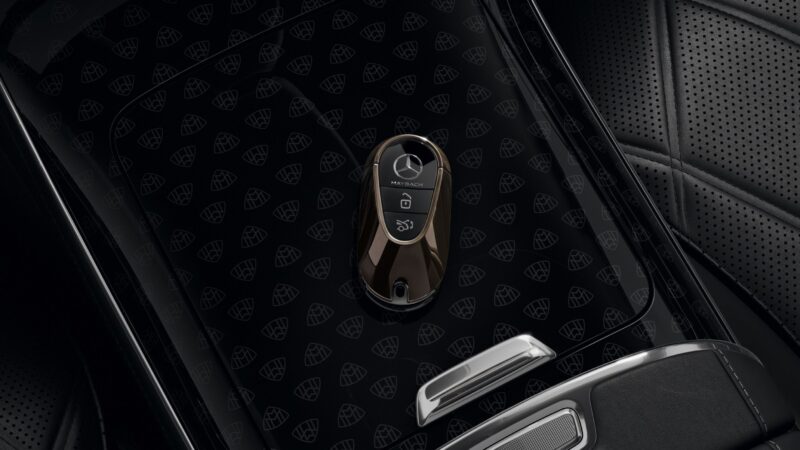
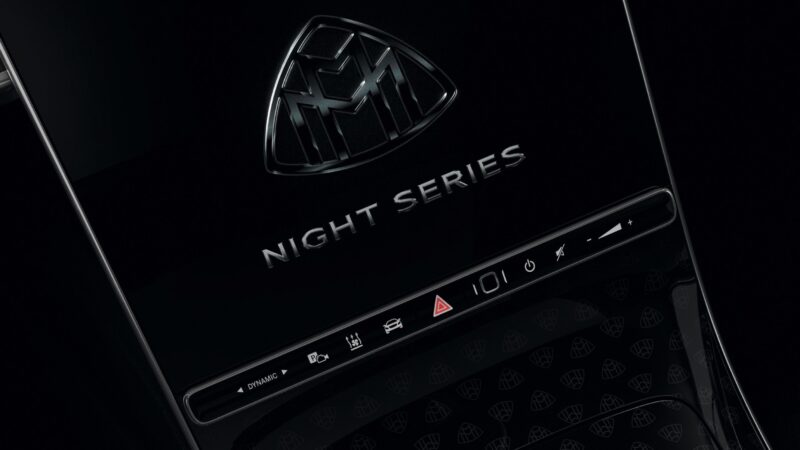
The S580 Night Series cabin is outfitted with Nappa leather upholstery in a Black/Black Pearl combination, glossy golden-grey accents, an active ambient lighting system with a Garnet Glow color scheme, Manufaktur wood trim, and a black crystal-style finish with Maybach patterns on the center console.
The air conditioning vents also feature dark shadow gloss finishes at both the front and rear.
In keeping with the black theme, the sedan includes a mystic-themed startup animation on the display screen.
The Mercedes-Maybach S580 4MATIC Night Series is powered by a 4.0-liter twin-turbo V8 engine, generating 496 hp @ 5,500 rpm and 700 Nm of torque @ 2,000-4,500 rpm.
This engine is paired with a 9-speed automatic transmission, a 4MATIC all-wheel drive system, and an EQ-Boost hybrid system that adds 23 hp and 205 Nm of additional power.
The Waterfront @ Desa ParkCity will be enlivened by the Light the Change Festival organized by BYD and Denza.
This electric mobility brand will set up camp for one month, from November 28 to January 4, featuring a variety of activities and performances scheduled each week.
The festival aims to strengthen BYD and Denza’s commitment to environmental responsibility while raising awareness about sustainability, climate issues, and the future of mobility.
Additionally, BYD is implementing the global initiative “One Degree. One Future,” aimed at reducing the Earth’s temperature by one degree through electric mobility solutions.
Exciting activities include:
Planting pledges in the Greenfield Zone
Exploration of Electric Mobility
Test Drives (10 AM to 6 PM)
Golden Hour Performances (Friday to Sunday, 8 PM to 9 PM)
Week
Dates
Golden Hour Show
Week 1
28 – 30 November
Bubble Show
Week 2
5 – 7 December
Week 3
12 – 14 December
LED Butterfly Dance Performance
Week 4
19 – 20 December
Bamboo Music Performance by Alena Murang
Week 5
22 – 28 December
Xmas Snowfall
Week 6
2 – 4 January
New Year Light Show
Since entering the new energy vehicle sector, BYD has successfully reduced over 9.3 million tons of CO2 emissions worldwide.
Locally, BYD and Denza have sold a total of 12,872 units as of November 2025, reflecting a 76% increase compared to the same period last year.
Since day one, total sales in Malaysia have surpassed 25,233 units, equivalent to reducing CO2 emissions by 62,191 tons annually or planting nearly 2.5 million trees.
Sime Motors has also played a crucial role in accelerating electric mobility in Malaysia.
In the past three years, Sime Motors and BYD have introduced seven EV models, established 39 sales and marketing branches, 24 after-sales branches, and 12 authorized body and paint centers.
Supported by a dedicated BYD Training Center and a centralized warehouse, Sime Motors ensures premium service and support for BYD customers across the country.
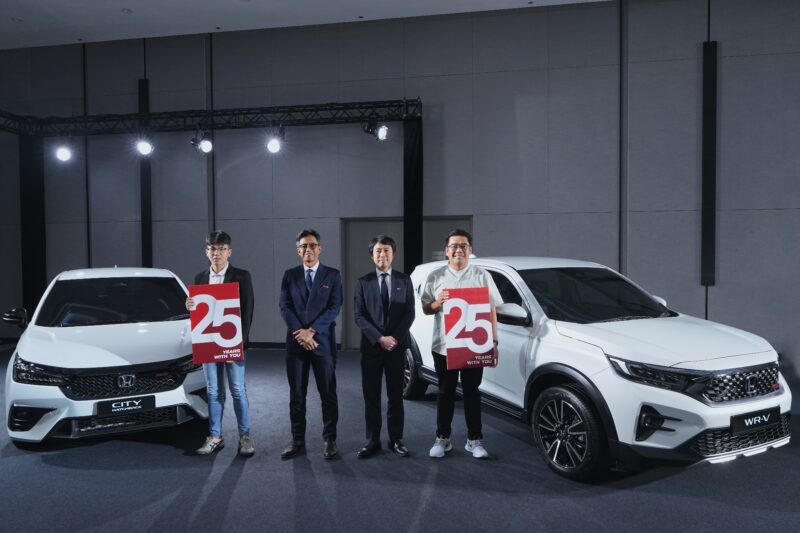
Honda Malaysia shared the joy of its 25th anniversary celebration with the announcement of the first two lucky winners of its “Because of You” campaign.
The prizes of a City Hatchback RS and a WR-V RS were presented at a special appreciation event.
The lucky winner of the City Hatchback RS, Mr. Chin from Perak, entered the contest after purchasing a Platinum White Pearl Civic RS.
He said, “Owning a Civic has always been my dream as I am captivated by its striking appearance and powerful performance that stays true to the Civic DNA. Receiving my new car was already exciting, but winning the City Hatchback RS on top of that makes it even more special. I was shocked when they called to inform that I won – I thought it was scam! Now, I can’t wait to take both my Honda cars out on the road and enjoy the different driving experiences each one has to offer.”
Ms. Ou, who purchased the CR-V as a family car could not be present to personally receive her prize, was presented by her husband, Mr. Liew Jeng Siong, who travelled all the way from Sarawak to claim her lucky draw prize, the WR-V RS.
She said, “I wanted an SUV that offers a complete package, such as comfort, spaciousness and elegant design. The moment I saw the CR-V, I knew it was the car for me and my family, and I booked it without hesitation. Little did I know that my new car would bring along its sibling to the family. I’m now the owner of not one, but two Honda SUVs, both perfectly suited for my family’s needs.”
The City Hatchback RS and WR-V RS are among the six grand prizes offered in conjunction with the Company’s 25th Anniversary “Because of You” Campaign lucky draw.
Edaran Tan Chong Motor (ETCM) recently held a preview session for its new MPV model set to launch next year, the Nissan Serena e-Power.
The sixth generation of the Nissan Serena e-Power (C28) is powered by the e-Power drivetrain, which consists of a 1.4-liter engine, a 163 PS electric motor producing 315 Nm, and a 1.769 kWh lithium-ion battery pack.
Unlike hybrid vehicles on the market, this e-Power system relies entirely on the electric motor for propulsion.
The 1.4-liter engine serves solely as a power generator but is equipped with direct injection technology and Mirror Bore Coating, which help reduce friction, vibration, and noise.
Fuel consumption is as low as 5.4 liters per 100 km, and this MPV can travel up to 1,000 km on a full tank.
In terms of appearance, the Serena e-Power C28 features a more modern design, beginning with a V-motion grille, a sleeker bumper, boomerang-patterned taillights, and the new Nissan logo.
The wheels are 16 inches in size.
According to ETCM, the Nissan Serena e-Power will be the first e-Power model to be assembled at the Serendah plant.
The retail price and full specifications of the Nissan Serena e-Power will be announced at the official launch, expected to take place in the first quarter of 2026 (Q1 2026).
The world’s oldest motorcycle and scooter brand, Peugeot Motorcycles, will officially enter the Malaysian market under the distribution of Aveta International Sdn Bhd.
Aveta was chosen as the official distributor due to several factors, including an extensive dealer and service network, technical expertise, and customer service programs such as ‘Aveta Care on Wheels.’
The entry of the Peugeot Motorcycles brand into the Malaysian market is set to introduce a variety of premium and affordable European-inspired options for consumers.
The first model from Peugeot Motorcycles is expected to be officially launched in the first quarter of 2026.
For information, Peugeot Motorcycles was established in 1898 and is now marketed in over 3,000 locations worldwide.
The brand offers a comprehensive range of models powered by three global production hubs located in France, China, and Vietnam.
Among the models available are the Peugeot Metropolis, XP400, Pulsion, Django Classic, and Speedfight.
Pininfarina and JAS Motorsport have unveiled official images of the restomod project for the first-generation Honda NSX, which is set to launch soon.
The project has also received an official name: “Tensei,” which means “rebirth” in Japanese.
From the images provided, the original look of the NSX NA1 has been carefully preserved, featuring elements such as the pop-up headlights, the rear spoiler, and the black canopy roof.
However, several modifications have been made, including the addition of LED daytime running lights (DRL), vents on the front hood, and larger air intakes at the rear.
The Tensei’s appearance has also been enhanced with a wider rear track and a shortened rear overhang.
Currently, the exact specifications of the Tensei have not been disclosed.
However, in a previous announcement, JAS Motorsport indicated that they would be re-tuning the original 3.0-liter V6 engine, which is expected to exceed the paper figures of 270 hp and 285 Nm that were standard when launched in the 1990s.
JAS Motorsport has also confirmed that the Tensei will feature a body construction made from carbon fiber.
Do you want a high-performance car made in Japan with acceleration that outpaces the Rimac Nevera? Consider the Aspark Owl Roadster.
This Japanese engineering company claims that the Owl Roadster EV can accelerate from 0 to 100 km/h in just 1.72 seconds!
With a mere 0.02-second advantage, the Owl Roadster holds the title of the fastest production car in the world.
While another speedster, the McMurtry Speirling, can achieve 0-100 km/h in just 1.40 seconds, it’s important to note that this is not a car intended for road use.
What makes the Aspark Owl Roadster so fast?
First and foremost, it features a carbon monocoque chassis and a full carbon fiber body, weighing a total of 2,050 kg, paired with four powerful electric motors.
It can achieve a top speed of 413 km/h, though it is electronically limited to 350 km/h for road use.
The 69 kWh battery offers a range of over 250 km on a single full charge.
The Owl Roadster comes with four driving modes: Rain-Snow, City-Comfort, Sport-Dynamic, and High Boost.
Driving dynamics are enhanced by double wishbone suspension with adjustable ride height, an active rear wing, a carbon ceramic brake system (10-piston front/4-piston rear), and 20-inch rims shod with Michelin Pilot Sport Cup 2R tires.
Since 2019, Aspark has shifted its production operations to Italy, with the Owl Roadster model limited to just 20 units worldwide.
Each unit is estimated to be worth US$3.5 million (RM14.45 million).
When we talk about flat or boxer engines, the names of two manufacturers typically come to mind: Porsche and Subaru.
This unique engine configuration offers benefits in terms of better vehicle handling due to its lower center of gravity compared to conventional engines.
You might not suspect that a popular name in China is also venturing into producing boxer engines.
That name is none other than BYD!
This news is quite surprising as BYD already has a family of engines for its plug-in hybrid (PHEV) model lineup.
This brand-new 2.0-liter turbo boxer engine will be paired with four electric motors to power the luxury sedan Yangwang U7.
Overall, it can generate up to 1,287 hp and 1,680 Nm of torque.
Acceleration from 0 to 100 km/h can be achieved in just 2.9 seconds, a truly impressive figure for a sedan weighing 3 tons!
Interestingly, the engine serves primarily as a range extender to charge the battery, which then supplies power to the electric motors.
However, under certain conditions, this engine can deliver 272 hp and 380 Nm of power directly to the rear axle.
With the help of this boxer engine, BYD was able to design the Yangwang U7 with a lower hood profile, giving the sedan a sportier appearance.
Additionally, the NVH (noise, vibration, and harshness) aspects of this sedan are significantly improved due to the reduced vibrations from the boxer engine.
With the boxer range extender, the Yangwang U7 can travel up to 966 km on a full tank and fully charged battery, while the zero-emission range can reach up to 193 km.
In China, the BYD Yangwang U7 is priced between RMB628,000 and RMB708,000 (RM367,000 to RM414,000).
Shell Malaysia recently announced the integration of BUDI95 into its online application, the Shell App.
Customers can purchase subsidized fuel by completing the eKYC verification for the TNG eWallet just once. After the verification is completed, they can simply press the BUDI95 button to make payments securely and enjoy immediate subsidized rates.
According to Seow Lee Ming, General Manager of Shell Mobility and Convenience Malaysia, “We believe this enhanced Shell App will help Malaysians maximize every Ringgit spent.”
“In addition to Shell FuelSave95, which helps drivers go further on a full tank, the Shell App offers convenience and opportunities to earn rewards every time they visit a gas station.”
Shell Malaysia also announced two exclusive campaigns for Shell App users, featuring vouchers worth up to RM2 million and a contest for free fuel for three years!
Customers who successfully complete the eKYC verification for the TNG eWallet and make a minimum BUDI95 transaction of RM10 will automatically qualify to receive a RM5 voucher within the app.
New Shell App users will also receive an additional RM5 voucher.
For the Free Fuels Contest, customers only need to purchase selected Shell Helix or Shell Advance products at any Shell station to receive a special voucher.
This voucher can be redeemed through the Shell App, allowing them to enter the Free Fuels Contest.
Mdua Motor Sdn Bhd has officially launched the latest scooter model, the Moda Aero-E, for the local market.
This scooter is powered by a single-cylinder, air-cooled engine with a displacement of 118.8 cc, delivering 9.1 hp at 7,500 rpm and a torque of 9.5 Nm at 6,000 rpm, paired with a CVT transmission.
The Aero-E features a telescopic suspension setup at the front, complemented by a single shock absorber at the rear.
The braking system includes a disc setup for the front wheel, assisted by a drum brake at the rear.
The Moda Aero-E is equipped with features such as dual LED projector headlights, LED taillights, an LCD display, USB Type-A and Type-C charging ports, and 14-inch rims.
Additionally, the scooter comes with a 5.5-liter fuel tank, a 6.5-liter storage compartment under the seat, and a seat height of approximately 780 mm.
Two attractive colors are available: Cobalt Blue and Carmine Red. The starting price is RM5,189, excluding road tax, registration, and insurance.
ASEAN NCAP has announced that Perodua’s first electric SUV, the QV-E, has achieved a five-star rating in its newly launched vehicle assessment tests.
Based on these tests, the Perodua QV-E attained an impressive overall score of 88.36 points across four categories:
Adult Occupant Protection (AOP) – 36.63/40.00
Child Occupant Protection (COP) – 16.73/20.00
Safety Assistance (SA) – 20.00/20.00
Motorcycle Safety (MS) – 15.00/20.00
The Perodua QV-E is a segment B electric SUV available in a single variant, offering standard features such as six airbags, Electronic Stability Control (ESC), ABS, Seat Belt Reminder (SBR) for both front and rear passengers, a rear passenger detection system, ISOFIX anchor points, and a Child Presence Detection (CPD) system.
This electric vehicle is also equipped with advanced safety features including Autonomous Emergency Braking (AEB), Lane Departure Warning (LDW), Forward Collision Warning (FCW), Lane Keeping Assist (LKA), Blind Spot Detection (BSD), and High Beam Assistance (AHB).
The Perodua QV-E is priced starting at RM80,000 excluding insurance, while the battery leasing package starts from RM275 per month over a period of nine years.
Perodua has officially launched its first electric vehicle (EV), named QV-E.
With a starting price of RM80,000, the Perodua QV-E is the first passenger car in Malaysia to come with a battery leasing scheme.
Here are some key facts you need to know:
1. Collaboration with Magna Steyr
The QV-E is a joint project between Perodua and Magna Steyr. A brand-new platform has been developed to accommodate various body shapes within the A and B segments.
This platform is not only for EVs but can also be adapted for hybrid drivetrains, as well as extended-range electric vehicles (REEVs).
2. Dimensions
The QV-E measures 4,170 mm in length, 1,800 mm in width, and 1,502 mm in height, with a wheelbase of 2,680 mm. It also offers a ground clearance of 158 mm.
When compared to its closest competitors, the QV-E has dimensional advantages with a length of 35 mm longer and a wheelbase 30 mm longer.
Additionally, the QV-E is significantly longer and wider but slightly lower compared to the Myvi model.
3. Performance
The Perodua QV-E is powered by a single electric motor delivering 201 hp and 285 Nm of torque, enabling acceleration from 0 to 100 km/h in just 7.5 seconds and a top speed of 165 km/h.
This makes the QV-E the fastest model ever produced by Perodua.
There are three driving modes: Eco, Normal, and Sport.
4. Battery
The 52.5 kWh battery pack from CATL allows this EV to travel up to 445 km on a full charge (NEDC data).
The QV-E supports AC charging at 6.6 kW, where the battery can be fully charged from 0 to 100 percent state of charge (SoC) in 8 hours.
For convenience, users can take advantage of DC fast charging at 60 kW, allowing the battery to charge from 30 to 80 percent SoC in just 30 minutes.
This battery also features a liquid cooling system and is rated IP68 (water) and IP69 (dust).
5. Exterior
The coupe SUV design of the QV-E brings a unique look not found in any existing Perodua model.
Standard features of the QV-E include 18-inch alloy wheels, LED headlights with daytime running lights (DRL), flush door handles, protective cladding on the sides, and a roof spoiler.
The charging port is located on the left front fender.
6. Cabin
In the cabin, there is a flat-bottom steering wheel, a 10.25-inch TFT digital cluster screen, a central screen of the same size, wireless support for Apple CarPlay and Android Auto, as well as a digital rearview mirror.
The QV-E still retains physical buttons for air conditioning controls located at the bottom of the air vents, along with a driving mode selection lever and a PRND rotary knob on the center console.
Other features include a driver’s seat with six-way power adjustment, automatic climate control, ambient lighting, a wireless smartphone charging slot, and partially leather-wrapped seats.
7. Safety
The QV-E comes equipped with six airbags, ABS (Anti-lock Braking System), EBD (Electronic Brakeforce Distribution), Brake Assist, Electronic Stability Control (ESC), Traction Control System (TCS), a dashcam, ISOFIX anchor points, and a Surround View Monitoring (SVM) system.
Active safety features include Autonomous Emergency Braking (AEB), Adaptive Cruise Control (ACC), Traffic Jam Assist (TJA), Highway Assist (HWA), Forward Collision Warning (FCW), Blind Spot Detection (BSD), Lane Departure Warning (LDW), Lane Keep Assist (LKA), and Rear Cross Traffic Alert (RCTA).
Additionally, there is a Child Presence Detector (CPD) for the second row seats, along with an Emergency Call System (SOS).
8. Battery as a Service
Perodua offers a battery leasing service to ensure guaranteed performance throughout a 9-year (108-month) contract period.
The monthly subscription fee (RM275 per month) will be added to the vehicle financing.
Under this program, the battery will remain the property of Perodua, but customers can fully own it after 9 years.
Once the battery reaches its End of Life, it must be returned to Perodua for proper disposal.
Perodua also installs battery tracking devices to minimize environmental risks if the battery is removed from the vehicle or left unused for an extended period.
This battery leasing program aims to alleviate customer concerns regarding the low resale value of EVs and the currently high costs associated with replacing EV batteries.
Chery Malaysia launched its latest plug-in hybrid SUV model, the Tiggo 7 PHEV, two months ago, with a starting price of RM129,800.
This makes the Tiggo 7 PHEV a highly worthwhile option to consider, especially for those affected by the implementation of the Budi95 subsidy and who do not want to make an electric vehicle (EV) their primary mode of transport.
On paper, the Chery Tiggo 7 PHEV is equipped with a 1.5-liter turbo engine (143 PS/215 Nm) paired with an electric motor (204 PS/310 Nm), yielding a total power output of 279 PS and 365 Nm.
With an 18.3 kWh battery pack (electric range of 90 km) and a 60-liter fuel tank, the Tiggo 7 PHEV can achieve a travel distance of up to 1,200 km.
The question now is: Can the Tiggo 7 PHEV reach the claimed distance?
Recently, Chery Malaysia organized a media test drive session called the Endless Horizon Challenge.
The challenge was straightforward: prove that the Tiggo 7 PHEV can achieve a driving range of 1,200 km without refueling or recharging the battery.
To avoid any cheating, both the fuel tank cap and the charging port were sealed with stickers, and we had to rely solely on what was provided from the starting line.
Day One: Kuala Lumpur to Kuala Terengganu
Our journey began at Bamboo Hills with a full 60-liter fuel tank and a 100 percent battery.
While the meter reading showed a driving distance of 862 km, it was enough to make any driver feel nervous. “Can this SUV really reach 1,200 km?”
Driving through the morning traffic congestion in Kuala Lumpur was not a significant challenge.
This was due to the Chery Super Hybrid (CSH) system, which intelligently adjusted its operations based on the throttle input from the driver’s right foot.
For most of the time, it relied solely on the electric motor, with the engine engaging only when necessary, especially when climbing steep roads on the KL-Karak Highway.
In Tandem mode, drivers hardly noticed when the engine was activated, thanks to its smooth operation that did not transmit any vibrations to passengers in the cabin.
Once we entered the East Coast area, rain began to fall, necessitating a slower driving speed—this was not an issue since we were committed to achieving the 1,200 km challenge.
The spacious cabin felt comfortable, with ample legroom and headroom, which helped reduce fatigue during long journeys.
We arrived in Kuala Terengganu shortly after 8 PM, having covered a total distance of approximately 471 km, leaving us with about 721 km remaining.
The fuel consumption rate recorded was 3.5 liters per 100 km.
Day Two: Kuala Terengganu to Royal Belum to Penang
The rain that had been falling since midnight made the second day appear more challenging.
We started from the Raia Hotel in Kuala Terengganu in heavy rain, leading to a lower average speed compared to the previous day.
Additionally, we had to navigate normal road conditions with varying quality asphalt and some areas that were flooded.
However, this was not a major problem as the Chery Tiggo 7 PHEV is capable of traversing water up to 500 mm deep.
A greater challenge awaited us on the East-West Highway, which is typically associated with large trucks and wild animals.
While navigating uphill roads with countless bends, we noticed that the fuel meter reading dropped at a quicker rate than usual.
Due to the still wet road conditions, we drove the Tiggo 7 PHEV more cautiously to avoid any unwanted incidents.
Upon reaching the Titiwangsa Rest Area in Gerik, Perak, the fuel meter indicated we had only 470 km of range left.
This was enough to raise our concerns as there was still a long distance to cover.
However, the advantages of the CSH system became apparent when the Tiggo 7 PHEV began descending hills, allowing the system to recharge the battery through regenerative braking.
We used the lowest brake setting to ensure smoother driving.
After lunch at Royal Belum, we continued our journey towards Penang, needing to take an alternative route due to a flooded road before arriving at Sungai Petani.
After covering 433 km, we arrived at the Crowne Plaza Hotel with the fuel meter indicating 368 km remaining.
Throughout this East-West route, we noticed one thing: the Tiggo 7 PHEV offers significantly better handling and driving dynamics compared to ICE models.
We took the opportunity to inquire about this, and Chery Malaysia confirmed that specific tuning had been applied by the local R&D unit to enhance handling and make the driving experience more comfortable.
We will provide further insights on this if given the opportunity.
Day Three: Penang to Ipoh to Kuala Lumpur
The final day arrived for us to complete the 1,200 km mission without needing to refuel or recharge the battery.
From our overnight stay in Penang, we continued towards Ipoh and Kuala Lumpur, traversing the North-South Highway.
Besides the usual traffic congestion around the Menora Tunnel, the rain throughout the journey from Ipoh to Kuala Lumpur ‘forced’ us to drive more cautiously at a moderate speed.
All this was to ensure that the Tiggo 7 PHEV did not get stranded along the way.
As the trip meter displayed 1,200 km at Bestari Jaya, we cheered with joy, having accomplished the mission set by Chery Malaysia.
Upon returning to Bamboo Hills, the Tiggo 7 PHEV recorded a total driving distance of 1,248 km, with the cluster meter showing a remaining range of approximately 93 km and a battery capable of allowing the SUV to travel an additional 16 km on electric power alone.
The overall fuel consumption rate was around 4.5 liters per 100 km, significantly lower than the official figure of 5 liters/100 km.
Who would have thought that the most affordable PHEV in Malaysia could perform comparably with other, much more expensive PHEVs on the market?
Want a sporty image? Reliable handling? A cabin that is comfortable, spacious, and quiet? Fuel-efficient? The Chery Tiggo 7 PHEV can meet your expectations
After four years, Kia Corporation and Bermaz Auto Berhad have officially ended their strategic partnership, marking a new era for Kia’s operations in Malaysia.
Effective January 1, 2026, Kia Sales Malaysia will take over all aspects of sales, after-sales, marketing, customer service, and training across Malaysia from Bermaz.
The new entity will be led by Hyung Ho Kim as President and CEO, with Emily Lek serving as Managing Director, who previously worked at Omoda | Jaecoo Malaysia.
In an official statement, Ki Seok Ahn, President and CEO of Kia Asia Pacific, stated, “Kia is very excited to reinforce its brand presence in Malaysia.
“We believe that our customer-centric strategies and innovations will continue to enrich the customer experience as we support the growth of Malaysia’s economy and automotive industry.”
Kia Sales Malaysia will also focus on enhancing the Kia dealership network, investing in after-sales services, and introducing new models in the near future.
During this transition period, any orders placed before November 30 will be fulfilled as scheduled.
Customers can begin placing orders for new vehicles starting in January 2026 to facilitate a smoother operational transition.
Hong Leong Yamaha Motor (HLYM) has announced the arrival of the new Yamaha Ego Gear Pro, with a retail price of RM6,198 excluding insurance.
This scooter is powered by a single-cylinder 125 cc Blue Core Hybrid engine, assisted by a Smart Motor Generator (SMG), producing 8.4 PS at 6,500 rpm and a torque of 9.9 Nm at 5,000 rpm.
The engine also features a Power Assist function for more robust acceleration, along with smoother Start & Stop operations.
The suspension consists of telescopic forks at the front, complemented by a swingarm setup and a single shock absorber at the rear.
Available features include LED lighting units, a wide anti-slip floorboard, an 18.6-liter under-seat storage compartment, a 5.1-liter fuel tank, an LCD display screen, and support for connection to the Y-Connect app.
The scooter is available in three colors: Stellar White, Navy Green, and Cosmic Blue.
Proton has officially announced the sales prices for the 2026 Proton Saga in the Malaysian market.
The following are the sale prices for each variant offered:
1.5 Standard – RM37,990
1.5 Executive – RM43,990
1.5 Premium – RM48,990
The 2026 Proton Saga is powered by a 1.5-liter inline four-cylinder i-GT engine that produces 120 PS at 6,100 rpm and 150 Nm of torque at 4,000 rpm.
There are two transmission options available: a 4-speed automatic for the Standard and Executive variants, while the Premium variant features a CVT.
In terms of dimensions, the new Saga measures 4,390 mm in length, 1,690 mm in width, and 1,525 mm in height, with a wheelbase of 2,465 mm. The turning radius is a compact 5.2 meters.
The suspension system consists of MacPherson struts in the front, complemented by a torsion beam setup in the rear.
Exterior features include LED projector headlights, LED daytime running lights, 15-inch alloy wheels (14 inches for the Standard variant), electrically adjustable side mirrors, and a full-width LED rear light.
Inside the cabin, the Saga boasts a seven-inch instrument cluster display, a nine-inch infotainment screen, support for Apple CarPlay and Android Auto, four speakers (two for the Standard variant), leatherette seat upholstery (fabric for the lower two variants), and USB charging ports.
Safety features include six airbags, ABS, EBD, Brake Assist, Electronic Stability Control (ESC), Traction Control System (TCS), Hill Hold Assist (HHA), and various Advanced Driver Assistance Systems (ADAS) such as:
iCaur Malaysia has recently announced the official selling price for the V23 electric off-road SUV in the local market, starting from RM119,800 for the 2WD version and RM132,800 for the iWD version.
The 2WD variant is powered by a rear-wheel electric motor, producing 136 PS and 180 Nm of torque, paired with a 59.9 kWh LFP battery for a driving range of 360 km (NEDC data).
Meanwhile, the iWD variant features a dual motor setup with a total power output of 211 PS and 292 Nm, equipped with an 81.8 kWh NMC battery for a range of up to 430 km.
The V23 supports AC charging at 6.6 kW and DC fast charging of 85 kW, or up to 104 kW for the iWD variant.
With dimensions of 4,220 mm in length, 1,915 mm in width, 1,845 mm in height, and a wheelbase of 2,735 mm, the V23 boasts a short overhang design at both ends, offering a departure angle of 41 degrees and an approach angle of 42 degrees.
Additionally, it features a ground clearance of 210 mm and the capability to wade through water up to 600 mm deep.
Exterior features include LED headlights, LED daytime running lights, LED taillights, side steps, and 21-inch or 19-inch wheels for the 2WD variant.
The V23’s cabin houses a 15.4-inch infotainment screen powered by a Qualcomm Snapdragon 8155 processor, supports Apple CarPlay and Android Auto, features an audio system with seven speakers, and physical buttons for the air conditioning system and driving modes (Eco, Comfort, Sport, Individual, Slippery, Off-road).
The cargo space measures 234 liters and can expand to 744 liters when the second-row seats are folded down.
Safety features include Autonomous Emergency Braking (AEB), Forward Collision Warning (FCW), Lane Change Warning (LCW), Lane Departure Warning (LDW), Rear Collision Warning (RCW), Lane Departure Prevention (LDP), Rear Cross Traffic Alert (RCTA), Adaptive Cruise Control (ACC), Blind Spot Detection (BSD), and Door Open Warning (DOW).
Furthermore, it is equipped with a 540-degree Surround View Camera (AVM) system, a Tire Pressure Monitoring System (TPMS), and an NFC reader located in the driver’s side door.
Five color options are available: Off Road Orange, Khaki White, Army Green, Slate Silver, and Carbon Black.
Each purchase comes with the following packages:
A 7-year vehicle warranty or a limit of 150,000 km
An 8-year warranty for the battery and drive unit or a limit of 160,000 km
A battery replacement warranty if the state of charge (SoC) drops below 70 percent
For the first 1,000 buyers, iCaur Malaysia is offering a complimentary 7 kW wall charger valued at RM3,400, along with an additional 6.86-inch instrument cluster unit worth RM1,000.
Additionally, buyers will receive an extended warranty for the battery, electric motor, and power control unit for up to 10 years or a limit of 200,000 km.
World-renowned watchmaker Seiko has announced three new models under its Speedtimer series: SPB517, SRQ057, and SSC957.
Each of these watches features a unique design inspired by the legendary Datsun 240Z.
The SPB517 watch showcases the classic Datsun logo on the dial and the case back.
The Seiko SPB517 is powered by the automatic movement Caliber 6R55, housed in a 39.5 mm case and offers water resistance up to 20 bar.
Only 2,500 units will be produced, each priced at RM6,000.
Meanwhile, the SRQ057 features the Datsun name in cursive writing and includes the Datsun logo used on rally vehicles on its case back.
The Seiko SRQ057 is powered by the automatic movement Caliber 8R48, protected by a 42 mm case, and offers water resistance of 10 bar.
Only 500 units will be available, each priced at RM16,500.
Finally, the SSC957 presents the Datsun name in a sleeker font and has a case back featuring an original sketch of the Datsun 240Z.
The Seiko SSC957 boasts a solar chronograph movement V192 within a 41.4 mm case and offers water resistance up to 10 bar.
Only 4,000 units will be produced, with each priced starting from RM4,500.
The Speedtimer series began in 1969 when Seiko launched the world’s first automatic chronograph watch featuring advanced vertical clutch and column wheel technology.
That same year, the Datsun 240Z became an incredibly popular model worldwide, especially in Japan and North America.
Sharing a spirit of challenge, Seiko also supported motorsport activities for the Datsun 240Z in the early 1970s.
In 1971, Datsun 240Z number 11, adorned with the Seiko logo on its side, achieved success in the East African Safari Rally, covering 6,200 km and regarded as one of the toughest races in the world.
Sime Darby Auto ConneXion-Ford (Auto ConneXion-Ford) has launched a corporate social responsibility (CSR) initiative to provide assistance to those in need across the Klang Valley, Penang, Ipoh, and Kuantan.
During an 11-day campaign, over 600 beneficiaries were reached, including families from the B40 income group, persons with disabilities, single mothers, and communities classified as needy, as well as Indigenous people. The aid provided consisted of food and basic healthcare services.
The assistance distributed was as follows:
Klang Valley: 200 recipients (B40 group, needy individuals, and persons with disabilities in Putra Ria & Abdullah Hukum apartments).
Penang: 100 recipients (B40 community and needy individuals in George Town & Jalan Patani).
Ipoh: 150 recipients (single mothers, B40 group, and needy individuals in Sungai Rokam).
Kuantan: 150 recipients (Indigenous community in Kampung Paya Bungor, Gambang).
At the core of this local campaign is the use of the Ford Mobile Clinic, launched in February this year.
In collaboration with Auto ConneXion-Ford, Sime Darby Foundation, Ford Philanthropy, and MyFundAction, the Ford Mobile Clinic deployed healthcare professionals to the four locations to provide basic healthcare services in rural areas.
This initiative in Malaysia is part of Ford’s Global Caring Month, an annual global volunteer program under Ford Philanthropy.
The local effort contributes to the world’s largest automotive dealer food drive campaign under Ford’s Building Together initiative, involving over 1,600 Ford dealers across 31 countries.
This program successfully gathered over 907,000 kg of food supplies, surpassing the original target of 500,000 kg.
Previously, Auto ConneXion-Ford has undertaken community aid projects such as the Clean Water Project in Gerik and the Better World Operation in Kuala Lumpur.
Naza Eastern Motors has officially launched the latest Suzuki Fronx Hybrid SUV for the local market, priced at RM147,888.
Here are some key facts you should know:
Dimensions
The Fronx Hybrid measures 3,995 mm in length, 1,765 mm in width, and 1,550 mm in height, with a wheelbase of 2,520 mm.
It also offers a ground clearance of 170 mm, along with a cargo space of 308 liters.
Engine
The Fronx is powered by a 1.5-liter mild hybrid engine (code K15C) that produces 103 hp at 6,000 rpm and a torque of 138 Nm at 4,400 rpm, paired with a six-speed automatic transmission.
With a fuel tank capacity of 37 liters, the Suzuki Fronx Hybrid can travel up to 700 km on a single tank (WLTP data).
Suspension & Brakes
The Fronx features a MacPherson strut front suspension, complemented by a torsion beam setup in the rear. The braking system utilizes ventilated disc brakes at the front axle, followed by drum brakes at the rear.
Exterior Features
As standard, the Fronx Hybrid comes equipped with roof rails, 16-inch rims, LED headlights with daytime running lights (DRL), LED tail lights, skid plates on the front, sides, and rear, door visors, and chrome accents on the front grille.
Interior
In the cabin space, there are seats upholstered in fabric/leather, a three-spoke electric power steering (EPS), paddle shifters, a 9-inch infotainment screen with Apple CarPlay and Android Auto support, a head-up display, and a wireless charging slot for smart devices.
The Fronx Hybrid also includes safety features such as six airbags, ABS, EBD, adaptive cruise control (ACC), blind spot monitoring (BSM), rear cross traffic alert (RCTA), lane departure warning (LDW), lane departure prevention (LDP), lane keeping assist (LKA), lane change assist (LCA), high beam assist (HBA), and a 360-degree camera system.
Several colors are available, including Magma Gray, Pearl Snow White, Cool Black, Pearl Mellow Deep Red, as well as three two-tone options: Rising Orange/Cool Black, Ice Grayish Blue/Cool Black, and Savanna Ivory/Cool Black.
Malaysia’s Leading Automotive News | ENGEAR ENGLISH